 Rowing Machine Nerd
BodyCraft VR400 Pro Review
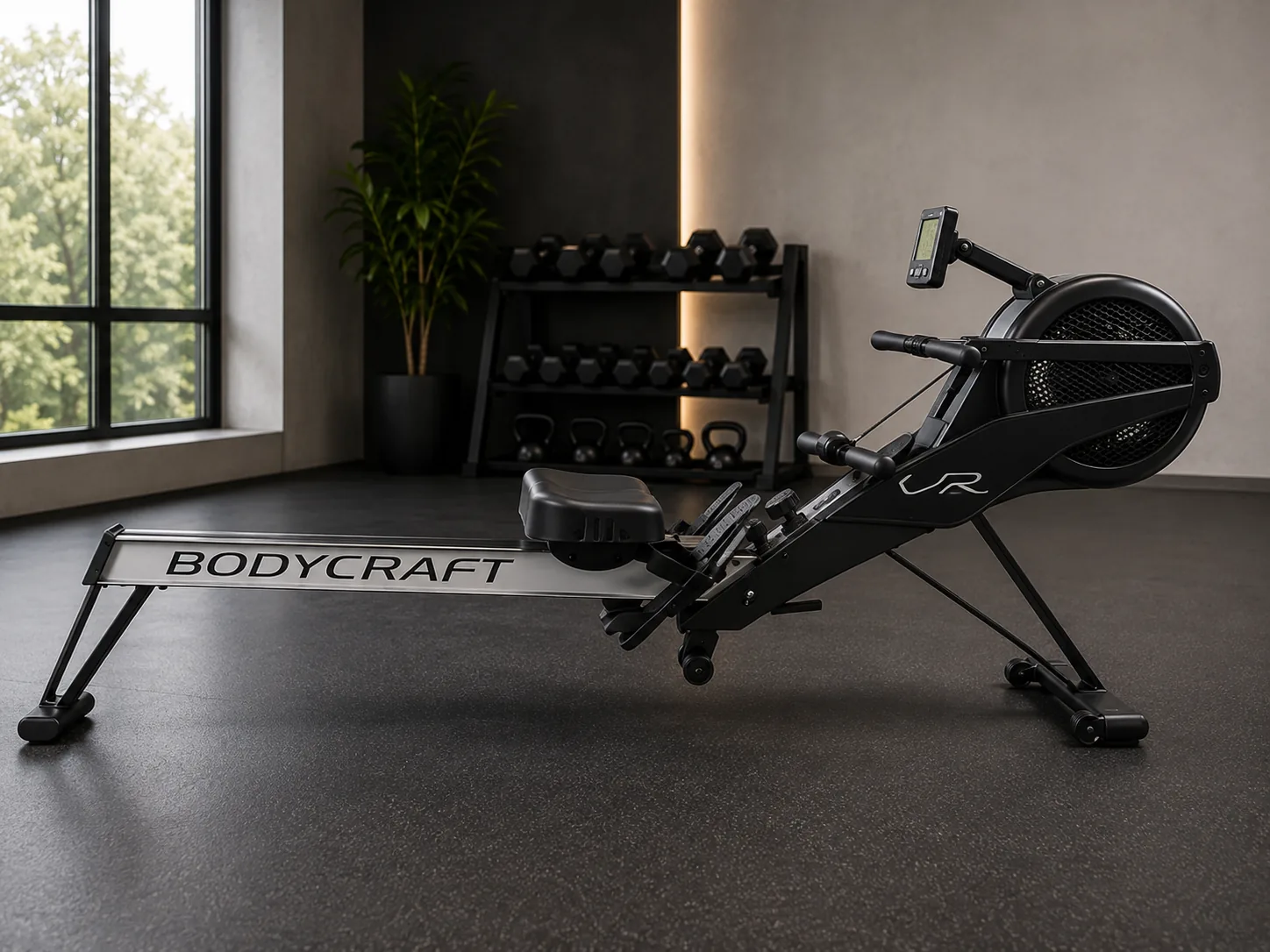
Air + magnetic rower · ~$1,599
BodyCraft VR400 Pro
A sturdy, quiet air-magnetic rower with a strong warranty, held back by manual resistance, limited connectivity and a premium price.

How we review
Every rower is scored on the same six weighted criteria - resistance & feel, build, monitor, comfort, footprint, and value - from verified specifications, expert consensus, and aggregated long-term owner feedback. Our reviews are independent: we never accept payment for placement or a higher score. Reviewed by Jordan Lockwood (BSc, CPT). See our full methodology.
The BodyCraft VR400 Pro is a residential rowing machine that pairs air resistance with an eddy-current magnetic brake, giving 16 selectable levels of difficulty. It sits in BodyCraft's mid-range, above entry air rowers and below the more feature-rich VR500, and is built around an extruded aluminum mono-rail with steel support legs, a 350 lb user capacity and a fold-and-roll storage design.
It is aimed at home users who value build quality and a smooth, quiet stroke over connected-fitness extras. The console reports a full set of metrics and the warranty is generous, but resistance is changed by hand and there is no native Bluetooth, so buyers should weigh it carefully against performance staples like the Concept2 that cost noticeably less.
Specifications at a glance
| Resistance type | Air + eddy-current magnetic, 16 levels (level 1 air-only; 2-16 air + magnetic) |
|---|---|
| Resistance adjustment | Manual lever (not motorized/automatic) |
| Monitor | Large LCD; runs on 2 AA batteries with auto-shutoff |
| Monitor metrics | Time, distance, calories, pulse, 500m split, strokes, SPM, total strokes, watts, resistance, recovery profile |
| Programs | Quick-start, race mode, five goal-based programs, recovery profile |
| Heart rate | Built-in heart-rate receiver |
| App / Bluetooth | No native Bluetooth; optional Connect-22 Android touchscreen tablet (sold separately) |
| Assembled dimensions | 98.5" L x 21.25" W x 40.25" H |
| Folded dimensions | 43.25" L x 21.25" W x 69.25" H |
| Machine weight | 86 lbs |
| Max user weight | 350 lbs |
| User height accommodation | Up to ~6'8" (38.5" seat travel) |
| Storage | Fold-and-roll system with safety child lock |
| Frame / rail | Extruded T13 aluminum mono-rail; powder-coated steel support legs |
| Warranty (residential) | Lifetime frame, 7-year parts, 2-year labor, 1-year wear items |
| Approx. price | ~$1,499-$1,699 |
Pros
- Air + eddy-current magnetic resistance gives a smooth, quiet stroke with 16 selectable levels
- Strong build: extruded aluminum mono-rail, steel legs, 350 lb user capacity and a long 38.5" seat travel that suits tall rowers
- Excellent warranty for the category (lifetime frame, 7-year parts)
- Folds upright and rolls away for storage, with a child-lock safety catch
- Comprehensive on-screen metrics including 500m split, watts and a recovery profile
Cons
- Resistance is changed by a manual lever rather than electronically, which interrupts interval-style training
- No native Bluetooth or app connectivity; streaming requires the optional Connect-22 tablet at extra cost
- Expensive relative to performance benchmarks like the Concept2 Model D
- Modest program library and no heart-rate-driven workouts
Best for: Home users who want a well-built, quiet air-magnetic rower with strong warranty coverage and don't need motorized resistance or built-in app connectivity.
The resistance system is genuinely good, but the manual lever undercuts it
BodyCraft's pairing of a wind flywheel with an eddy-current magnetic brake is the VR400 Pro's best engineering decision. At level 1 you get pure air resistance that builds naturally with effort, and from level 2 up the magnetic brake layers in a heavier, more consistent load. The practical payoff is a stroke that feels lively and connected at the catch without the loud, fan-like roar of an air-only erg. For a household where someone rows early in the morning or near a sleeping baby, that quietness is a real, daily benefit rather than a spec-sheet line.
The frustration is how you change that resistance. The VR400 Pro uses a manual tension lever, so adjusting load means reaching down mid-session rather than tapping a button. For steady-state distance work this barely matters - set it once and forget it. But the moment you want true interval training, where resistance should jump between a hard push and an easy recovery, the lever interrupts your rhythm and your data. On a machine north of $1,500, that is the kind of friction buyers reasonably expect to have been engineered out, and it is the single biggest reason this rower does not score higher.
The monitor is readable and complete, but it is an island
The console itself is one of the better self-powered LCD units in this segment. It runs on AA batteries, so there is no plug to find, and it surfaces the metrics that actually matter for training: a 500m split, watts, stroke rate, distance, calories and a recovery profile. The display arm stays stable when you are pulling hard, and the screen is large and legible from the seat, which sounds trivial until you have squinted at a cheaper rower's monitor.
Where it falls short is everything beyond the glass. There is no native Bluetooth or ANT+, so the VR400 Pro will not talk to Strava, Kinomap, Peloton, or a phone-based logbook out of the box. If you want a streaming or app experience you are pushed toward BodyCraft's optional Connect-22 tablet, an added cost on an already-premium machine. The program library is also modest and there are no heart-rate-driven workouts, with no chest strap in the box. In an era when a sub-$1,000 competitor opens up to dozens of apps, this closed approach feels dated and is a meaningful strike against the value case.
Built like a commercial machine, sized like one too
This is where the price starts to make sense. The extruded-aluminum mono-rail, steel legs and 350 lb user capacity are squarely in light-commercial territory, and the long 38.5-inch seat travel is a genuine differentiator for tall rowers - users up to roughly 6'6" to 6'8" can take a full stroke without bottoming out, something many home rowers simply cannot accommodate. The warranty backs the hardware up: a lifetime frame and 7-year parts coverage is excellent for the category and signals that BodyCraft expects this thing to last a decade or more.
The trade-off is footprint. At nearly 98.5 inches long, the VR400 Pro is one of the larger rowers you can buy, and even folded upright it still occupies roughly 44 inches of floor length. The upright fold, transport wheels and child-lock catch make day-to-day storage and safety manageable, but this is not a machine for a cramped apartment. Owners should also temper expectations on the seat: it is comfortable enough for typical sessions, but reviewers note it feels more mid-tier than the premium rail and frame around it.
Who this rower is actually for
The VR400 Pro makes the most sense for a specific buyer: a taller user, or a heavier user near typical capacity limits, who rows mainly steady-state distance and prioritizes a quiet, smooth, built-to-last machine over data and connectivity. If you have the floor space, value a long warranty, and the idea of an air-only erg's noise puts you off, this rower delivers a calm, durable experience that should outlast cheaper rivals.
It also suits someone who simply does not care about apps. If your workout is you, a clock, and a distance goal, the closed ecosystem is a non-issue and you get a robust machine with a readable monitor. The hybrid air-magnetic feel is a legitimate draw for people who find pure magnetic rowers too dead and pure air rowers too loud.
Who should skip it
Interval trainers and data-driven athletes should look elsewhere. The manual resistance lever is fundamentally at odds with structured interval work, and the lack of native connectivity means your sessions live and die on a battery-powered LCD with no easy path to a logbook, leaderboard, or class. If you train by the numbers or want to race online, this is the wrong tool at this price.
Budget-conscious buyers should also pause. You are paying a clear premium for build quality and warranty, and a good portion of that premium buys you features - electronic resistance, open connectivity - that you do not actually get. Anyone in a small space should think hard about the footprint before committing.
BodyCraft VR400 Pro versus the Concept2 RowErg
This is the comparison that defines the VR400 Pro's value problem. The Concept2 RowErg sells for around $990 - roughly $600 less - and on the metrics that serious rowers care about, it wins decisively. Its PM5 monitor is an open platform with Bluetooth and ANT+ that connects to 30-plus apps and the Concept2 online logbook, its damper-based air resistance is the global standard used at indoor rowing championships and HYROX, and resale value and parts support are unmatched in the category.
The VR400 Pro's counter-arguments are narrow but real. It is meaningfully quieter than the RowErg, which is an honest, loud air machine. Its warranty (lifetime frame, 7-year parts) is more generous on paper than Concept2's coverage, and its folding, roll-away form factor stores more compactly upright than the two-piece Concept2. For a tall rower the 38.5-inch seat travel is competitive, though Concept2's optional tall legs address height differently. The honest summary: if you want the best training and data tool for the money, buy the RowErg and pocket the difference; the VR400 Pro only justifies its premium if quietness, build feel, and the long warranty matter more to you than connectivity and electronic resistance.
Our take
At 3.6 out of 5, the VR400 Pro is a good machine carrying a price tag that asks too much. The hardware - aluminum rail, steel legs, 350 lb capacity, lifetime-frame warranty - is genuinely excellent, and the air-magnetic stroke is smooth and impressively quiet. We have no hesitation recommending it to a tall or heavier rower who wants a quiet, durable, set-it-and-forget-it distance machine and has the floor space for it.
But we cannot recommend it to most buyers over the Concept2 RowErg. The manual resistance lever and the closed, app-less ecosystem are exactly the wrong limitations to ship on a $1,500-plus rower in 2026, and they hold an otherwise strong machine back. Buy it for the build, the quiet, and the warranty - not for the training experience, and only if you have shopped it against the RowErg and decided quiet and sturdy matter more to you than data and price.
Our verdict
The BodyCraft VR400 Pro is a well-built, quiet, genuinely durable rower wrapped around two decisions that hold it back: a manual resistance lever and a closed, app-less ecosystem. The hardware earns its keep - extruded aluminum rail, steel legs, 350 lb capacity, a long 38.5-inch seat travel for tall rowers, and a category-leading lifetime-frame, 7-year-parts warranty - and the air-magnetic stroke is smooth and impressively hushed for the class. At 3.6 out of 5 it is a good machine, just not a smart default at its price.
Buy it if you are a tall or heavier rower who wants a quiet, sturdy, set-and-forget distance machine, you value a long warranty, and you have the floor space. Skip it if you train in intervals, live by your data, or want app connectivity - in which case the Concept2 RowErg delivers more of what matters for around $600 less. The VR400 Pro is worth the premium only when quiet operation and build quality genuinely outrank price and connectivity for you.
Frequently asked questions
- Is the BodyCraft VR400 Pro quiet enough for an apartment or early-morning use?
- Yes, relative to other rowers in its class. The eddy-current magnetic brake layered over the air flywheel keeps it noticeably quieter than an air-only erg like the Concept2 RowErg, so it is a reasonable choice if you row near sleeping family members. The bigger apartment concern is size: at nearly 98.5 inches long and about 44 inches even when folded upright, it needs real floor space.
- Can I connect it to apps like Strava, Kinomap, or Peloton?
- Not natively. The VR400 Pro has no built-in Bluetooth or ANT+, so it will not sync to phone apps or online logbooks on its own. For a streaming experience you would need BodyCraft's optional Connect-22 tablet at extra cost. If app connectivity is a priority, a Concept2 RowErg with its open PM5 monitor is the better fit for far less money.
- Does the manual resistance lever make interval training hard?
- It is the machine's main weakness for interval work. Resistance is changed with a manual tension lever rather than electronically, so jumping between hard and easy efforts means reaching down mid-stroke and breaks your rhythm. For steady-state distance rowing, where you set the load once, it is a non-issue.
- Is the VR400 Pro a good choice for tall rowers?
- Yes, this is one of its standout strengths. The 38.5-inch seat travel and aluminum mono-rail accommodate users up to roughly 6'6" to 6'8", letting tall rowers reach full leg extension without running out of rail - something many home rowers cannot handle. Combined with the 350 lb user capacity, it suits larger athletes well.
- Why does it cost more than a Concept2 RowErg if the Concept2 is the category benchmark?
- You are paying for build quality, quietness, and warranty rather than performance or connectivity. The VR400 Pro offers a lifetime frame and 7-year parts warranty, a quieter air-magnetic stroke, and a compact upright fold. But the Concept2 RowErg costs roughly $600 less, has open Bluetooth/ANT+ connectivity to 30-plus apps, and is the standard for serious training. The premium only makes sense if quiet operation and build feel outweigh data and value for you.
References
- VR400 Rowing Machine - official product page - BodyCraft
- BodyCraft VR400 Pro Rowing Machine Review - Rowing Machine Guide
- The BodyCraft VR400 Pro is a Solid High End Rowing Machine - AllRowers
Jordan Lockwood (BSc, CPT)
Certified personal trainer (CPT), sports-science graduate, and lifelong rower. Jordan writes and reviews every guide on Rowing Machine Nerd.