 Rowing Machine Nerd
Kettler Favorit Review
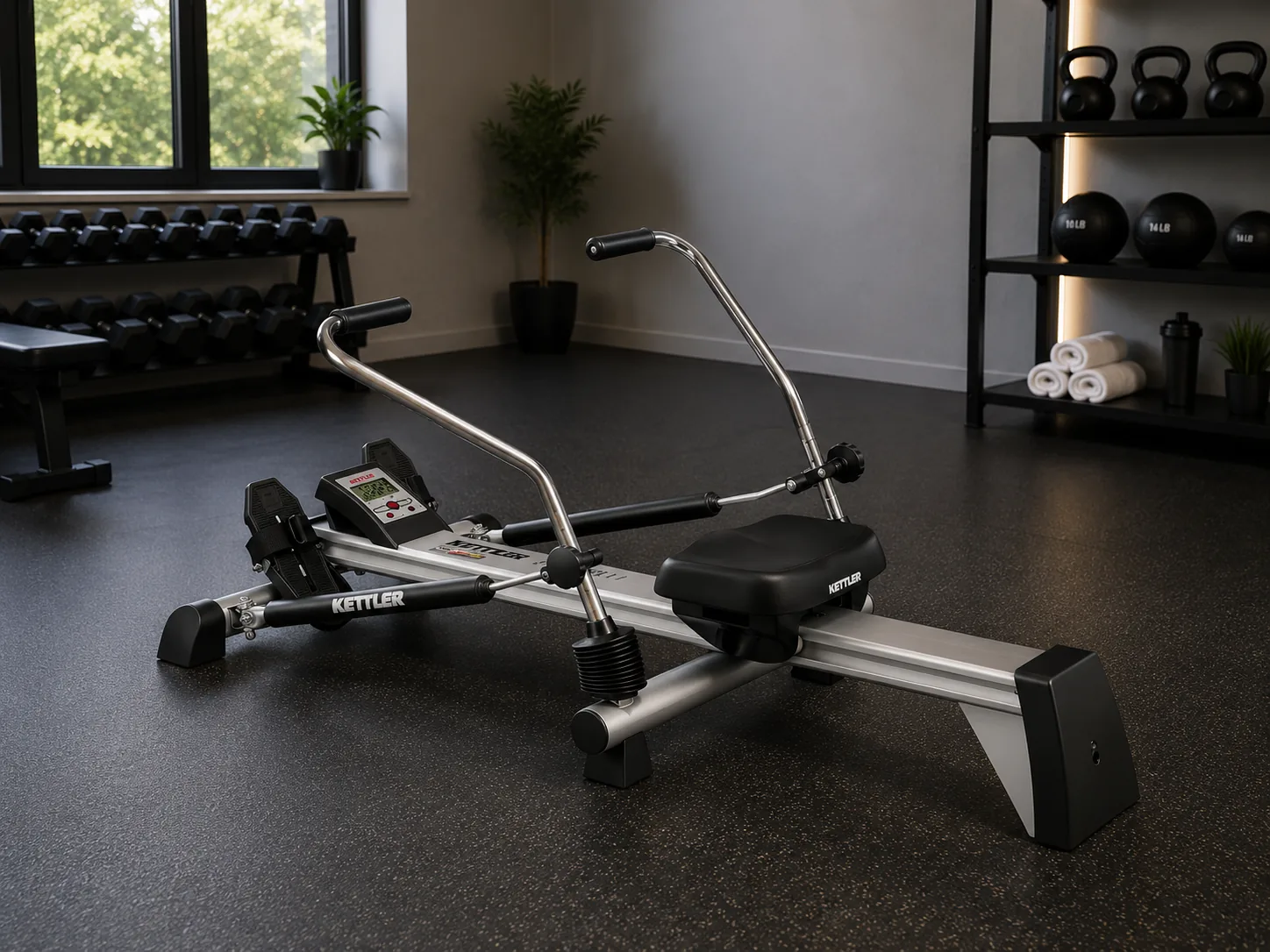
Hydraulic rower · ~$399
Kettler Favorit
A compact, budget hydraulic rower suited to short casual workouts, but resistance fades with use and there's no app connectivity.

How we review
Every rower is scored on the same six weighted criteria - resistance & feel, build, monitor, comfort, footprint, and value - from verified specifications, expert consensus, and aggregated long-term owner feedback. Our reviews are independent: we never accept payment for placement or a higher score. Reviewed by Jordan Lockwood (BSc, CPT). See our full methodology.
The Kettler Favorit is an entry-level hydraulic-piston rowing machine from the long-established German fitness brand Kettler. Rather than the air, water, or magnetic flywheels found on most modern rowers, it uses two hydraulic cylinders, one on each rowing arm, with resistance set manually by repositioning clamps along 50 marked levels. That design keeps the machine small, light, and inexpensive, and it has historically sold for around $399.
It is best understood as a casual, home-fitness tool rather than a serious training rower. The independent-arm hydraulic layout mimics a sculling motion and suits short, low-intensity sessions in a tight space. Buyers should know that the Favorit is now largely discontinued, so this is a research-based assessment of a machine that is mostly available secondhand or through clearance listings, where published specifications vary somewhat between sources.
Specifications at a glance
| Resistance type | Dual hydraulic pistons, 50 manually-set levels |
|---|---|
| Monitor | Battery-powered LCD: time, distance, strokes, energy (kJ), pulse, frequency; 1-6 recovery/wellness grade |
| App / Bluetooth | None (no Bluetooth or app connectivity) |
| Heart rate | Included infrared ear-clip; wireless chest-strap compatible (strap sold separately) |
| Assembled dimensions | Approx. 52" x 32" x 10" (sources vary; some list 49" x 31" x 10") |
| Machine weight | Approx. 44 lb (one source lists 52 lb) |
| Max user weight | 285 lb (some sources list 250 lb) |
| Folding / storage | Reported as folding by some retailers; non-folding by others |
| Warranty | Reported lifetime frame / 3 years parts (varies by listing) |
| Approx. price | ~$399 (historical street price; now largely discontinued) |
Pros
- Dual hydraulic pistons with 50 adjustable settings allow a wide notional resistance range
- Compact, low-profile footprint that stores easily in small spaces
- Included infrared ear-clip heart-rate sensor plus chest-strap compatibility
- Padded seat and pivoting footplates make casual sessions reasonably comfortable
- Kettler's frame has a solid reputation among budget hydraulic rowers
Cons
- Hydraulic resistance fades as the cylinder oil warms, limiting workouts to roughly 10-15 minutes
- Basic console lacks accuracy and shows energy in kilojoules rather than calories
- No Bluetooth, app integration, or structured programs
- Largely discontinued, so availability and parts support are limited
- Published specs (weight, capacity, folding) conflict across listings
Best for: Casual users with limited space who want short, low-intensity rowing sessions at a budget price rather than serious training.
Resistance and feel: a real ceiling, not a marketing number
The 50-setting figure sounds generous, but it describes a notional range rather than the resistance you actually get during a workout. The adjustment is mechanical and clumsy: you reposition where each piston attaches along the arm, often one side at a time, which is fiddly to balance and easy to get uneven. Owners repeatedly report that the settings drift mid-session, with one piston loosening before the other and producing a lopsided pull that nags at your form.
The bigger issue is physics, not assembly. As the oil inside the cylinders warms, the resistance softens noticeably, and most owners describe it fading within roughly 10 to 20 minutes. That is fine for a short, low-intensity session, but it means the machine effectively fights you hardest at the start and then gets easier exactly when you want to push. In a cold room the opposite happens and the pistons feel stiff and grabby until they warm up. If your goal is sustained conditioning or interval work, this resistance behaviour is the single biggest reason to look elsewhere.
Monitor and data: counts strokes, not effort
The console is a basic non-backlit display that cycles through time, strokes, stroke rate, distance, pulse and energy every few seconds. Two things undercut it. First, it reports energy in kilojoules rather than calories, which is harmless but unfamiliar to most home users and forces mental conversion. Second, and more importantly, the calorie or energy estimate is driven by stroke frequency alone and ignores resistance setting and body weight, so the number is a rough motivational counter rather than a meaningful measure of work done.
There is no Bluetooth, no app, no structured programs and no way to export or trend your sessions. The included infrared ear-clip heart-rate sensor and Polar chest-strap compatibility are a genuinely nice touch at this price, but several owners note the console can be temperamental about waking up and registering strokes. Treat the monitor as a basic stroke counter and a heart-rate readout, not a training tool.
Build, comfort and storage: the part Kettler actually gets right
This is where the Favorit earns its reputation. The powder-coated steel frame is well regarded among budget hydraulic rowers and historically carried a lifetime frame warranty, which is unusual in this category. At around 44 pounds and roughly 52 by 32 by 10 inches it is genuinely compact and low-profile, folds by loosening the arms, and tucks under a bed or into a closet. There are no transport wheels, but it is light enough that most people can just carry it.
Comfort gets consistent praise. The padded contoured seat on sealed ball-bearing rollers, thick swiveling handles and pivoting footplates make casual sessions pleasant, and the free-motion arms let you vary the pulling angle. Two caveats: the seat track is short, so taller users above roughly six foot one will feel cramped, and published specs for weight, capacity and dimensions conflict across listings, so verify the exact unit you are buying.
Who this machine is genuinely for
The Favorit makes sense for a narrow but real audience: someone in a small apartment who wants a quiet, low-cost way to do 10 to 20 minute light cardio in front of the television, values an upper-body and core stretch over hard conditioning, and cares more about something that stores invisibly than about training metrics. For that person the comfortable seat, quiet operation and tidy footprint are exactly the right trade-offs.
It is the wrong machine for anyone whose fitness is improving, anyone who wants to row for half an hour or do intervals, and anyone who cares about tracking progress or following programs. Those users will hit the resistance fade and the data limitations quickly and end up frustrated.
Versus the obvious alternatives
The honest comparison is not against the Concept2 RowErg on like-for-like terms, because they serve different buyers. The RowErg costs roughly two and a half times as much, has a far larger footprint, and is loud, but its air resistance never fades, scales with how hard you pull, lasts for years and feeds a respected PM5 monitor with accurate data and connectivity. If you have the space, the budget and any ambition to actually train, the RowErg is the machine to save for and it will outlast several Favorits.
The more relevant rival at this price is a budget magnetic rower such as the Sunny Health and Fitness magnetic models around 299 dollars. Magnetic resistance is quiet like hydraulic but does not fade as it warms, holds its setting reliably, and gives you consistent levels for longer sessions. The Favorit counters with a better-regarded frame, a more comfortable seat and heart-rate hardware, but for most buyers chasing a real workout at this budget, a decent magnetic rower is the smarter pick. The Favorit only wins on build feel and compactness.
Our take
At 2.8 out of 5 the Kettler Favorit is a well-built machine for a use case most buyers will outgrow. Buy it if you specifically want a compact, quiet, comfortable rower for short casual sessions, you can find one in good condition at a fair price, and you have realistic expectations about resistance. The frame quality and seat comfort are real, and for gentle daily movement it does the job.
Skip it if you want to get fitter, row for more than 15 to 20 minutes, do intervals, or track meaningful data, and skip it on principle if the asking price creeps toward 399 dollars, because at that level a magnetic rower makes more sense and a used Concept2 starts to enter the conversation. The other catch is availability: the Favorit is largely discontinued, so you are often shopping the used market with limited parts support, which makes condition and price the whole decision.
Our verdict
The Kettler Favorit is a genuinely well-made machine built for a job most people will quickly outgrow. The steel frame, comfortable padded seat and quiet, compact design are real strengths, and for short, gentle, living-room cardio in a small space it is pleasant to use. But the hydraulic resistance fades within 10 to 20 minutes, the piston-based adjustment is fiddly and drifts mid-session, and the console counts strokes rather than measuring real effort, with no app or programs to fall back on. That is a hard ceiling, not a quirk.
Our verdict at 2.8 out of 5: buy it only if you want a compact, quiet rower for short casual sessions and can get one in good condition at a fair price, since it is largely discontinued. If you have any ambition to actually get fitter, do longer sessions or track progress, put your money toward a budget magnetic rower at a similar price or save for a Concept2 RowErg, both of which will hold their resistance and serve you far longer.
Frequently asked questions
- Why does the resistance get easier partway through my workout?
- That is the inherent behaviour of hydraulic pistons. As you row, the oil inside the cylinders heats up and thins, so resistance softens, usually within about 10 to 20 minutes. It is not a fault you can fix; it is the main reason the Favorit suits short casual sessions rather than long or high-intensity ones. In a cold room you will see the reverse, with the pistons feeling stiff until they warm up.
- Can I use the Favorit for serious cardio or interval training?
- Not really. The resistance fade, the awkward piston-based adjustment that tends to drift mid-session, and a console that counts strokes rather than measuring true effort all work against structured training. For intervals or sustained conditioning, an air rower like the Concept2 RowErg or a budget magnetic rower is a much better fit.
- Is the calorie or energy readout accurate?
- Treat it as a rough motivator. The console reports energy in kilojoules and bases the estimate on stroke frequency alone, ignoring your resistance setting and body weight, so it does not reflect how hard you are actually working. The heart-rate readout from the ear clip or a Polar chest strap is more useful for gauging effort.
- Does it connect to apps or have workout programs?
- No. There is no Bluetooth, no app integration and no built-in programs. You get a basic non-backlit display and heart-rate hardware, and nothing to export or track over time. If app connectivity matters to you, this is not the machine.
- Is it still available to buy new?
- Largely no. The Favorit appears to be discontinued and no longer shows on Kettler's site, so you are mostly looking at the used market with limited parts support. Because of that, condition and asking price should drive your decision, and anything approaching 399 dollars is hard to justify against current magnetic alternatives.
References
- Kettler Favorit Rowing Machine Review - Rowing Machine Guide
- Kettler Favorit Rowing Machine Review - Good Choice for Casual Use - AllRowers
- Kettler Favorit Rower Review - FitRated
Jordan Lockwood (BSc, CPT)
Certified personal trainer (CPT), sports-science graduate, and lifelong rower. Jordan writes and reviews every guide on Rowing Machine Nerd.