 Rowing Machine Nerd
Sunny Health & Fitness SF-RW5623 Review
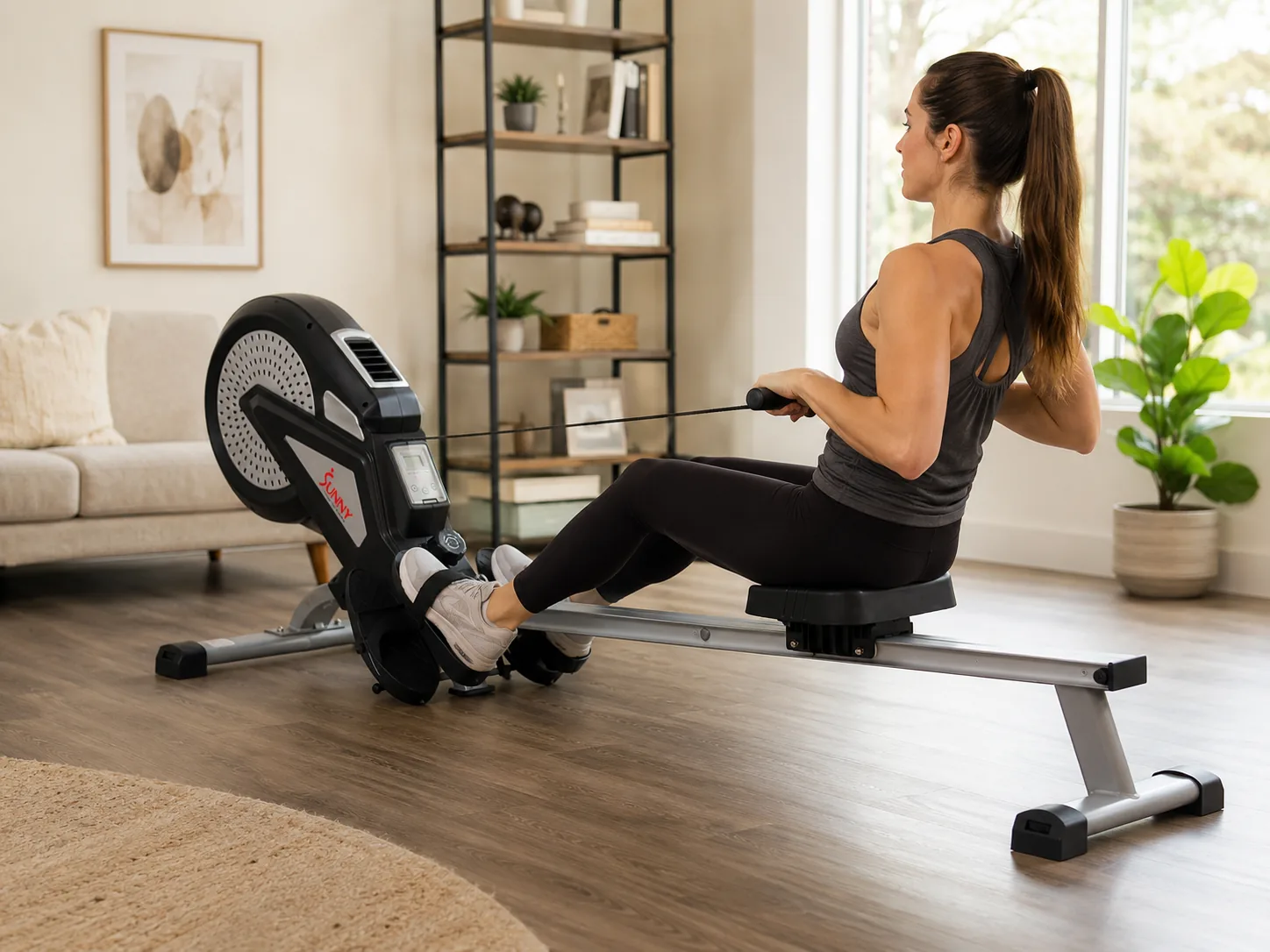
Air + magnetic rower · ~$220
Sunny Health & Fitness SF-RW5623
A budget dual-resistance rower that folds away and undercuts almost everything - fine for light home use, but the basic monitor and modest build show the price.

How we review
Every rower is scored on the same six weighted criteria - resistance & feel, build, monitor, comfort, footprint, and value - from verified specifications, expert consensus, and aggregated long-term owner feedback. Our reviews are independent: we never accept payment for placement or a higher score. Reviewed by Jordan Lockwood (BSc, CPT). See our full methodology.
Sunny Health & Fitness specialises in affordable home equipment, and the SF-RW5623 is its take on a do-it-all budget rower: an unusual dual system that pairs magnetic resistance with an air flywheel fan. At around $220 it's a fraction of the price of the category leaders.
The honest framing for a machine like this is expectation-setting. Judged against $1,000 rowers it falls short; judged on what it sets out to do - get a beginner rowing at home cheaply - it does a reasonable job.
Specifications at a glance
| Resistance | Dual: air + magnetic (8 levels) |
|---|---|
| Monitor | Basic LCD (time, count, calories) |
| Connectivity | None |
| Max user weight | 300 lb (136 kg) |
| Footprint | 86" × 19" × 28" (218 × 48 × 71 cm) |
| Rail | Extruded aluminium slide rail |
| Storage | Folds for storage |
| Warranty | Limited (≈3-yr frame / 180-day parts) |
Pros
- Very affordable - among the cheapest ways onto a rower
- Dual air + magnetic resistance adds a little 'whoosh' to a quiet base
- Folds down to store in a small space
- 300 lb capacity is reasonable for the price
Cons
- Basic monitor - no split, watts, or app connectivity
- Modest resistance ceiling; not for powerful or advanced rowers
- Budget materials and shorter warranty than premium machines
- Limited long-term durability data
Best for: Budget-conscious beginners and light, occasional users in small spaces.
Resistance and feel: the air whoosh is the headline, but the ceiling is real
The SF-RW5623's party trick is the combination of a fan flywheel and eight magnetic levels. The fan gives you the dynamic, speed-sensitive response that magnetic-only budget rowers cannot - pull harder and faster and you genuinely feel the air load build, along with the satisfying whoosh that makes a rower feel like a rower rather than a quiet cardio machine. The magnetic dial under the console then sets a baseline drag on top of that, so you can dial in something gentle for steady cardio or crank it up for shorter, harder pieces.
The honest limitation is the ceiling. At the top of its eight levels the resistance is adequate for general fitness, but a powerful or well-conditioned rower will run out of meaningful load and simply move the handle faster instead of working harder. If you already train hard or expect to progress into serious intervals, you will likely outgrow it. For a beginner or a returning exerciser doing 20 to 40 minute sessions, the range is more than enough to get a real sweat going.
One ergonomic quirk worth knowing: on some units the footrest position can let the handle bump the console housing at the very end of the drive, and rowers with longer arms or longer legs are the most likely to notice it. It is not a dealbreaker, but it is the kind of small annoyance that shows up over a long session.
The monitor is exactly as basic as the price implies
This is where the budget shows most clearly. The console tracks time, stroke count, total count, calories, and a SCAN mode that auto-cycles through them. It does not show distance in meters, it has no 500m split, no watts, no pace, and no app or Bluetooth connectivity. There is also no built-in heart rate receiver. For a rower, the missing 500m split is the big one, because split-per-500m is the single number serious rowers use to pace and compare workouts.
In practical terms, you can absolutely follow a 'row for 25 minutes and keep moving' plan, and the calorie and stroke readouts give you a rough sense of effort. What you cannot do is structured, data-driven training - chasing a target split, comparing today's 2k to last week's, or syncing to a training app. If you are the type who is motivated by metrics and leaderboards, the monitor alone is a reason to consider stepping up a tier. If you just want to move and sweat, it does the job and gets out of the way.
Build, comfort and storage: light, foldable, and built to a price
At roughly 59 pounds with a 300 lb user capacity, the SF-RW5623 is genuinely easy to live with in a small home. It folds vertically to a footprint around three feet by two feet and has transport wheels, so you can tuck it into a corner or behind a door between sessions. That foldability is one of its strongest selling points and a real advantage over the non-folding ergs it competes against on price.
The padded, contoured seat rides on sealed-bearing rollers and glides smoothly, and the aluminum rail angles up slightly at the back to add a bit of leg engagement on the recovery. Comfort is fine for average-sized users, though larger riders may find the seat a touch snug and very tall users may feel the rail length is borderline. The frame feels sturdy enough at a steady pace without obvious squeak or slip, but the materials and finish are clearly budget grade, and the warranty reflects that: roughly one year on the frame and only about 90 days on parts, which is far shorter than premium machines. Long-term durability data on this specific model is thin, so treat it as a light-to-moderate-use machine rather than a buy-it-for-life erg.
On noise: because of the fan, it is louder than a purely magnetic rower. Most owners find it apartment-friendly, but you may nudge the TV volume up a notch during harder efforts. That sound is the trade for the more authentic on-the-water feel.
Who actually thrives on this rower
The sweet spot is clear from the way it is built. This machine suits a beginner, a casual home exerciser, or someone returning to fitness who wants low-impact full-body cardio without spending real money. It also suits anyone whose decision is genuinely 'a folding budget rower or no rower at all' - in that framing, the SF-RW5623 wins easily, because the best rower is the one you will actually use, and one that disappears into a corner is one you keep.
It is a poor fit for two groups: strong or experienced rowers who will hit the resistance ceiling, and data-driven trainers who want splits, watts, and app integration. For those buyers the monitor and the modest top-end load are not minor compromises, they are the whole reason to look elsewhere.
How it stacks up against the obvious alternative
The default comparison at the next tier up is the Concept2 RowErg, and it is worth understanding exactly what the extra money buys. The Concept2 costs roughly double or more, but it brings a longer rail that comfortably fits taller users, a higher weight capacity, commercial-grade durability, and the PM5 monitor that gives you accurate distance, 500m splits, watts, and connectivity - everything the Sunny's console leaves out. It also holds resale value in a way budget machines never do, which softens the real cost of ownership over years.
The catch is that the Concept2 does not fold flat and takes up a fixed, generous footprint, and its air-only resistance is loud. So the choice is less 'good versus bad' and more about honesty with yourself. If you want a serious training tool you will keep for a decade and you have the floor space, the Concept2 is the better long-term buy and the Sunny will frustrate you. If your priority is a low price, a machine that folds away, and a feel that is good enough for general fitness, the SF-RW5623 delivers exactly that and the Concept2 is overkill. Closer to the Sunny's own price, magnetic-only budget rowers are quieter but lack the air whoosh, so the 5623's dual resistance is a genuine point of difference in its class.
Our take
Buy the SF-RW5623 if you want the cheapest credible way onto a rower, you value being able to fold it away in a small home, and you are realistic that this is a light-to-moderate-use machine with a bare-bones monitor. For a beginner or casual exerciser on a tight budget, it earns its keep, and the air-plus-magnetic feel is a nice bonus you do not usually get at this price.
Skip it if you are a strong or improving rower who will hit the resistance ceiling, if structured data training matters to you and you need splits and watts, or if you want a machine that will still be going strong in ten years. In those cases, save longer and buy a Concept2 RowErg instead - paying twice for something you will not outgrow beats replacing a budget rower in a couple of years. Our 3 out of 5 reflects exactly that balance: a sensible, space-saving entry point that does what it promises, held back by a basic monitor, a modest ceiling, and budget-grade build.
Our verdict
The Sunny SF-RW5623 is an honest budget rower that knows what it is. For around $220 you get dual air-plus-magnetic resistance with a genuinely satisfying whoosh, a frame that folds into a corner of a small home, and a 300 lb capacity - everything a beginner or casual exerciser needs to start rowing without overspending. As the cheapest credible way onto a rower that also disappears when you are done, it does its job, and the best rower is the one you will actually use.
But the price shows where it counts. The monitor is bare-bones with no distance, splits, watts, or app, the resistance ceiling is modest, and the build and warranty are budget grade with thin long-term durability data. Strong rowers and data-driven trainers should skip it and save for a Concept2 RowErg, which costs roughly double but will not be outgrown. For its intended buyer it is a sensible 3 out of 5; for everyone else, it is a false economy.
Frequently asked questions
- Does the SF-RW5623 monitor show distance or 500m splits?
- No. The console shows time, stroke count, total count, calories, and a SCAN mode that cycles through them. It does not display distance in meters, pace, watts, or a 500m split, and it has no app, Bluetooth, or built-in heart rate receiver. If split-based pacing matters to you, this monitor will frustrate you.
- Is the resistance strong enough for a fit or experienced rower?
- Probably not for long. The eight magnetic levels plus air give a fine range for beginners and general fitness, but the top end is modest. A powerful or well-conditioned rower will tend to run out of meaningful load and just move the handle faster. If you already train hard, you are likely to outgrow it.
- How much space does it need, and does it really fold?
- It is long when extended, roughly 86 inches, so you need a clear stretch of floor to row. But it folds vertically to about a three-foot by two-foot footprint and has transport wheels, so storing it in a corner or behind a door between sessions is genuinely easy. That foldability is one of its best features.
- Is it loud enough to bother neighbors or wake the house?
- It is louder than a magnetic-only rower because of the air fan, but most owners consider it apartment-friendly. You get a satisfying whoosh and may nudge the TV volume up during harder efforts. It is not silent, but it is not a gym-grade air erg roar either.
- How long will it last, and what does the warranty cover?
- Treat it as a light-to-moderate-use machine rather than a lifetime erg. The frame feels sturdy at a steady pace, but materials are budget grade and long-term durability data on this model is thin. Warranty is short, around one year on the frame and roughly 90 days on parts, far less than premium machines offer.
References
- Sunny Health & Fitness SF-RW5623 - product listing & specifications - Amazon / Sunny Health & Fitness
- Sunny SF-RW5623 Rowing Machine Review - Rowing Machine Guide
Jordan Lockwood (BSc, CPT)
Certified personal trainer (CPT), sports-science graduate, and lifelong rower. Jordan writes and reviews every guide on Rowing Machine Nerd.