 Rowing Machine Nerd
Xterra ERG500 Air Turbine Rower Review
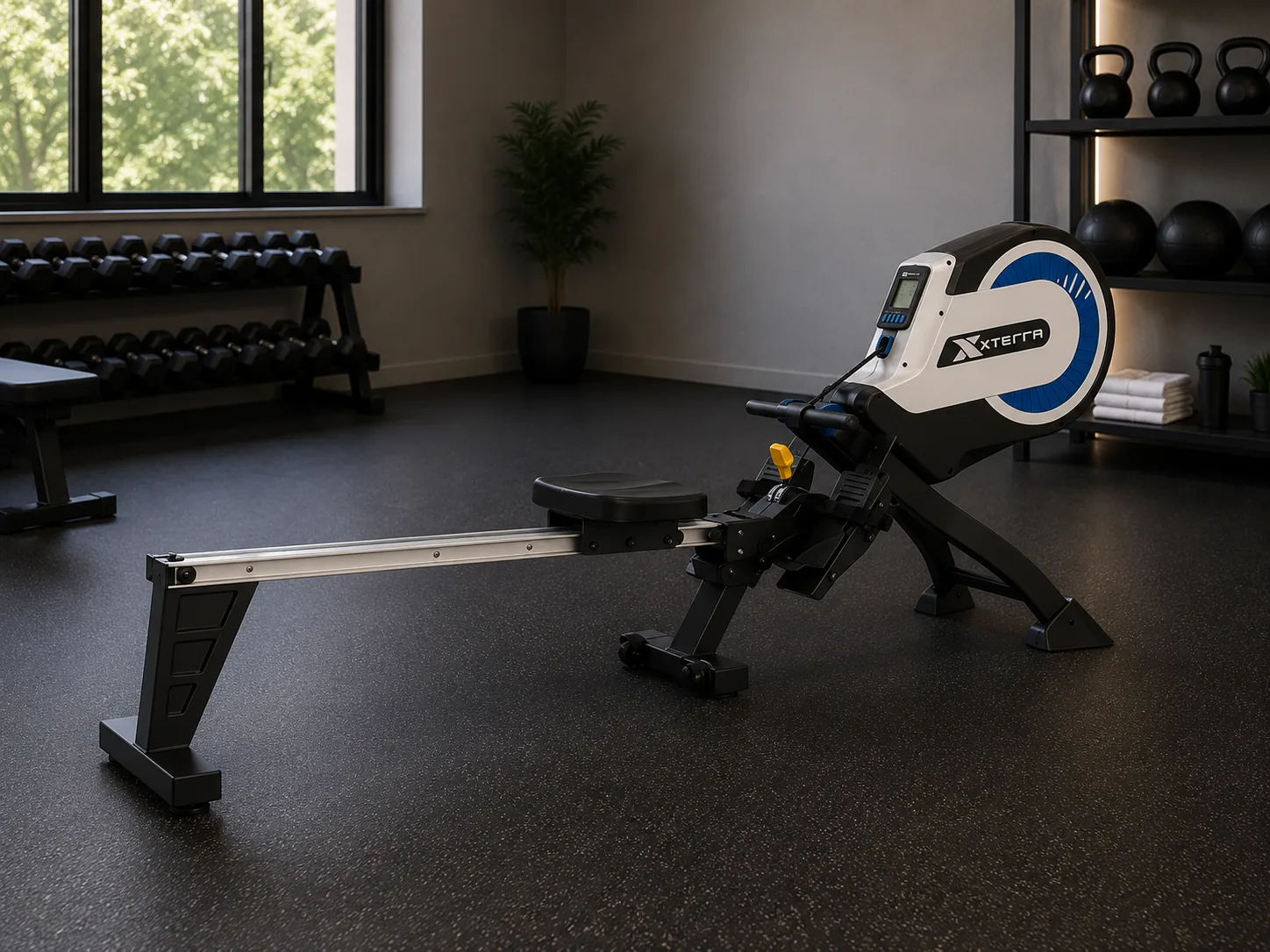
Air rower · ~$499-$699
Xterra ERG500 Air Turbine Rower
An affordable air-turbine rower with a responsive feel and 300 lb capacity, held back by a basic monitor and no app connectivity.

How we review
Every rower is scored on the same six weighted criteria - resistance & feel, build, monitor, comfort, footprint, and value - from verified specifications, expert consensus, and aggregated long-term owner feedback. Our reviews are independent: we never accept payment for placement or a higher score. Reviewed by Jordan Lockwood (BSc, CPT). See our full methodology.
The Xterra ERG500 is the brand's lone air rower, positioned at the upper edge of the budget category. It uses an air turbine flywheel rather than the magnetic or hydraulic systems common at this price, which gives it a more dynamic, effort-scaling stroke. With an MSRP near $900 but a typical street price closer to $499-$699, it competes for buyers who want the air-rowing experience without paying for a premium-brand machine.
This is a no-frills, fitness-focused rower rather than a connected trainer. There is no Bluetooth, no companion app, and no data export, so it is best suited to people who simply want to row for cardio and general conditioning. Anyone seeking guided classes, structured programming, or progress tracking on a phone will need to look elsewhere or pair it with a separate timer and heart-rate device.
Specifications at a glance
| Resistance type | Air turbine, 8 adjustable settings (slider damper) |
|---|---|
| Monitor | Battery-powered LCD: time, distance, strokes/min, stroke count, calories, pulse |
| Programs | Reported as 4 preset goals plus recovery on some listings; FitRated lists none |
| Connectivity | None - no Bluetooth, no app, no USB data export |
| Power | 3 x AAA batteries (no mains power required) |
| Assembled dimensions | 72" L x 19" W x 33" H |
| Folded dimensions | 45" L x 20" W x 57" H |
| Machine weight | approx. 79.4 lbs |
| Max user weight | 300 lbs |
| Storage | Folding frame with transport wheels |
| Warranty | 5 yr frame / 2 yr parts / 90-day labor |
| Price | ~$499-$699 (MSRP $899.99) |
Pros
- Air turbine resistance gives a responsive, intensity-scaling feel rare at this price
- 300 lb user capacity and steel frame suggest solid build for a budget machine
- Folds with transport wheels and runs on AAA batteries, so placement is flexible
- Pivoting padded foot pedals and a contoured seat aid comfortable form
- Frequently discounted well below its MSRP, improving value
Cons
- No Bluetooth, app sync, or data export, so no structured training ecosystem
- Maximum resistance may feel light for experienced or powerful rowers
- Air mechanism is inherently noisy compared with magnetic or water rowers
- Still has a tall, sizable footprint even when folded
Best for: Beginner to intermediate home exercisers who want an affordable air rower for general fitness without caring about app connectivity.
Resistance and feel: genuine air-rower behavior on a budget
The ERG500's appeal starts with its physics. Like every air rower, the turbine scales resistance to effort, so a lazy stroke feels easy and an aggressive one fights back. That self-regulating quality is exactly what serious rowers chase and what magnetic budget machines cannot replicate, and getting it for as little as $499 is the single best reason to consider this rower. Owners consistently say they can get genuinely winded in 10 to 20 minutes, which tells you the feel is real rather than a marketing claim.
The catch is the ceiling. The damper offers eight airflow settings, and at the top end the resistance still tops out lighter than what a powerful or experienced rower wants. If you can already pull strong splits on a gym Concept2, you will likely find the ERG500's maximum underwhelming within a few sessions. For deconditioned, average, and intermediate users it is plenty; for athletes building toward race pace it is the wrong tool. Be honest about which group you are in before buying, because this is the limitation most likely to cause regret.
The monitor is where the budget shows
The 3.5-inch LCD covers the basics: time, distance, strokes per minute, stroke count, calories, an estimated pulse, and a small stroke-rhythm graphic. The angle pivots and the digits are large and readable in low light, and because it wakes on motion and runs on AAA batteries there is nothing to plug in. For casual fitness tracking that is adequate.
Look closer and the cracks appear. There are no preset or interval programs, so every workout is something you have to structure and pace yourself. More frustrating, several owners report the distance readout is loosely calibrated, where pulling noticeably harder does not always register as proportionally more distance, which undermines trust in the numbers if you care about progress tracking. And a recurring gripe is that changing the batteries requires partially dismantling the console housing, a small but genuinely annoying piece of design. There is no Bluetooth, no app sync, and no data export, so anyone who wants their sessions to live in a training app or sync to a watch should rule this out now rather than discover it later.
Build, comfort and the reality of storing it
The steel frame, 300 lb capacity, pivoting padded pedals and contoured seat add up to a machine that feels more solid than its price suggests, and the seating position is a quiet strength. The beam sits high enough that getting on and off does not require a deep squat, which matters for older users or anyone with cranky knees. Assembly runs about 30 minutes and owners describe it as straightforward.
Storage is the honest weak spot. Yes, the rail folds upright and rolls on built-in wheels, but folded it still stands roughly 57 inches tall with a 45 by 20 inch footprint, so it leans tall rather than tucking flat into a closet. Plan a corner for it rather than expecting to make it disappear. On durability, most owners are happy, but it is worth knowing that component failures are not unheard of. One documented owner had the resistance drop out after two months; the reassuring part is that Xterra shipped a replacement part and the machine has run fine since, which points to a backstop most budget brands lack.
Warranty and support are better than the price implies
This is an underrated reason to trust the ERG500. The warranty runs five years on the frame, two years on parts, and 90 days of in-home labor, which is unusually generous for a sub-$700 air rower. More telling than the paper terms is the pattern in owner reports: when something fails, buyers describe Xterra as responsive and quick to send replacement components. For a budget machine, where the usual fear is being stranded with a dead unit, that track record meaningfully lowers the risk of buying. It does not eliminate the chance of a faulty part, but it makes one far less catastrophic.
How it stacks up against the Concept2 RowErg
The obvious comparison is the Concept2 RowErg, and the gap is exactly what you would expect from the price difference. The RowErg costs meaningfully more but delivers a deeper resistance range, far more accurate and trusted data through the PM5 monitor (with workout programs, on-screen metrics, and connectivity, all without a subscription), and a reputation for lasting a decade or more. If your budget can stretch and you are serious about rowing, the RowErg is the better long-term buy and it is not close.
Where the ERG500 fights back is value and accessibility. It delivers authentic air-resistance feel for hundreds less, folds for storage in a way the longer RowErg does not, and is frequently discounted to around $499. The honest framing: the Concept2 is the machine you buy for a lifetime of rowing, while the ERG500 is the machine you buy to start rowing today without overspending. If you are uncertain whether rowing will stick, the Xterra is the lower-risk financial bet.
Our take
Buy the ERG500 if you are a beginner-to-intermediate home exerciser who wants the responsive, intensity-scaling feel of an air rower without paying air-rower-flagship money, who has a corner to store a tall folded frame, and who is fine pacing your own workouts off a simple screen. At its frequent $499 sale price, with a strong warranty and a support team that actually sends parts, it is a genuinely good value and earns its 3.3 out of 5.
Skip it if you are a powerful or experienced rower who will outgrow the resistance ceiling, if you want your data flowing into apps, watches, or a training log, or if you are unbothered by spending more for the durability and accuracy of a Concept2. Also skip it if a tall, bulky folded footprint is a dealbreaker in your space. This is a smart entry-level air rower, not a do-it-all machine, and buying it with that expectation is the difference between satisfaction and disappointment.
Our verdict
The Xterra ERG500 nails the one thing that is hardest to find at this price: the authentic, effort-scaling feel of a real air rower. For beginners and intermediate home exercisers, especially at its frequent $499 sale price, it is a smart, low-risk way to start rowing, backed by a surprisingly strong warranty and a support team that actually ships replacement parts. That combination is what earns it a solid 3.3 out of 5.
Just buy it for what it is. The light resistance ceiling, the basic and occasionally imprecise monitor, the complete absence of app connectivity, and the tall folded footprint are real limitations, not nitpicks. Powerful rowers, data nerds, and anyone who can stretch to a Concept2 RowErg should spend up for the durability and accuracy. But if you want genuine air-rower feel without the flagship price and you can live with a no-frills screen, the ERG500 delivers more than its cost suggests.
Frequently asked questions
- Is the Xterra ERG500 good for tall or heavier users?
- It supports up to 300 lb on a steel frame, and the seat sits on a fairly high beam, which makes getting on and off easier and suits heavier or less mobile users well. Very tall rowers should still check the rail length against their stroke, but most users report a comfortable, roomy position.
- Does the ERG500 connect to apps like Kinomap or sync to a fitness watch?
- No. There is no Bluetooth, app sync, or data export of any kind. The 3.5-inch LCD shows time, distance, strokes per minute, calories, an estimated pulse, and a stroke graphic, but nothing leaves the console. If app-based training or syncing to a watch matters to you, this is the wrong rower.
- Is the resistance strong enough for an experienced rower?
- Probably not at the top end. The eight airflow settings are plenty for beginners and intermediates, who can get a hard workout in 10 to 20 minutes, but powerful or competitive rowers tend to find the maximum resistance lighter than they want. If you already pull strong splits on a gym Concept2, expect to outgrow it.
- How loud is it and how does it store?
- Like all air rowers it is noisier than magnetic or water models, since the turbine pushes air on every stroke, so it is not ideal for a shared room or late-night use near sleepers. It folds upright on built-in wheels, but folded it is still about 57 inches tall with a 45 by 20 inch footprint, so plan for a corner rather than a closet.
- Is it reliable, and what happens if a part fails?
- Most owners are satisfied, though occasional component failures (including a documented resistance dropout) do occur. The reassuring part is the warranty (five years frame, two years parts, 90 days in-home labor) and Xterra's reputation for responsive support and quick replacement parts, which lowers the risk of a budget-machine purchase.
References
- Product Guide & Review: ERG500 Air Rower - Xterra Fitness
- Xterra ERG500 Rowing Machine Review - Rowing Machine Guide
- XTERRA ERG500 Air Turbine Rower Review - FitRated
Jordan Lockwood (BSc, CPT)
Certified personal trainer (CPT), sports-science graduate, and lifelong rower. Jordan writes and reviews every guide on Rowing Machine Nerd.