 Rowing Machine Nerd
BodyCraft VR200 Review
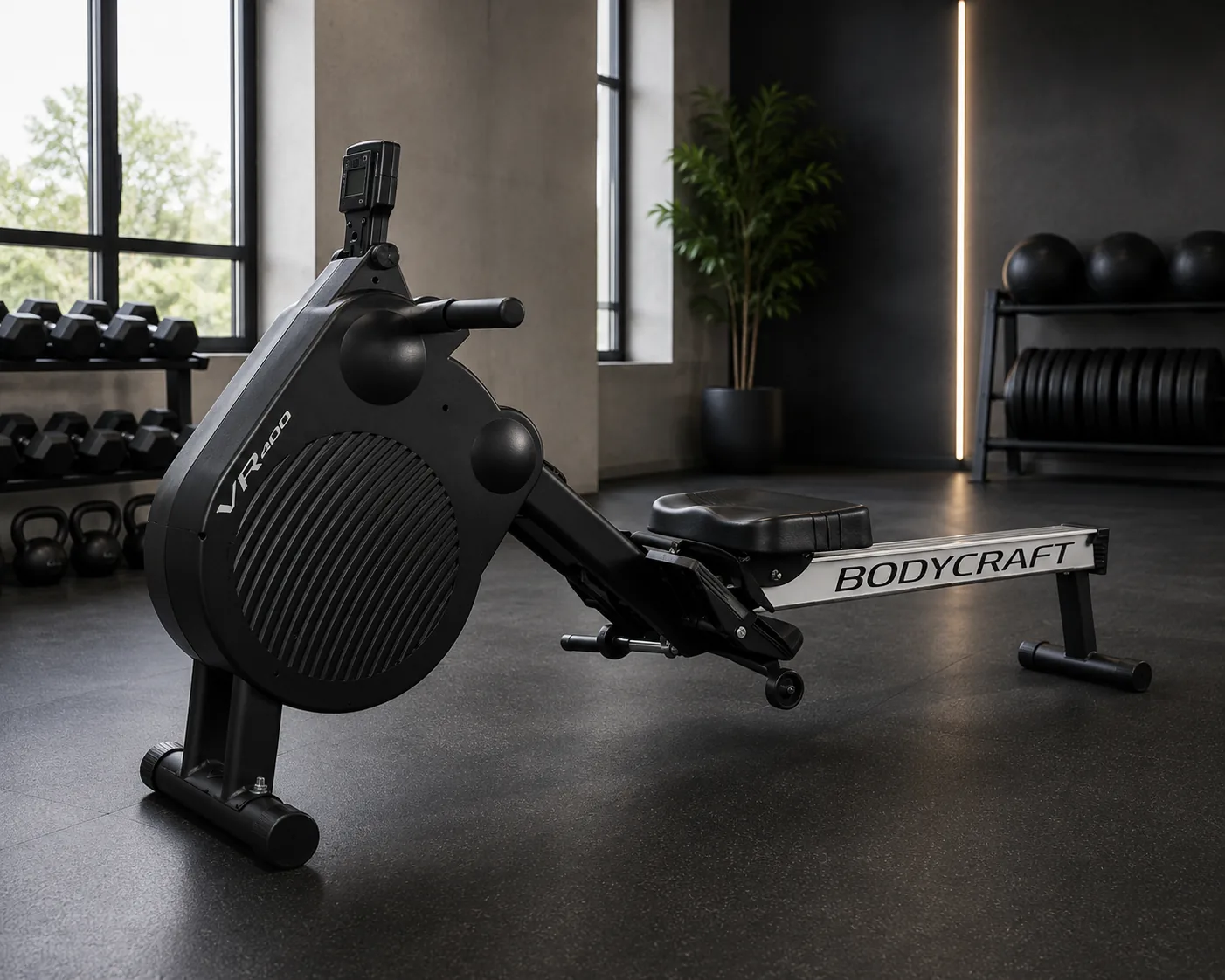
Air + magnetic rower · ~$999
BodyCraft VR200
A compact, foldable air-and-magnetic rower with solid build and simple metrics, but a basic monitor and ~$999 price put it against stronger rivals.

How we review
Every rower is scored on the same six weighted criteria - resistance & feel, build, monitor, comfort, footprint, and value - from verified specifications, expert consensus, and aggregated long-term owner feedback. Our reviews are independent: we never accept payment for placement or a higher score. Reviewed by Jordan Lockwood (BSc, CPT). See our full methodology.
The BodyCraft VR200 is the entry point in BodyCraft's rower lineup, pairing air resistance with magnetic eddy-current braking to deliver eight adjustable levels in a frame that folds for storage. It targets home users who want quiet, repeatable resistance and a small footprint rather than the connected features and performance ceiling of higher-end machines.
Priced around $999, the VR200 lands in the same bracket as established performance rowers, so it has to justify itself on build quality, comfort, and convenience rather than raw spec count. This research-based assessment draws on the manufacturer's documentation and retailer listings to gauge where it fits for a typical buyer.
Specifications at a glance
| Resistance type | Air + magnetic (eddy current), 8 levels |
|---|---|
| Monitor | 2" x 3" tilting LCD |
| Monitor metrics | Time, distance (m), calories, time/500m, strokes, SPM, total strokes profile |
| App / Bluetooth | Not specified (no app connectivity) |
| Assembled dimensions | 79" L x 17.75" W x 36.25" H |
| Folded dimensions | 35.5" L x 17.5" W x 58" H |
| Seat travel | 34" |
| Seat height | 15.5" |
| Machine weight | 59.5 lbs |
| Max user weight | 300 lbs |
| Max user height | Up to 6'4" |
| Warranty | Lifetime frame, 5 yr parts, 1 yr wear items, 1 yr labor |
| Approx. price | ~$999 |
Pros
- Combined air and magnetic resistance gives a usable spread of 8 levels for quiet, adjustable workouts
- Compact folding design with a relatively small footprint stores easily in a home
- Sturdy steel and aluminum construction with a 300 lb user capacity and a lifetime frame warranty
- Accommodates taller users up to 6'4" thanks to 34 inches of seat travel
- Simple, beginner-friendly LCD that covers the core training metrics
Cons
- Basic monitor omits watts, heart rate, and any Bluetooth or app connectivity
- At around $999 it competes directly with the better-known Concept2 Model D, which offers a stronger monitor and ecosystem
- Parts and labor warranty (5 yr / 1 yr) is shorter than some rivals at this price
- Air resistance is quieter than a pure fan rower but does not fully replicate on-water feel
Best for: A home user who wants a compact, foldable air-plus-magnetic rower with simple metrics and is willing to forgo app connectivity.
Resistance and feel: smooth and quiet, but tuned for comfort over realism
The VR200's headline trick is layering eddy-current magnetic resistance on top of a small air flywheel. At the lowest setting you get mostly air; as you climb the eight levels, magnets add load. The practical payoff is exactly what BodyCraft advertises: a quiet, smooth pull that won't rattle a shared wall or wake a sleeping household, and a resistance spread broad enough to cover light recovery rows up through a genuinely taxing effort. For general fitness, weight management, and low-impact cardio, that range is plenty.
What it does not do is replicate the dynamic, self-scaling feel of a pure fan rower or a water rower, where the harder you pull the harder it pushes back within a single stroke. The magnetic component flattens that responsiveness. Rowers who care about on-water feel or who are training toward crew or competitive erg numbers will notice the difference immediately, and they are not the buyer this machine is built for. One detail worth flagging for the long term: the VR200 uses a nylon belt drive rather than a chain. It is quieter and maintenance-light up front, but belts can stretch or fray over years of heavy use, whereas the chain on some rivals is essentially indestructible.
Monitor and features: the weakest link by a wide margin
This is where the VR200 loses most of its points, and it is the single most common owner and reviewer complaint. The LCD is a basic, manual-mode-only readout. It shows the core training metrics - time, distance, stroke count, strokes per minute, and an estimated calorie figure - and nothing more. There are no preset programs, no watts, no heart-rate input, and crucially no Bluetooth or app connectivity of any kind. The calorie and pace figures are also estimates rather than the carefully calibrated power data serious rowers rely on.
In 2026 that feature set feels a decade behind. At entry-level prices a bare monitor is forgivable; near a thousand dollars it is not. If you like structured intervals delivered on screen, want to follow a guided class, care about tracking power output, or simply expect your workouts to sync to your phone and stack up over time, the VR200 will frustrate you. It assumes you bring your own motivation and your own watch, and that you are content rowing in plain manual mode forever.
Build, comfort and storage: where your money actually shows up
The hardware is the VR200's strongest argument. The frame mixes high-strength T13 aluminum with a steel front section housing the flywheel, and owners consistently describe it as sturdy, well-finished, and reassuringly quiet in motion. It carries a 300 lb user capacity and a lifetime frame warranty, which is genuine confidence in the chassis. The deep contoured seat rides on roller bearings, the foot pedals pivot and strap securely, and the 34 inches of seat travel comfortably fits taller rowers up to around 6'4" - a real consideration, since many compact rowers run short on rail length for big users.
Storage is a legitimate selling point. At about 79 inches long it folds upright into a footprint near 35 by 17 inches, with transport wheels to roll it out of the way, and at under 60 lbs one person can reposition it without help. Assembly draws steady praise too: most owners report being up and rowing in roughly half an hour with no special skill required. If your priority is a solid, foldable rower that disappears into a spare room or apartment corner, the VR200 delivers on the physical product.
Who it really suits
This is a machine for the home exerciser who values quiet, compact convenience and a trustworthy frame over data and connectivity. If you want a low-impact cardio tool you can fold away in a small home or apartment, you row mostly by feel, and you have no interest in apps, classes, or chasing split times, the VR200 is a comfortable, durable fit that should last for years.
It is a poor match for anyone training seriously, anyone who wants on-screen programs or guided workouts, and anyone who expects their rower to talk to a phone or heart-rate strap. Data-driven beginners are an awkward case too: the bare monitor gives you little to learn from or improve against, which can stall motivation faster than a few extra dollars saved is worth.
Versus the Concept2 RowErg: the comparison that defines this review
At roughly $999 the VR200 lands squarely on top of the Concept2 RowErg, and that is an unfavorable place to be. The RowErg is the benchmark of the category for a reason. It ships with the PM5 monitor, which delivers accurate, calibrated power and pace data, built-in workouts, and both Bluetooth and ANT+ so it syncs to heart-rate straps, the ErgData app, and a large online training ecosystem. It carries a 500 lb capacity, separates into two pieces for storage, and has a decades-long reputation for outlasting almost anything you throw at it.
The VR200 answers with two real advantages: it is quieter, thanks to the magnetic assist, and it folds more compactly upright, which matters in a tight apartment. For those two specific needs the BodyCraft is a defensible choice. But on the things most buyers ultimately care about - data quality, connectivity, resale value, and proven longevity - the RowErg wins decisively for the same money. Unless quiet operation or the upright fold is a genuine dealbreaker for your space, the obvious alternative is also the smarter buy.
Our take
The BodyCraft VR200 is a well-built, genuinely quiet, easy-to-store rower undercut by a monitor that belongs on a machine costing half as much. Buy it if your non-negotiables are near-silent operation and a compact upright fold, your frame and warranty matter more than your data, and you are happy rowing in manual mode with your phone and watch handling everything else. For that narrow buyer it is a pleasant, durable machine that earns its keep.
Skip it if you train with any seriousness, want guided programs or class content, care about accurate power numbers, or expect app and heart-rate connectivity - all of which it simply lacks. And skip it if you are cross-shopping the Concept2 RowErg purely on value, because at this price the RowErg gives you far more rower for the same outlay. The 3.2 out of 5 reflects exactly that split: strong hardware, a real niche around quiet and compact, but a feature set and price that struggle against the category leader.
Our verdict
The BodyCraft VR200 is a tale of two halves. The physical machine is excellent: a sturdy aluminum-and-steel frame with a lifetime warranty, a comfortable seat, room for tall rowers, near-silent magnetic-assisted resistance, and a genuinely compact upright fold that suits small homes and apartments. If quiet operation and easy storage top your list, it delivers exactly what it promises.
The problem is the price tag and the monitor behind it. At around $999 the VR200 competes head-on with the Concept2 RowErg, which offers a vastly better monitor, accurate power data, app and heart-rate connectivity, and proven longevity for the same money - while the VR200 gives you a basic, manual-only display with no watts, no heart rate, and no Bluetooth. Recommend it to the buyer who specifically needs a quiet, foldable rower and rows by feel without any interest in data or apps. Everyone else, especially anyone training with intent or shopping on value, should put the RowErg at the top of the list. That mix of strong hardware and weak features at a demanding price is why it lands at 3.2 out of 5.
Frequently asked questions
- Does the BodyCraft VR200 connect to apps or a heart-rate monitor?
- No. The VR200's LCD has no Bluetooth, ANT+, or app connectivity, and there is no heart-rate input. It runs in manual mode only and shows just basic metrics like time, distance, stroke rate, and estimated calories. If app syncing or heart-rate tracking matters to you, this is the wrong machine.
- Is the VR200 quiet enough for an apartment?
- Yes, this is one of its real strengths. The eddy-current magnetic resistance layered over a small air flywheel makes it noticeably quieter than a pure fan rower, so it is well suited to apartments, shared walls, or rowing while others sleep.
- How does the VR200 compare to the Concept2 RowErg at the same price?
- The RowErg generally wins for most buyers. For roughly the same money it includes the PM5 monitor with accurate power data, built-in workouts, Bluetooth and ANT+ connectivity, a 500 lb capacity, and a legendary reliability record. The VR200's advantages are quieter operation and a more compact upright fold. Choose the BodyCraft only if those two things are dealbreakers for your space.
- Will the VR200 fit a tall user?
- Generally yes. With 34 inches of seat travel it accommodates rowers up to around 6'4", which is better than many compact folding rowers that run short on rail length for taller people.
- What is the warranty and how durable is it?
- The frame carries a lifetime warranty, with shorter parts (5 year) and labor (1 year) coverage that trails some rivals at this price. The aluminum-and-steel build and 300 lb capacity are widely praised as sturdy. The main long-term watch item is the nylon belt drive, which can stretch or fray over years of heavy use, unlike a chain drive.
References
- BodyCraft VR200 Owner's Manual - BodyCraft
- BodyCraft VR200 Rowing Machine - ISF Fitness Equipment
- BodyCraft VR200 Rower - Garage Gym Reviews
Jordan Lockwood (BSc, CPT)
Certified personal trainer (CPT), sports-science graduate, and lifelong rower. Jordan writes and reviews every guide on Rowing Machine Nerd.