 Rowing Machine Nerd
Kettler Kadett Outrigger Review
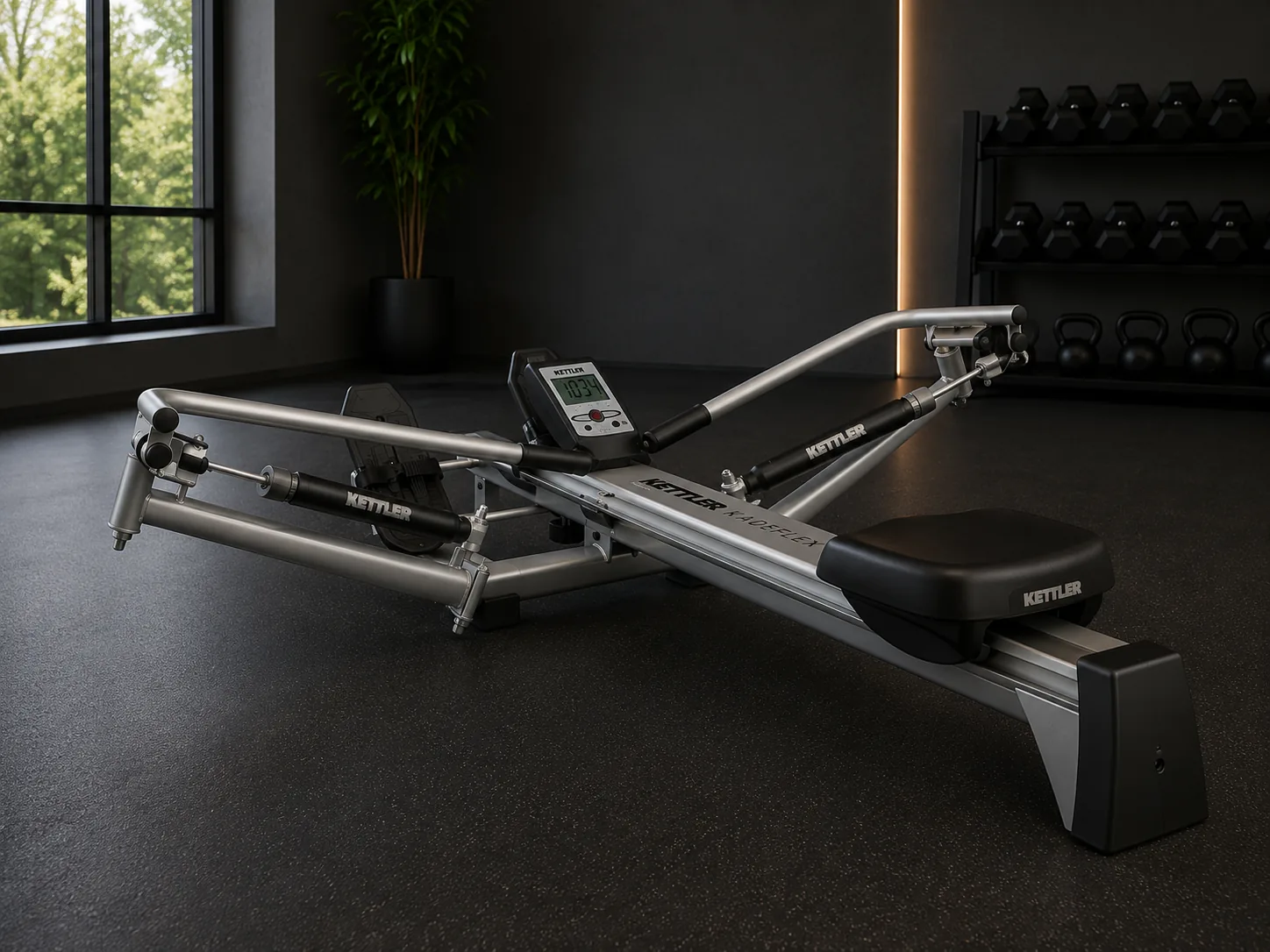
Hydraulic rower · ~$599
Kettler Kadett Outrigger
A well-built hydraulic rower with a unique outrigger feathering action, but dated metrics and high pricing limit its appeal versus modern rivals.

How we review
Every rower is scored on the same six weighted criteria - resistance & feel, build, monitor, comfort, footprint, and value - from verified specifications, expert consensus, and aggregated long-term owner feedback. Our reviews are independent: we never accept payment for placement or a higher score. Reviewed by Jordan Lockwood (BSc, CPT). See our full methodology.
The Kettler Kadett Outrigger is an unusual entry in the hydraulic rowing category. Where most home rowers lock you into a single straight-line pull, the Kadett uses an outrigger arm design, with two independent hydraulic cylinders and rotating handles meant to imitate the feathering of real sculling oars. That makes it one of the few affordable machines that tries to recreate the lateral, multi-direction motion of on-water rowing rather than the strictly guided action of a Concept2 or a typical magnetic rower.
Kettler built its reputation on solid German-engineered fitness gear, and the Kadett carries that lineage with a high-carbon steel frame and a lifetime frame warranty. It is aimed at the home user who wants a more authentic, oar-like stroke and a compact, foldable machine, rather than someone chasing precise wattage data or a connected training ecosystem. It is worth noting the Kadett has been discontinued in the US market, so this assessment is based on published manufacturer and retailer specifications rather than hands-on testing, and current availability is largely secondhand.
Specifications at a glance
| Resistance type | Hydraulic (two independent piston cylinders), 12 levels |
|---|---|
| Console | LCD: time, distance, oar strokes, stroke frequency, calories, heart rate |
| App / Bluetooth | None |
| Heart rate | Infrared earlobe clip sensor included |
| Assembled dimensions | Approx. 59" L x 67" W (arms extended) x 18" H |
| Folded dimensions | Approx. 59" L x 20" W x 18" H |
| Machine weight | Listed 51 lbs (some retailers list 66 lbs) |
| Max user weight | Listed 285 lbs (some sources cite 250 lbs) |
| Folding/storage | Outrigger arms fold inward for storage |
| Warranty | Lifetime on frame; 3 years on parts/electronics |
| Power | Battery (2x AA) |
Pros
- Genuine outrigger design with rotating handles that mimic the feathering action of real sculling oars
- High-carbon steel, powder-coated frame with a lifetime frame warranty and reputation for durability
- Two independent hydraulic cylinders with 12 selectable resistance levels
- Folds to a compact footprint and is light enough to move and store easily
Cons
- Hydraulic resistance lacks the smooth, dynamic feel of air, water, or magnetic rowers and can fade as the cylinders warm up
- Basic LCD console with no Bluetooth, no app, and metrics that are not known for accuracy
- Priced high for a hydraulic rower, well above similarly capable budget machines
- Now discontinued in the US market, so support, parts, and pricing depend on secondhand availability
Best for: Buyers drawn to a sweeping, sculling-style stroke in a compact, foldable footprint who don't need app connectivity or precise performance data.
The outrigger action is the whole point
Almost every hydraulic rower on the market drives a single central piston and a fixed bar, which produces a stiff, gym-machine motion that feels nothing like a boat. The Kadett is the rare exception. Its two independent arms pivot outward on outriggers and the handles rotate in your grip, so the catch and the recovery loosely echo the feathering of real sculling oars. For someone who has actually sat in a single scull, this is the feature that justifies the machine existing at all, and owner reviews consistently single it out as the thing that makes the Kadett feel different from a generic piston rower.
Set realistic expectations, though. The arms travel in an arc rather than a true straight pull, the handles rotate but do not load like real blades catching water, and the resistance underneath it all is still hydraulic. It is an evocative approximation, not a simulator. People who row on water tend to enjoy it as a winter substitute that keeps the right muscle memory alive, while people who have never sculled mostly just notice that it is a more natural, less robotic stroke than a single-piston machine.
Hydraulic resistance: strong, but with the usual caveats
Reviewers who have used several piston rowers tend to agree that Kettler's cylinders are a cut above the budget pack: the resistance feels firmer at the top of the range and the pistons hold up better over time. The twin-cylinder layout with 12 selectable levels also lets you load each arm independently, which is genuinely useful and not something a single-piston rower can do.
The physics of hydraulics still apply, and the existing cons page is right to flag them. As the oil warms over a longer session the resistance fades, and owners commonly report bumping up a level after the first 20 to 30 minutes to keep the load honest. The more Kadett-specific gripe is balance: because each arm has its own cylinder, the two sides can drift out of sync, leaving one arm noticeably lighter than the other. It is usually correctable with the per-arm adjusters, but it is a recurring annoyance you do not get on a single-flywheel design. None of this changes the basic ceiling of the resistance type. It will never deliver the smooth, dynamic, speed-responsive feel of air, water, or magnetic, and serious interval or distance training is not what this format is built for.
Where it lets owners down
The single most repeated complaint in owner feedback has nothing to do with the rowing feel: it is the footrests. The plates can shift mid-stroke, the strap design is loose and oversized, and the attachment to the frame is the weakest link on an otherwise solidly built machine. Several owners report the footrests breaking and needing replacement, and some have resorted to velcro or bungee fixes. On a rower where you brace hard against the stretcher every stroke, this is more than cosmetic.
Two other practical points deserve a mention. Assembly routinely takes one to two hours rather than the optimistic 45 minutes Kettler quoted, so budget an afternoon. And at roughly 66 pounds with no transport wheels on many units, calling it easy to move is generous. It folds and stores compactly, which is real, but lifting and repositioning it is a two-handed chore rather than a tilt-and-roll.
Console and data: functional, not modern
The LCD covers the basics of time, distance, strokes, calories and pulse, and that is the end of the story. There is no Bluetooth, no app, no programmable workouts and no way to export anything. The metrics are also not known for accuracy, which is typical of hydraulic rowers but worth stating plainly: treat the numbers as motivational feedback for spotting trends over weeks, not as training data you would pace intervals or chase splits against.
Owners also note the monitor mount can work loose over time. If structured, data-driven training is anywhere near the top of your list, this is the part of the Kadett that will frustrate you the most, and no amount of charming outrigger action makes up for a console that was dated even when the machine was new.
Versus the Stamina 1215 and the Concept2 RowErg
At its price the Kadett sits in an awkward gap. Below it, a hydraulic rower like the Stamina 1215 Orbital does the same fundamental job, also with twin pistons, for a fraction of the cost. You give up the genuine outrigger feathering, the German build quality and the piston refinement, but if you only want a compact, affordable, low-impact upper-body row, the value math heavily favors the cheaper machine. Most buyers who do not specifically care about the sculling motion should not be paying Kettler money for hydraulics.
Above it, and at a similar street price, sits the Concept2 RowErg, the air rower that the entire category measures itself against. The Concept2 gives you smooth, infinitely responsive resistance that does not fade, a genuinely accurate PM5 monitor with Bluetooth and ANT+, a deep training ecosystem, and a global parts-and-resale network. For anyone whose goal is fitness, conditioning or measurable progress, the Concept2 is simply the better machine and the safer purchase. The Kadett only wins on one axis, which is feel: it tries to recreate the sculling motion, and the Concept2 does not pretend to. That is the entire case for buying the Kettler instead.
Our take
Buy the Kadett only if the outrigger feathering action is the specific reason you want it. That essentially means current or former scullers who want a winter cross-training tool that keeps the sculling motion familiar, and who value Kettler's lifetime-frame durability and quiet operation over data, smoothness and split times. For that narrow buyer it is a likable, well-made machine with a unique trick no mainstream rower replicates.
Everyone else should skip it. If you want low-impact, low-cost rowing, a budget hydraulic like the Stamina costs far less for the same resistance type. If you want a real training rower, the Concept2 RowErg out-performs it on feel-consistency, accuracy, connectivity and resale. Add the now-discontinued US status, which makes pricing, support and replacement pistons dependent on secondhand luck, and the case for paying near 600 dollars gets very thin unless you find a clean used unit at a steep discount. That trade-off is exactly why it lands at 3.1 out of 5: a charming niche machine that is hard to recommend at its price.
Our verdict
The Kettler Kadett is a well-built, likable oddity with one genuine claim to fame: its twin-outrigger arms and rotating handles recreate the feathering motion of sculling oars better than any mainstream hydraulic rower. If you have rowed on water and want a quiet, durable winter substitute that keeps that motion familiar, it earns its keep. The German build quality and lifetime frame warranty are real, and the pistons are a clear step up from budget hydraulics.
For almost everyone else, the numbers do not work. The resistance still fades and lacks the dynamic feel of air, water or magnetic, the two arms can drift out of balance, the footrests are a recurring weak point, and the basic LCD has no app, no Bluetooth and metrics you cannot trust. At close to 600 dollars it is priced above cheaper hydraulics that do the same job and right alongside the Concept2 RowErg, which beats it on feel, accuracy, connectivity and resale. Now discontinued in the US, it is only worth chasing as a clean used buy for the specific rower who wants the sculling action and nothing more. That niche appeal, undercut by price and dated tech, is why it lands at 3.1 out of 5.
Frequently asked questions
- Does the Kettler Kadett actually feel like rowing on water?
- It is the closest a hydraulic rower gets, and that is its main selling point. The independent outrigger arms and rotating handles loosely mimic the feathering of sculling oars, so the stroke feels more natural than a single-piston machine. But the resistance underneath is still hydraulic, the arms travel in an arc rather than a straight pull, and it does not load like blades catching real water. Think evocative approximation, not simulator.
- Why does one arm feel easier than the other?
- Because each arm has its own hydraulic cylinder, the two sides can drift out of balance, which is the most Kadett-specific complaint among owners. You can usually rebalance them with the per-arm resistance adjusters, but it is a recurring fiddle you would not face on a single-flywheel design. Resistance also fades as the oil warms, so many owners go up a level after the first 20 to 30 minutes.
- Are the footrests really a problem?
- It is the most common complaint by far. The plates can shift mid-stroke, the straps are loose, and the connection to the frame is the weakest part of an otherwise sturdy machine. Some owners report the footrests breaking and have rigged velcro or bungee fixes. On a machine you brace against every stroke, it is worth knowing before you buy.
- Is it worth the price over a cheaper hydraulic rower?
- Only if you specifically want the outrigger feathering motion and Kettler's build quality. A budget hydraulic rower such as the Stamina 1215 delivers the same resistance type for a fraction of the cost. If you do not care about the sculling action, you are paying a large premium for a feel that may not matter to you.
- Can I still buy one new, and is parts support a concern?
- It is now discontinued in the US market, so new stock is scarce and most purchases will be secondhand. That makes pricing, warranty support and replacement parts (especially the hydraulic cylinders) dependent on availability. If you buy used, factor in that pistons can be expensive or hard to source, and inspect the footrests and arm balance carefully first.
References
- Kettler Kadett Outrigger Review - RowingMachine-Guide.com
- Kettler Kadett Rowing Machine Review (Complete Breakdown) - RowingMachineKing.com
- Kettler Kadett Outrigger Style Rower Rowing Machine - Amazon.com
Jordan Lockwood (BSc, CPT)
Certified personal trainer (CPT), sports-science graduate, and lifelong rower. Jordan writes and reviews every guide on Rowing Machine Nerd.