 Rowing Machine Nerd
Circuit Fitness Deluxe Foldable Magnetic Rowing Machine Review
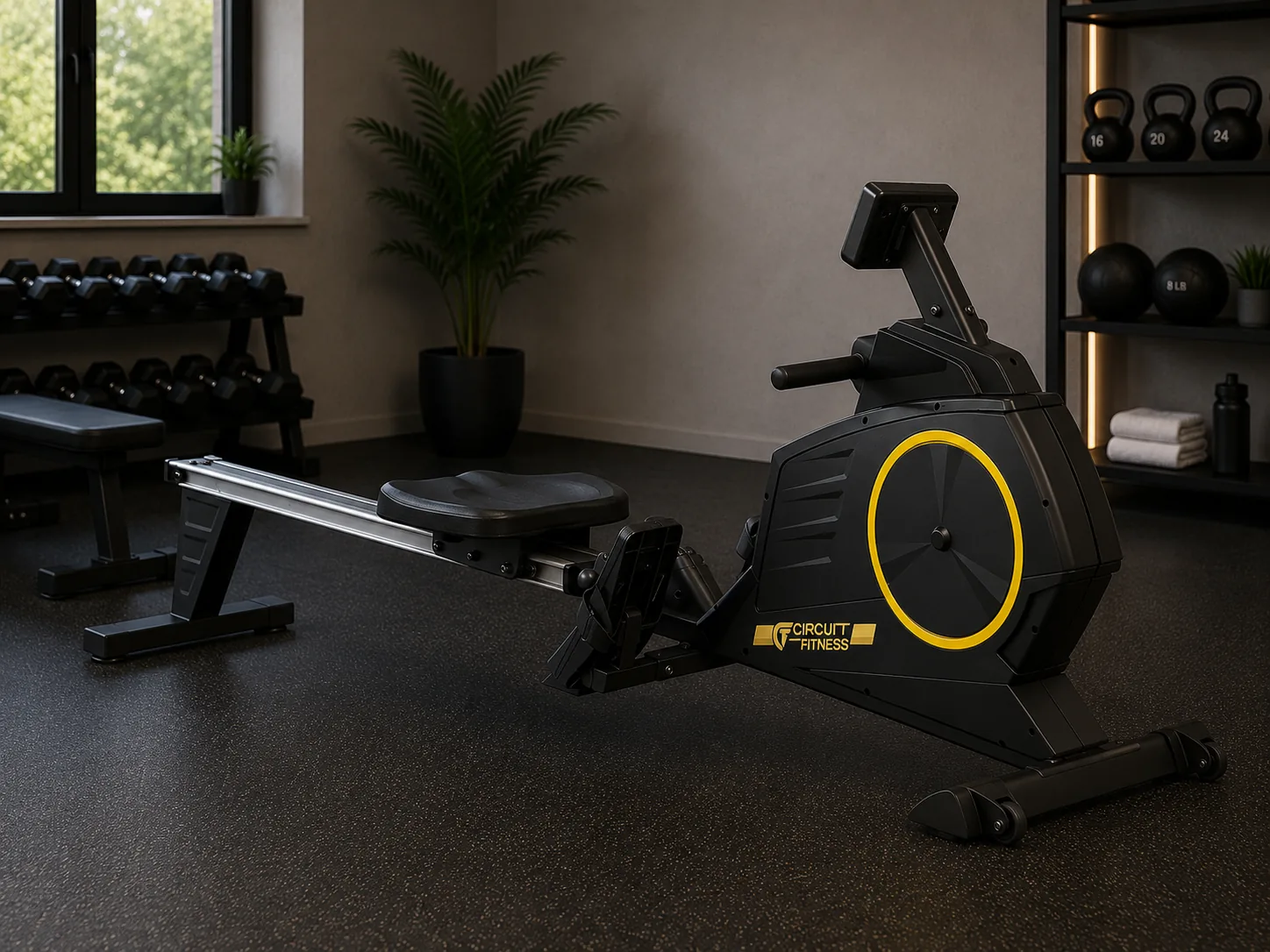
Magnetic rower · ~$400
Circuit Fitness Deluxe Foldable Magnetic Rowing Machine (AMZ-986RW)
A quiet, foldable mid-budget magnetic rower with 8 resistance levels and a basic LCD, best for casual home cardio rather than connected training.

How we review
Every rower is scored on the same six weighted criteria - resistance & feel, build, monitor, comfort, footprint, and value - from verified specifications, expert consensus, and aggregated long-term owner feedback. Our reviews are independent: we never accept payment for placement or a higher score. Reviewed by Jordan Lockwood (BSc, CPT). See our full methodology.
The Circuit Fitness Deluxe Foldable Magnetic Rowing Machine (model AMZ-986RW) is a full-length magnetic rower aimed squarely at the home-fitness budget tier. Sold under the Marcy/Circuit Fitness umbrella and widely available through Amazon, Walmart and other retailers for around $400, it pairs an 11 lb flywheel with eight levels of manually selected magnetic resistance, a folding frame and a basic LCD console. It is positioned as an affordable way to get a low-impact, full-stroke rowing workout at home without the noise of an air rower or the price of a premium machine.
This is not a connected fitness product. The base model offers no app integration, and heart-rate tracking requires a chest strap that is sold separately. Instead, the appeal is straightforward: a quiet, foldable rower with a generous 300 lb weight capacity that stores against a wall when you are done. Buyers cross-shopping it against the Concept2 RowErg or app-driven machines should understand what they are trading away, but for casual users the value proposition is clear.
Specifications at a glance
| Resistance type | Manual magnetic, 8 levels (stick-shift lever) |
|---|---|
| Flywheel | 11 lb |
| Monitor | LCD: distance, time, stroke rate, calories, speed, SPM, calories, clock, temperature; goal modes; race mode (no backlight) |
| Heart rate | Compatible with chest strap (sold separately) |
| App / Bluetooth | Not specified (base AMZ-986RW); a separate -BT variant exists |
| Assembled dimensions | 91" L x 20.5" W x 31.5" H |
| Folded dimensions | 49" L x 20.5" W x 51" H |
| Machine weight | 90 lb |
| Max user weight | 300 lb |
| Folding / storage | Folds via quick-release pin; front transport wheels |
| Warranty | 2-year limited |
| Price | ~$400 (MSRP $439.99) |
Pros
- Quiet manual magnetic resistance with eight selectable levels
- Folds down and rolls on front transport wheels for easy storage
- High 300 lb user weight capacity and sturdy 90 lb frame
- Comfortable molded seat, foam-covered handle and pivoting footplates
- Reasonable price for a full-length magnetic rower with goal and race modes
Cons
- LCD lacks a backlight and is hard to read in low light
- No built-in app or Bluetooth on the base model; heart-rate strap not included
- Step-based magnetic resistance feels less natural than air or a Concept2 flywheel
- Only a 2-year warranty, short of premium machines
Best for: Budget-minded home users who want a quiet, foldable full-length rower for steady low-impact cardio rather than connected training or competitive metrics.
How the magnetic resistance actually feels
Magnetic rowers like the AMZ-986RW work by moving a magnet closer to or further from a spinning flywheel, which means the resistance is constant rather than responsive. Unlike an air rower that pushes back harder the faster you pull, or a water rower that builds a wave of resistance through the stroke, this Circuit Fitness gives you the same drag regardless of how aggressively you row. For steady-state cardio that is genuinely pleasant, the pull is quiet and smooth and there is no whoosh of air to wake the house. But it also means the machine cannot reward a powerful, explosive stroke the way performance rowers do, and that disconnect is the single biggest reason experienced rowers find magnetic units underwhelming.
The eight levels are adjusted manually with a tension knob, and the practical issue is the ceiling. Multiple reviewers note that even the top setting feels light to anyone who has trained seriously, so a fit user can blow past the hardest level and lose the ability to progressively overload. If your goal is to break a sweat doing 20 to 40 minutes of moderate rowing, the range is fine. If you expect the resistance to keep challenging you as you get stronger over a year or two, it will not.
The monitor is the weak link
The LCD covers the basics competently: time, distance, strokes per minute, calories, speed, and a recovery readout, plus Manual and Race modes and a goal function. That is more than the bare-bones consoles on some cheaper rowers. But the screen is not backlit, which the existing review rightly flags, and in a dim garage or an early-morning living room it becomes genuinely hard to read. There are no structured workout programs to follow, so motivation is entirely on you.
Connectivity is where buyers most often get tripped up. The base AMZ-986RW has no Bluetooth and no companion app, so it does not sync to Strava, Kinomap, or any training platform, and the heart-rate chest strap it can read wirelessly is not included and costs roughly forty dollars extra. Circuit Fitness does sell a Bluetooth variant under a similar model number, so before you buy, confirm exactly which version is in the cart if app connectivity matters to you. On the standard model, treat this as a disconnected machine and you will not be disappointed.
Build, comfort and the storage reality
At around 90 pounds with a steel-and-aluminum frame and a 300 lb capacity, this is a notably more substantial machine than most rowers in its price band, and that heft translates into a stable, planted feel mid-stroke. The molded seat, foam-covered handle and pivoting footplates are comfortable enough for the casual sessions this rower is built for, and the long rail comfortably fits users up to roughly 6 foot 3.
The folding mechanism and front transport wheels are a real selling point for apartments and shared rooms, but set expectations honestly. Owners report that while it does fold and roll, maneuvering a 90 lb machine between rooms is awkward rather than effortless, so this is better thought of as fold-and-tuck-in-a-corner than carry-it-upstairs portable. A couple of owners have also flagged the seat rollers getting noisier over time and, in isolated cases, frame flex affecting the glide, and one reported the resistance resetting to the lowest level after about ten minutes in Manual mode. These are not widespread, but they are worth knowing given the mid-budget price and short warranty.
Is it worth around 400 dollars?
The value question hinges on what you compare it to. Against flimsier sub-300-dollar magnetic rowers, the AMZ-986RW justifies its premium with a heavier, more stable frame and a more capable monitor. Against the gold-standard Concept2, it simply is not in the same conversation on resistance feel, data, or longevity, and it carries only a 2-year warranty versus the multi-year coverage premium machines offer.
So the 400 dollar price is reasonable but not a steal. You are paying mainly for build quality and the folding convenience, not for training depth or connected features. If those two things top your list, the money is well spent. If you want resistance that scales with effort or any kind of app ecosystem, your dollars are better deployed elsewhere.
How it stacks up against the Sunny SF-RW5515
The most direct alternative is the Sunny Health and Fitness SF-RW5515, the default budget magnetic rower most shoppers cross-shop. The two are remarkably similar on paper: both have eight levels of manual magnetic resistance, both are belt-driven, both fold, both fit users up to around 6 foot 3, and neither has a backlit screen, a tablet holder, or Bluetooth on the standard model.
The differences are weight, monitor and price. The Sunny is far lighter at roughly 59 pounds, which makes it easier to move but less planted feeling, and its console is more basic than the Circuit Fitness with its Race mode and recovery function. Crucially, the Sunny typically sells for around 250 dollars, well below this machine. That makes the decision fairly clean: if you want the sturdiest frame and the better monitor and do not mind paying up, the Circuit Fitness is the nicer object. If you simply want a competent foldable magnetic rower for the lowest sensible price, the Sunny delivers most of the same experience for less, and the extra 150 dollars here buys refinement rather than a different category of machine.
Our take
Buy the Circuit Fitness AMZ-986RW if you are a beginner or returning exerciser who wants quiet, low-impact cardio at home, values a genuinely sturdy frame, and needs to fold the machine away between sessions. For that buyer it does its job well and feels more solid than its price suggests, which is why it lands at a fair 3.2 out of 5 rather than lower.
Skip it if you are a committed or competitive rower, if you want resistance that pushes back harder as you pull harder, or if connected training matters to you. Serious rowers will outgrow the resistance ceiling and miss the data, and anyone who lives in their fitness app will be frustrated by the lack of Bluetooth on the base model. If budget is the priority, the Sunny SF-RW5515 covers most of the same ground for less; if training quality is the priority, save toward a Concept2. This machine is for the casual middle, and it knows it.
Our verdict
The Circuit Fitness Deluxe AMZ-986RW is a well-built, genuinely quiet foldable magnetic rower that punches slightly above its frame quality for the money, and for the casual home exerciser it was designed for it earns its keep. The 90 lb frame feels planted, the seat and handle are comfortable, and the fold-away design suits tight spaces. At 3.2 out of 5 it is a solid, unspectacular pick: good for steady cardio, not built for training depth.
Just go in clear-eyed about its limits. The resistance does not push back harder as you pull harder, the non-backlit screen is awkward in low light, the base model has no Bluetooth, and the warranty is only two years. If you are a casual rower who wants a sturdy machine to tuck in a corner, buy it. If you want resistance that scales or any connected training, spend less on a Sunny SF-RW5515 or save up for a Concept2 instead.
Frequently asked questions
- Does the Circuit Fitness AMZ-986RW have Bluetooth or an app?
- The standard AMZ-986RW does not. There is no companion app and the base model will not sync workouts to platforms like Strava or Kinomap. Circuit Fitness offers a separate Bluetooth variant under a similar model number, so if connectivity matters, confirm exactly which version you are buying before checkout.
- Is the resistance strong enough for a fit or experienced rower?
- For casual and intermediate users, yes. For experienced rowers, generally no. The eight magnetic levels are constant rather than responsive, and reviewers consistently note that even the top setting feels light to anyone who trains seriously, so you can outgrow the ceiling and lose the ability to progressively overload.
- How easy is it really to move and store?
- It folds and has front transport wheels, so it tucks into a corner well. But it weighs around 90 pounds, so owners describe rolling it between rooms as awkward rather than effortless. Treat it as fold-and-stash in the same room, not as something to haul up and down stairs.
- Is a heart-rate monitor included?
- No. The console can read a wireless chest strap, but the strap is not in the box and costs roughly forty dollars separately. Budget for that if heart-rate tracking is important to you.
- How does it compare to the Sunny SF-RW5515?
- They are very close in features, both eight-level foldable belt-driven magnetic rowers with non-backlit screens and no Bluetooth. The Circuit Fitness has a heavier, sturdier frame and a more capable monitor, but costs around 150 dollars more. The Sunny is lighter and cheaper at roughly 250 dollars and delivers most of the same experience for less.
References
Jordan Lockwood (BSc, CPT)
Certified personal trainer (CPT), sports-science graduate, and lifelong rower. Jordan writes and reviews every guide on Rowing Machine Nerd.