 Rowing Machine Nerd
Stamina Air Rower Review
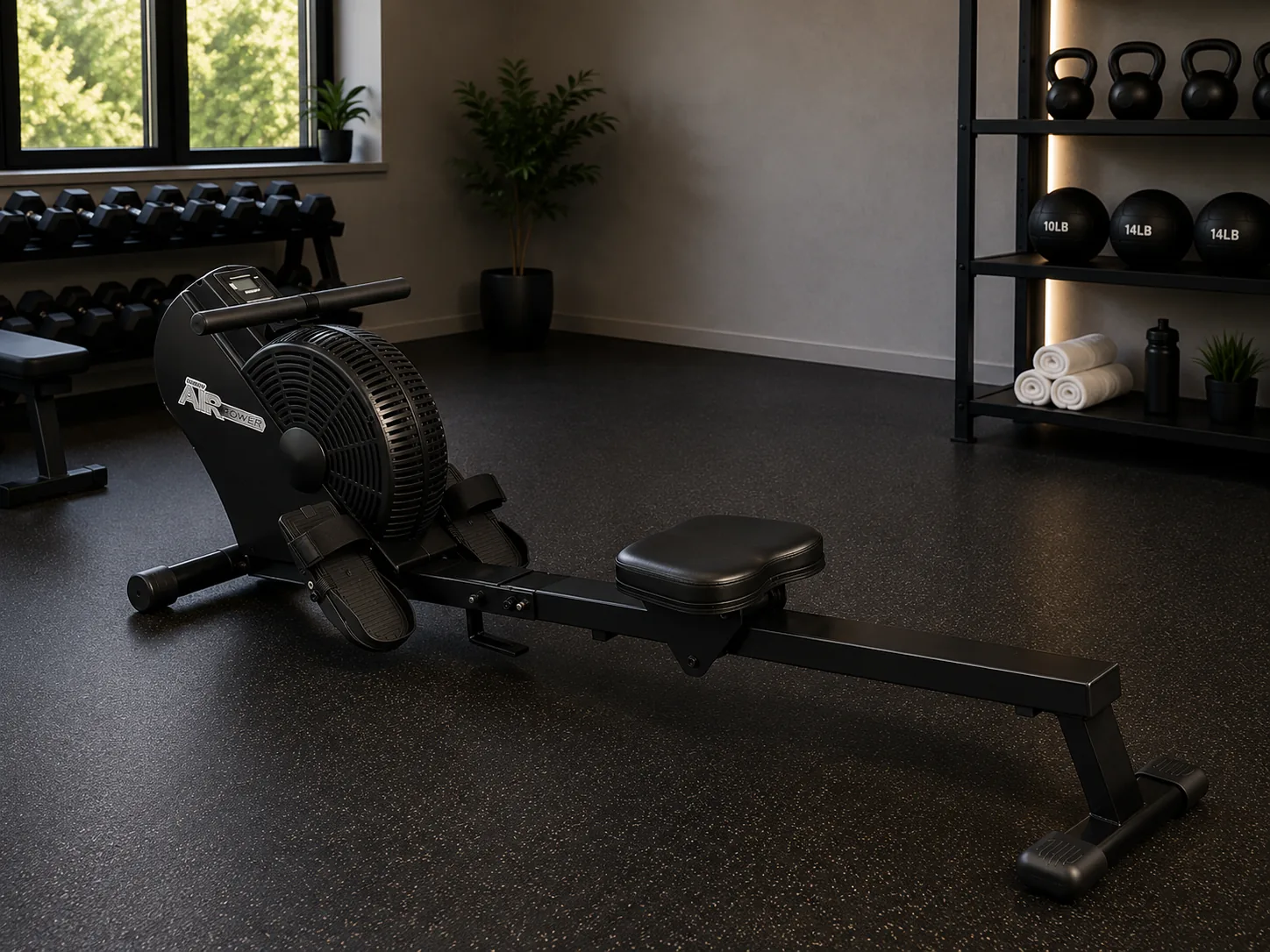
Air rower · ~$299
Stamina Air Rower
An affordable, foldable air rower that covers the basics for beginners but is held back by inconsistent resistance and ergonomic limits.

How we review
Every rower is scored on the same six weighted criteria - resistance & feel, build, monitor, comfort, footprint, and value - from verified specifications, expert consensus, and aggregated long-term owner feedback. Our reviews are independent: we never accept payment for placement or a higher score. Reviewed by Jordan Lockwood (BSc, CPT). See our full methodology.
The Stamina Air Rower is one of the most widely sold entry-level air rowing machines in the United States, typically found around $300 and frequently appearing in the ATS 1399, 1402, 1403 and 1404 variants. It uses a flywheel-and-fan resistance system that responds to how hard and fast you pull, paired with a basic multi-function monitor and a steel frame that folds for storage. It is positioned squarely as a budget alternative to premium air rowers that cost two to three times as much.
This is a machine aimed at beginners and casual users who want low-impact cardio at home without a large financial commitment. It is not built to compete with performance-oriented rowers on resistance consistency, ergonomics or data, but its low price, light weight and compact folded footprint make it an accessible starting point. The sections below assess where it delivers and where its budget compromises show.
Specifications at a glance
| Resistance type | Air (wind) resistance, no damper settings |
|---|---|
| Monitor | Multi-function LCD: speed, distance, time, calories |
| Connectivity | No Bluetooth; Muuv app compatible (no on-board holder) |
| Assembled dimensions | 77" L x 18" W x 22" H (approx.) |
| Folded dimensions | 48" L x 18" W x 28" H (approx.) |
| Machine weight | 54 lbs |
| Max user weight | 250 lbs |
| Recommended user height | 4'9" to 6'4" |
| Folding / storage | Folding frame with transport wheels |
| Warranty | 3 years frame, 90 days parts |
| Price | ~$299 street |
Pros
- Genuine air resistance that scales with how hard you pull, at a budget price
- Folds in half and rolls on transport wheels for easy storage in small spaces
- Lightweight 54 lb steel frame is simple to move and set up
- Covers the basic metrics most beginners need: time, distance, speed, calories
- Costs roughly a third of a premium air rower
Cons
- No damper or resistance settings, and reviewers note inconsistent tension during the stroke
- Short seat rail and seat stoppers limit range of motion, awkward for taller users
- Mostly plastic components beyond the steel frame; some flex and shake under hard effort
- No Bluetooth and 90-day parts warranty fall well short of premium machines
Best for: Budget-minded beginners of average or shorter height who want a foldable air rower for occasional, low-impact home cardio.
How the air resistance actually feels
Like every air rower, the Stamina has no damper or resistance dial: the only way to make it harder is to pull faster, and the fan does the rest. That is exactly how a Concept2 works in principle, but the execution here is where independent reviewers get blunt. Testers describe the flywheel as underwhelming and the tension as inconsistent through the stroke, so the satisfying loading you feel at the catch on a quality erg never quite materializes. Pull hard and you get noise and movement more than a clean wall of resistance to push against.
The practical upshot: this rower rewards a fast, light cadence and punishes anyone who wants to grind out heavy, powerful strokes. For HIIT-style intervals and getting a sweat going it is fine. For building a genuine sense of rowing power, or for a strong rower who already knows what good resistance feels like, the ceiling is low and you will likely outgrow it. A common owner complaint is simply that it does not feel hard enough, which is partly a misunderstanding of air resistance and partly a real limitation of this particular flywheel.
Ergonomics are the real dealbreaker
The short seat rail is the single biggest constraint, and it is worse than the spec sheet suggests because the rail also sits on an aggressive decline. A reviewer at 5 foot 6 found it uncomfortably short, which means anyone meaningfully taller is going to bottom out before reaching full leg extension and will fight the angle the whole time. Seat stoppers further clip the range of motion. If you are over roughly 5 foot 8, test your stroke length before committing, because a truncated drive turns rowing into a choppy half-movement that defeats the point.
Comfort is mixed. The seat is reasonably padded for a budget machine, but the firmness draws complaints on longer sessions, and the decline keeps your hips lower than many rowers prefer. Pivoting footrests are a nice touch and accommodate different shoe sizes. None of this is a problem for short, casual users doing 20-minute workouts; it becomes a daily annoyance for taller people or anyone planning long steady-state pieces.
Build quality and what breaks
The steel frame is genuine and the 54 lb weight makes it easy to move, but nearly everything else is plastic, including the flywheel housing, and it shows. Reviewers note visible flex and shake under hard effort even from users well under the 250 lb capacity, which both undercuts confidence and bleeds energy out of each stroke. This is normal at the price, but it is the kind of thing you feel every session.
Longevity is the recurring worry in owner reports. Cracked pedal covers, worn seat rollers within a month or two, frayed nylon straps, and a resistance spring mechanism that some heavy users replace every 6 to 12 months all come up repeatedly. To Stamina's credit, customer service and replacement-part availability earn praise, which matters given the stingy 90-day parts warranty. Treat this as a machine you may need to nurse with occasional cheap parts rather than one you bolt together and forget for a decade.
The monitor does the minimum
The LCD is about as basic as it gets: time, distance, speed, and calories, cycled in pairs through a single button so you cannot see everything at once. There is no stroke rate, no metric units on some versions, no backlight, and no Bluetooth, app connectivity, or device holder. The calorie figure in particular is best treated as a rough motivator rather than data.
For a beginner who just wants to see the clock tick and a distance climb, it is adequate. For anyone who cares about pacing by split, tracking stroke rate, or logging workouts to an app, the absence of real data and connectivity is a hard limit. There is no ecosystem here and no path to add one, so what you buy is what you get.
How it compares to the Concept2 RowErg
The honest comparison is not flattering, and price is the only category the Stamina wins. Both use air resistance, but the Concept2 RowErg, widely treated as the benchmark, delivers consistent, scalable tension, a long rail that fits tall rowers, a 500 lb capacity versus 250 lb here, a rock-solid frame that barely flexes, and the PM5 monitor that gives accurate splits, stroke rate, and full app and racing connectivity. It also lasts essentially forever and holds strong resale value, which softens its roughly 3x higher price over time.
The cheaper apples-to-apples rival is Stamina's own X Air Rower, which adds an angled-pull handle and a slightly beefier feel for a bit more money. But if your budget can stretch, the gap to the Concept2 is the one that actually changes the experience. The Stamina makes sense only when the Concept2 is genuinely out of reach and you accept a real downgrade in feel, fit, and durability to get there.
Our take
Buy the Stamina Air Rower if you are a budget-locked beginner, you are not tall (ideally 5 foot 6 or under), you have a small space and value the fold-in-half storage, and your goal is light cardio or short interval sessions rather than serious training. For that person it is a legitimately affordable way to start rowing, and the easy folding and light weight are real, daily benefits.
Skip it if you are over about 5 foot 8, if you want progressive resistance you can lean into, if you plan long or daily hard sessions, or if you care about data, app tracking, or long-term durability. In those cases the short rail, inconsistent resistance, plastic-heavy build, and 90-day parts warranty will frustrate you fast, and you are better off saving for a Concept2 RowErg or buying one used. Our 2.6 out of 5 reflects exactly this: it does the basics at a third of the price, but the compromises are significant and you feel them in the stroke.
Our verdict
The Stamina Air Rower is a budget on-ramp, not a destination. At around 299 dollars it gives you genuine air resistance, a foldable steel frame that tucks away in a small apartment, and the handful of metrics a beginner needs, all for roughly a third of a premium erg. For a short, casual user doing light cardio in a tight space, that value is real and the easy storage is a daily perk.
But the compromises run deep and you feel them every stroke: inconsistent, low-ceiling resistance, a short and steeply declined rail that boxes out anyone over about 5 foot 8, a plastic-heavy build that flexes and shakes, a bare-bones monitor with no connectivity, and a 90-day parts warranty backed by parts you may actually need. At 2.6 out of 5 it earns a narrow recommendation for budget-locked beginners who fit it, and a clear skip for taller users, data-driven rowers, or anyone who plans to train hard. If you can stretch the budget, save for a Concept2 RowErg or buy one used; you will not outgrow it the way you will outgrow this.
Frequently asked questions
- Can I adjust the resistance on the Stamina Air Rower?
- No. There is no damper lever or resistance dial. Like all air rowers it gives variable resistance, meaning the only way to make it harder is to pull faster. Many owners who expected an adjustment knob are disappointed, and reviewers note the tension feels inconsistent through the stroke, so the resistance ceiling is fairly low for stronger rowers.
- How tall can you be to use it comfortably?
- Shorter than most rowers allow. The seat rail is short and sits on a steep decline; a reviewer at 5 foot 6 already found it cramped. If you are over roughly 5 foot 8 you will likely run out of rail before full leg extension and fight the angle. Test your stroke length before buying if you are tall.
- Is it durable enough for daily use?
- For light, regular sessions, yes, but expect upkeep. The frame is steel but most other parts are plastic, and owners report cracked pedal covers, worn seat rollers, frayed straps, and a resistance spring that heavy users sometimes replace every 6 to 12 months. The 90-day parts warranty is short, though Stamina's replacement-part service is well regarded. It is not built for hour-long daily hard training.
- Does it connect to apps or Bluetooth?
- No. The basic LCD shows only time, distance, speed, and calories, cycled in pairs, with no stroke rate, no backlight, no Bluetooth, and no device holder. There is no app ecosystem and no way to add one, so it is not suitable if you want to log workouts or pace by split.
- Should I buy this or save for a Concept2 RowErg?
- If the Concept2 is genuinely out of budget and you are a short, casual beginner in a small space, the Stamina is a reasonable entry point at about a third of the price. If you can stretch, the Concept2 wins on resistance consistency, rail length, 500 lb capacity, build, the PM5 monitor with full data and connectivity, longevity, and resale value. For most people who plan to stick with rowing, saving up or buying a used Concept2 is the better long-term call.
References
- Stamina Air Rowing Machine 1404 - Official Product Page - Stamina Products
- Stamina ATS 35-1403 Air Rower Review (2026) - Garage Gym Reviews
- Stamina ATS Air Rower 1399 Review - AllRowers
Jordan Lockwood (BSc, CPT)
Certified personal trainer (CPT), sports-science graduate, and lifelong rower. Jordan writes and reviews every guide on Rowing Machine Nerd.