 Rowing Machine Nerd
Joroto M35 Magnetic Review
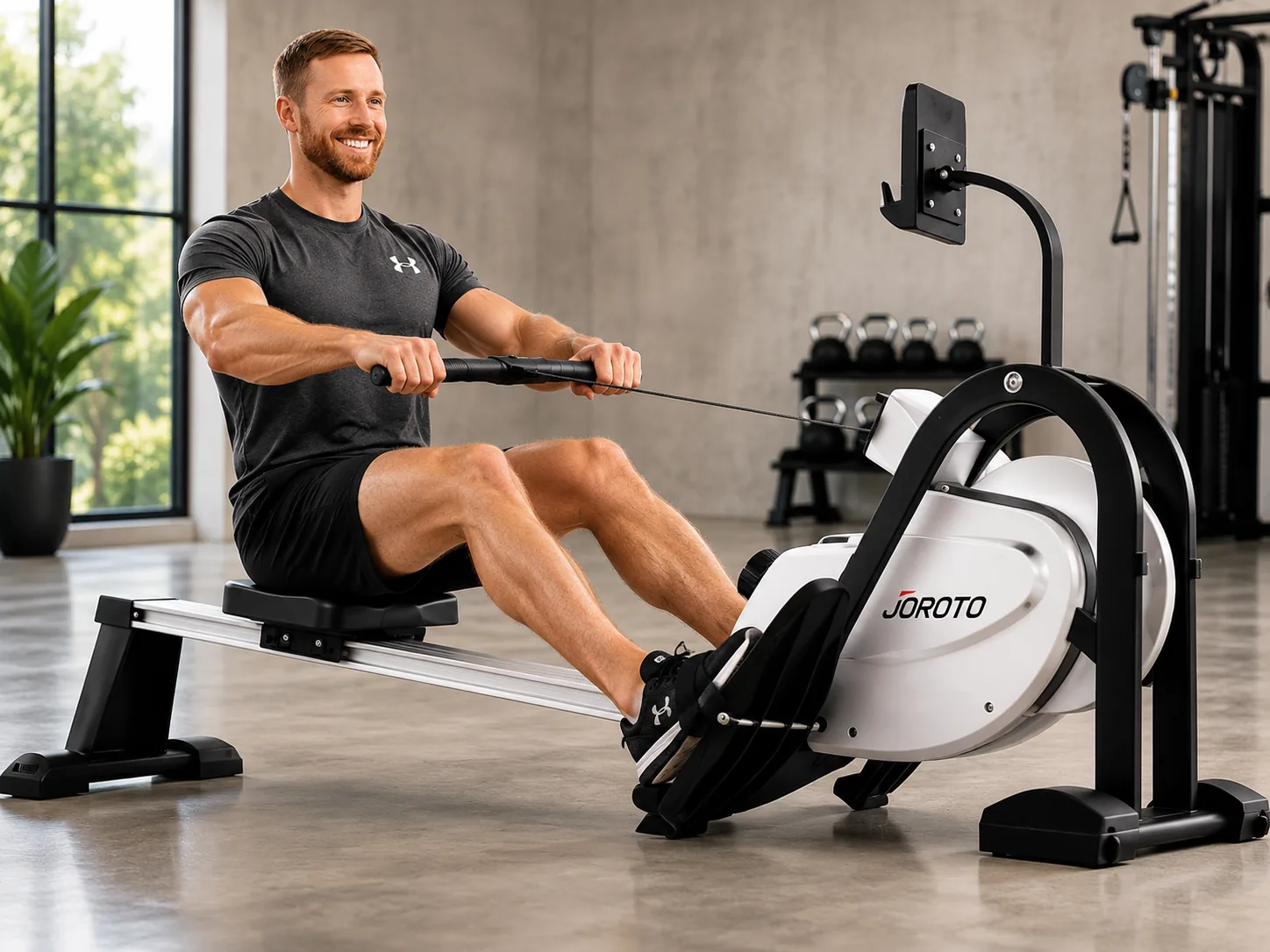
Magnetic rower · ~$399
Joroto M35 Magnetic
A quiet, compact budget magnetic rower with vertical storage and a 300 lb capacity, but a bare-bones monitor and no app connectivity.

How we review
Every rower is scored on the same six weighted criteria - resistance & feel, build, monitor, comfort, footprint, and value - from verified specifications, expert consensus, and aggregated long-term owner feedback. Our reviews are independent: we never accept payment for placement or a higher score. Reviewed by Jordan Lockwood (BSc, CPT). See our full methodology.
The Joroto M35 (also sold as the MR35) is an entry-level magnetic rowing machine aimed at home users who want quiet, low-impact cardio without the noise of an air rower or the space demands of a fixed-position machine. It pairs a manual magnetic brake with an aluminum slide rail and a frame that combines steel, aluminum, and ABS components, landing in the roughly $300-$500 price bracket where most budget rowers compete.
This is a machine built around convenience and price rather than performance instrumentation. It offers 10 selectable resistance levels via a tension knob, folds to a vertical standing position for storage, and supports users up to 300 pounds. What it does not offer is the connected experience or data depth of pricier rowers, which makes it a straightforward pick for casual exercisers and a poor match for data-driven athletes.
Specifications at a glance
| Resistance type | Manual magnetic, 10 levels (tension knob) |
|---|---|
| Flywheel | Aluminum, approx. 4.4 lb (2 kg) |
| Monitor | Basic LCD: time, stroke count, total count, calories (scan mode) |
| App / Bluetooth | Not specified (detailed review reports no Bluetooth/app) |
| Assembled dimensions | 71 x 21 x 36 in (L x W x H) |
| Machine weight | 53 lb |
| Max user weight | 300 lb |
| Storage | Folds to vertical standing position; transport wheels |
| Max user height | Up to about 6 ft 4 in (35 in rail) |
| Warranty | 2 years frame / 6 months (parts) per guide; some retailers list 12-month parts |
| Price | Roughly $300-$500 depending on retailer |
Pros
- Quiet, non-contact magnetic resistance suitable for apartments and shared spaces
- Stands vertically for storage, occupying a very small footprint
- 300 lb user capacity and a 35-inch rail that accommodates taller users
- Lightweight at 53 lb with transport wheels, easy to reposition
- Reasonable entry price for a magnetic home rower
Cons
- Basic LCD lacks distance/meters and stroke-rate consistency across sources; no reliable performance metrics
- No Bluetooth or app connectivity per the detailed review, so no app-based tracking or classes
- Light aluminum flywheel limits the inertia and stroke realism serious rowers expect
- Short parts warranty relative to premium rowers
Best for: Beginners and casual home exercisers who want a quiet, compact, affordable magnetic rower and do not need app connectivity or precise performance data.
Resistance and feel: smooth and quiet, but a low ceiling
The M35 runs a belt drive against a light aluminum flywheel of roughly 4.4 pounds, paired with 10 levels of magnetic resistance set by a dial on the central post. The practical payoff is exactly what budget magnetic rowers are bought for: a near-silent, vibration-free stroke you can use early or late in an apartment without bothering anyone, and consistent resistance that holds even at slow leg-driven cadences. Reviewers consistently describe the stroke as smoother than most rowers at this price, which is a genuine compliment in a category full of clunky pull-and-recoil feel.
The catch is the resistance ceiling. With so little flywheel mass, the inertia between strokes is minimal, so the catch feels abrupt rather than fluid and the machine never builds the carrying momentum a heavier flywheel or a Concept2 air drum provides. Several reviews note that fit or strong rowers find even level 10 underwhelming. If you are a lighter or beginning user doing 20 to 40 minute steady sessions, this is a non-issue. If you already row hard or expect the resistance to scale with your effort the way an air or water rower does, you will outgrow it.
The monitor is the weakest link
The bare LCD is where the M35 shows its price. Coverage of what it actually reports is inconsistent across sources, with some listing distance and strokes-per-minute and others noting those readings are missing or unreliable, which itself tells you not to trust the data for any kind of structured training. At best you get time, stroke count and an estimated calorie figure, on a non-backlit screen with no heart-rate input, no preset programs and no scan you can lean on for pacing.
More important is what is flatly absent: there is no Bluetooth and no app connectivity on this model. You cannot push sessions to Strava, Kinomap or any of the app-based class platforms, and there is no way to bolt that on later. For a buyer who wants to follow guided workouts or watch a 2,000 meter split tick down, this is the single biggest reason to look elsewhere. For someone who just wants a quiet machine to log minutes on, the weak monitor matters far less than the spec sheet makes it sound.
Build, comfort and the squeak problem
The aluminum frame is genuinely well regarded for the money, described as sturdy with a 300 pound capacity and a 35 inch rail that lets users up to roughly 6 feet 4 inches reach full leg extension. At about 53 to 55 pounds with transport wheels it is easy to wheel around and tip into its vertical storage position, where it occupies a very small footprint against a wall. That combination of compact storage and a tall enough rail is the M35's strongest practical argument.
Comfort is more mixed. The seat sits around 10 inches off the floor, which is fine for most but can be a nuisance for anyone with stiff knees or a bad back who has to drop down and push back up. The seat is also on the narrow side, so larger riders often add a cushion. The recurring red flag in owner feedback is a squeaking seat or rail that can appear within the first few uses and does not always respond to silicone spray. It is not universal, but it shows up often enough that you should treat it as a known quirk and budget a little patience for lubrication and adjustment.
Warranty and what ownership really costs
The warranty is short by serious-rower standards: commonly cited as two years on the frame and only six months on parts. For context, premium ergs warranty their frames for five to seven years and parts for two or more. Six months of parts cover tells you Joroto is pricing this as a disposable-tier budget machine, not a decade-long investment, and you should buy it with that expectation.
The flip side is low running cost. The belt drive is maintenance-free compared with a chain, there is no water tank to dose with purification tablets and no air filter to clean, and it runs on batteries so it needs no outlet. Day to day this is one of the cheaper rowers to live with. The realistic ownership picture is a low-fuss machine for a few years of casual use, not an heirloom.
How it compares to the Sunny Health SF-RW5515 and the Concept2 RowErg
The obvious head-to-head at this price is the Sunny Health SF-RW5515, the best-selling budget magnetic rower. The Sunny undercuts the M35 on price and is praised for resistance that bites even at its lower settings, plus a longer beam and a folding frame. The M35 answers with two more resistance levels, an aluminum flywheel and a noticeably more premium look and feel, and it stores upright in a smaller footprint than the Sunny does folded. If your priority is the strongest resistance per dollar and folding storage, the Sunny is the value pick. If you want the cleaner stroke and the tidier vertical storage and you do not mind paying a little more, the M35 earns its premium.
The Concept2 RowErg is the other comparison worth making, not because it is a direct rival but because it is the bar the M35 cannot reach. The RowErg costs more than double, but it brings effectively unlimited resistance, a trusted PM5 monitor with real meters and watts, Bluetooth and ANT plus, and a warranty and resale value that make it cheap over a decade. Anyone planning to train seriously, race virtually or keep a rower for years should save up for the Concept2 rather than spend on the M35 twice.
Our take
Buy the M35 if you are a beginner to intermediate rower in an apartment, condo or shared space who values silence and small-footprint vertical storage above all, and whose goal is steady-state cardio rather than data or competition. For that buyer it is a smooth, quiet, good-looking machine at a fair entry price, and our 3 out of 5 reflects a machine that does its narrow job well.
Skip it if you want app classes or guided workouts, if you train hard enough to need real resistance and trustworthy metrics, or if you are buying a rower you expect to keep for many years. The missing Bluetooth, the light flywheel, the unreliable monitor and the short six-month parts warranty all push serious users toward the Concept2 RowErg, and bargain hunters toward the cheaper Sunny SF-RW5515. The M35 lives in the middle: better-looking and smoother than the cheapest options, but capped well below anything you would call a long-term training tool.
Our verdict
The Joroto M35 is a competent, quiet, good-looking budget magnetic rower that knows exactly what it is: a low-fuss machine for beginners and intermediates who want to row in silence in a small space. The aluminum flywheel gives a smoother stroke than most rivals at this price, the 35 inch rail handles tall users, and vertical storage in a tiny footprint is a real selling point for apartments. At a fair entry price it earns a solid 3 out of 5.
But the ceiling is low and the corners are visible. The light flywheel runs out of resistance for strong rowers, the LCD monitor is bare and its readings are not consistent enough to train by, there is no Bluetooth or app support, and the six-month parts warranty signals a few years of casual life rather than a decade. If you want data, classes or serious training, save for the Concept2 RowErg; if you just want the cheapest capable magnetic rower, look hard at the Sunny SF-RW5515. The M35 is the right call only for the buyer who prizes quiet, smooth, compact rowing over everything else.
Frequently asked questions
- Does the Joroto M35 connect to apps like Kinomap, Strava or Zwift?
- No. This magnetic model has no Bluetooth and no app connectivity, so you cannot sync workouts or follow app-based classes, and there is no way to add it later. Some other Joroto models do offer Bluetooth, so check the exact listing if connectivity matters to you.
- Is the resistance strong enough for a fit or experienced rower?
- Probably not. With a light aluminum flywheel of about 4.4 pounds and 10 magnetic levels, multiple reviews note that even the top setting feels easy for strong rowers. It suits beginners and intermediates doing steady cardio; serious trainers will want an air rower like the Concept2 RowErg instead.
- Why does the seat squeak, and can I fix it?
- A squeaking seat or rail is the most commonly reported M35 complaint and can show up within the first few uses. Owners try silicone spray on the rail and tightening hardware, which helps in many cases but not all. Treat it as a known quirk rather than a guaranteed dealbreaker.
- Will it fit a tall user, and how much space does it need?
- The 35 inch rail accommodates users up to roughly 6 feet 4 inches with a 300 pound capacity. It does not fold, but it stands vertically against a wall in a very small footprint, and built-in wheels make it easy to move. The seat is fairly narrow and sits about 10 inches high, so larger users may add a cushion.
- How does it compare to the Sunny Health SF-RW5515?
- The Sunny is usually cheaper, folds, and is praised for strong resistance even at low settings. The M35 costs a bit more but offers a smoother stroke, an aluminum flywheel, two more resistance levels and tidier upright storage. Choose the Sunny for value and folding, the M35 for feel and footprint.
References
- Joroto Magnetic M35 Rower Review - RowingMachine-Guide.com
- JOROTO Magnetic Rower (MR35) with LCD Display, 300LB Capacity - The Home Fitness Corp
- JOROTO MR35 Magnetic Rower Review - BestFitnessEq.com
Jordan Lockwood (BSc, CPT)
Certified personal trainer (CPT), sports-science graduate, and lifelong rower. Jordan writes and reviews every guide on Rowing Machine Nerd.