 Rowing Machine Nerd
Teeter Power10 Elliptical Rower Review
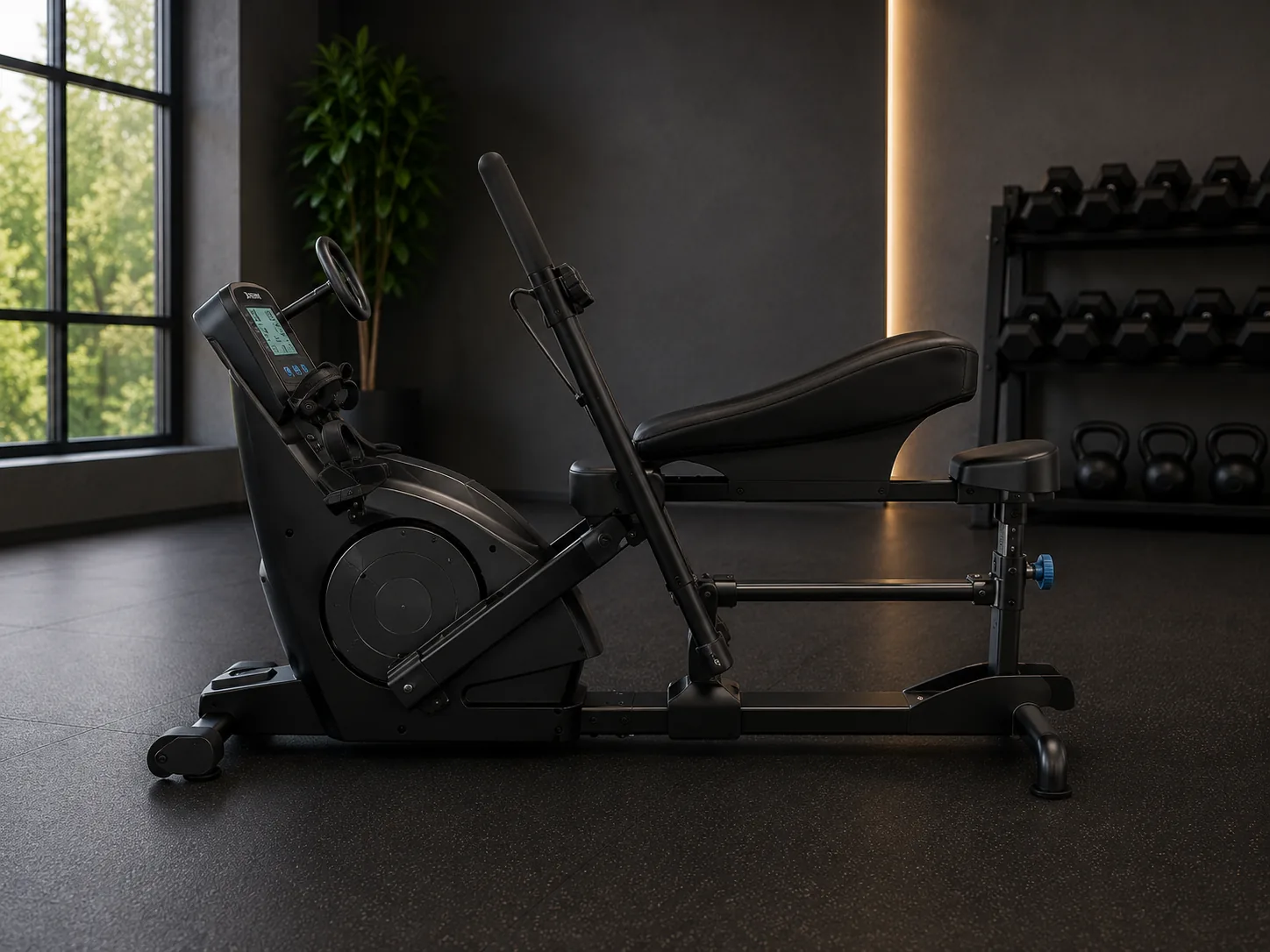
Magnetic rower · ~$899
Teeter Power10 Elliptical Rower
A hybrid rower-elliptical with patented bi-directional resistance; great for low-impact full-body cardio, less so for true rowing technique.

How we review
Every rower is scored on the same six weighted criteria - resistance & feel, build, monitor, comfort, footprint, and value - from verified specifications, expert consensus, and aggregated long-term owner feedback. Our reviews are independent: we never accept payment for placement or a higher score. Reviewed by Jordan Lockwood (BSc, CPT). See our full methodology.
The Teeter Power10 Elliptical Rower is an unusual entry in the home-rowing space. Rather than replicating the catch-drive-finish stroke of a traditional rower, it uses a patented bi-directional magnetic resistance system that lets you both pull and push against the handles, paired with a curved, elliptical-style seat path. The result is a machine that markets itself as a rower but behaves more like a hybrid cardio trainer designed to recruit more muscle groups in a single low-impact session.
Priced recently around $899, the Power10 sits in the mid-range and competes less with dedicated rowers and more with multi-modal home cardio equipment. It will appeal to buyers who prioritize joint-friendly, full-body conditioning and variety over rowing-specific fidelity. Anyone shopping for a machine to mirror on-water technique or to log precise rowing splits should weigh that distinction carefully before buying.
Specifications at a glance
| Resistance type | Magnetic, 7 levels |
|---|---|
| Special feature | Patented bi-directional (push/pull) resistance with elliptical-style motion |
| Flywheel | 22.7 lb inertia-enhanced flywheel |
| Monitor | 4.25" LCD; shows time, distance, strokes, strokes/min, calories, pulse |
| Connectivity | Teeter Move app (subscription-free); heart rate via 5.3 kHz HRM (strap not always included) |
| Assembled dimensions | 62.8 x 37.5 x 43.3 in (L x W x H) |
| Machine weight | 181.8 lb |
| Max user weight | 300 lb |
| User height range | 4 ft 8 in to 7 ft 0 in |
| Storage | Upright storage via transport wheels |
| Warranty | 3-year structural / 1-year mechanical-electrical (extendable to 6/2 years) |
| Price | ~$899 (recently $1,099) |
Pros
- Unique bi-directional motion blends rowing and elliptical work to engage more muscle groups
- Low-impact, comfortable stride with a large ergonomic seat and multi-grip handles
- Solidly built at 181.8 lb with a 300 lb user capacity and broad height range
- Upright storage with transport wheels reduces footprint between sessions
- Subscription-free Teeter Move app for guided workouts
Cons
- Not a true rower: the elliptical-style stroke won't satisfy athletes training for on-water rowing
- Basic 4.25" LCD console is dated and lacks integrated screen or rich data export
- Heavy and bulky; the upright footprint is still large for small rooms
- Mechanical parts warranty is short (1 year) unless extended
Best for: Home users wanting a low-impact, full-body cardio machine that blends rowing and elliptical motion, rather than rowing-specific training.
What the bi-directional motion actually feels like
The Power10's headline feature is real and genuinely different: instead of pulling a handle toward you on a fixed seat track, the seat travels up and down while you alternate between pulling and pushing against magnetic resistance. The practical payoff is that you recruit muscles a conventional erg leaves idle - chest, triceps and shoulders get loaded on the push phase, not just your back, legs and biceps on the pull. For someone whose goal is well-rounded low-impact conditioning, that is a legitimate advantage and the main reason to choose this machine over anything else in its class.
The catch is that this motion does not translate to rowing skill. The stroke path, timing and drive sequence bear little resemblance to a sliding-seat erg or an on-water boat, so muscle memory you build here will not carry over. Owners also consistently note that the elliptical-style arc takes a session or two to feel natural, and that the seat travels enough that you need real clearance around the machine - one reviewer damaged hers by setting it too close to a wall. Treat the Power10 as a hybrid cardio device first and a rower second, because that is what it is.
Noise: not the whisper-quiet machine the marketing implies
Magnetic resistance has a reputation for near-silence, and Teeter leans on that in its messaging, but real-world owners tell a more nuanced story. There is an audible mechanical sound on every stroke, and a recurring complaint is a more pronounced noise from the front housing or around the wheel that can show up within the first week or two of use. In several cases Teeter authorized warranty replacements for it, which suggests it is a known issue rather than a one-off defect.
In context, it is still far quieter than a Concept2's fan and you can comfortably watch TV over it, so apartment dwellers are not ruled out. But if you bought this specifically expecting silent operation, calibrate your expectations: a faint per-stroke whir is normal, and a louder grinding or knocking from the front end is a sign to contact support while you are still inside the coverage window.
Console and the Teeter Move app
The 4.25-inch LCD console is the weakest part of the package and the clearest reminder of where the budget went. It shows the basics - time, distance, calories, stroke rate and heart rate from the included Bluetooth strap - but it is a small monochrome readout, not the bright tablet-style screen you get on connected rowers near this price. There is no rich on-board data history or polished export, so anyone who lives for split times, watts and long-term trend tracking will find it thin.
The redeeming feature is that the companion Teeter Move app is free, with instructor-led classes and coaching and no recurring subscription. That is a meaningful contrast to the connected-rower world, where the hardware is often a loss-leader for a $30-plus monthly membership. The content library is smaller and less slick than what you get from a paid ecosystem, but you own your guided-workout experience outright, which over a few years quietly saves hundreds of dollars.
Build, comfort and the small annoyances owners flag
At roughly 182 pounds with a 300-pound user capacity, the Power10 feels planted and well made; assembly is doable but is genuinely a two-person job, and the printed and online guides do not always match the variant you receive. The oversized, contoured seat is a real high point - owners repeatedly call it more comfortable than a standard rower's hard perch - and the multi-grip handles plus ratcheting foot straps suit a wide range of body types.
Two recurring nitpicks keep coming up and are worth knowing before you buy. First, the seat can be fiddly and awkward to adjust, and some owners simply do not love its shape. Second, the console cable runs externally and can be snagged as you move around the machine, risking damage to the connection over time - a cheap-feeling oversight on an otherwise solid build. Neither is a dealbreaker, but both speak to a product that is sturdy where it counts and a little unrefined at the edges.
Warranty and the case for spending up on the Max
The standard Power10's warranty is the single biggest red flag at this price. The base, including the drive mechanism and all the moving parts most likely to fail, is covered for only 90 days, with one year on the rest of the machine. For an $899 device with a complex resistance assembly, that is short, and owners have called it out directly. The 90-day money-back trial softens the blow for early defects, but it does nothing for a failure in year two.
This is where the upgraded Power10 Max becomes relevant: it roughly doubles coverage to around six years structural and two years mechanical and electrical, which is far more appropriate for the money. Teeter also sells one-year and five-year extended warranties. If you are set on the standard Power10, budget for an extension or seriously price out the Max, because buying the base model and crossing your fingers is the riskiest way to own this machine.
Teeter Power10 versus Concept2 RowErg
At nearly identical money - both hover around $900 - these two answer completely different questions. The Concept2 RowErg is the category benchmark for actual rowing: air resistance that feels like water drag, a PM5 monitor with deep, exportable data trusted by competitive rowers, a 500-pound capacity, a longer two-year warranty (five years on the frame), and a 65-pound frame that splits in half for easy storage. If you want to train rowing technique, race, or track performance seriously, the Concept2 wins without much debate.
The Power10 is not trying to win that fight. It trades authentic rowing feel and data depth for full-body push-and-pull engagement, a far more comfortable seat, a free guided-workout app, and a low-impact motion some users find easier on the back. It is also the heavier, bulkier machine with the weaker warranty. Choose the Teeter if your priority is varied, joint-friendly whole-body cardio and you will use the app; choose the Concept2 if you actually want to row, value longevity and data, or need to stow it in a tight space.
Our take
Buy the Power10 if you want a low-impact, full-body cardio machine that breaks the monotony of straight rowing, you value a genuinely comfortable seat and a subscription-free app, and you have the floor space and a tolerance for a basic console. It is a good fit for general-fitness home users, people easing back from injury who want push-and-pull variety, and anyone who would rather not pay a monthly membership to use their equipment.
Skip it if you are training for on-water rowing or want crossover rowing technique - the motion simply will not give you that. Skip it too if you have a small room, demand silent operation, or want competition-grade data. And if you do buy it, strongly consider the Power10 Max or an extended warranty, because the standard model's 90-day base coverage is the main thing keeping our rating at 3.2 rather than higher. It is a likeable, well-built niche machine held back by a dated console and thin standard warranty.
Our verdict
The Teeter Power10 is a genuinely distinctive machine that does one thing well: low-impact, full-body cardio that loads your chest and arms on the push and your back and legs on the pull, all from a seat far more comfortable than a typical rower's. Owners largely like it, the build is solid, and the free, subscription-free Teeter Move app is a real cost advantage over connected rivals. As a varied joint-friendly conditioning tool for general-fitness home users, it earns its place.
But it is held back by exactly the things our 3.2 out of 5 reflects. It is not a real rower and will not satisfy anyone training for the sport; the 4.25-inch console is dated and data-thin; it is heavy and space-hungry; and the standard model's roughly 90-day base warranty is uncomfortably short for an $899 machine. Buy it for what it is - and if you do, get the Power10 Max or an extended warranty rather than gambling on the base coverage. If you actually want to row, or want serious data and longevity, the Concept2 RowErg is the smarter buy at the same price.
Frequently asked questions
- Is the Teeter Power10 a real rowing machine?
- Not in the traditional sense. It uses a patented bi-directional, elliptical-style motion where the seat moves up and down and you alternate pushing and pulling, rather than the front-to-back sliding-seat stroke of a true erg. It is excellent for low-impact full-body cardio but will not build rowing technique or carry over to on-water rowing.
- Is the Power10 quiet enough for an apartment?
- Mostly, but it is not silent. There is an audible mechanical sound on every stroke, and some owners report a more noticeable noise from the front housing or wheel area that can appear within the first couple of weeks. It is quieter than an air rower like the Concept2, but do not expect whisper-quiet operation despite the magnetic resistance.
- How good is the warranty?
- On the standard Power10 it is weak: roughly 90 days on the base, drive mechanism and moving parts, and one year on the rest, plus a 90-day money-back trial. The pricier Power10 Max roughly doubles this to about six years structural and two years mechanical. If you buy the standard model, budget for an extended warranty.
- Power10 or Concept2 RowErg for the same money?
- Get the Concept2 if you want authentic rowing feel, deep performance data, a higher weight capacity, a longer warranty and a frame that splits for easy storage. Get the Power10 if you want low-impact full-body push-and-pull cardio, a much more comfortable seat and a free guided-workout app, and you are not chasing rowing technique.
- Does the app require a subscription?
- No. The Teeter Move app with instructor-led classes and coaching is free with the machine, with no recurring fee. The content is less extensive and polished than paid connected-fitness ecosystems, but you avoid the ongoing monthly cost that comes with many app-driven rowers.
References
- Power10 Elliptical Rower (Official Product Page) - Teeter
- Teeter Power10 Elliptical Rower Review - Two Machines in One - AllRowers
- Teeter Power10 Review: I Tried the Rower-Elliptical for 1 Month! - Indoor Cycling Love
Jordan Lockwood (BSc, CPT)
Certified personal trainer (CPT), sports-science graduate, and lifelong rower. Jordan writes and reviews every guide on Rowing Machine Nerd.