 Rowing Machine Nerd
Echelon Smart Row Review
Smart/connected rower · ~$800-$1,900
Echelon Smart Row (Row-S)
A quiet, foldable magnetic rower with a 22-inch touchscreen and app classes, best suited to subscription-minded home users rather than performance rowers.

How we review
Every rower is scored on the same six weighted criteria - resistance & feel, build, monitor, comfort, footprint, and value - from verified specifications, expert consensus, and aggregated long-term owner feedback. Our reviews are independent: we never accept payment for placement or a higher score. Reviewed by Jordan Lockwood (BSc, CPT). See our full methodology.
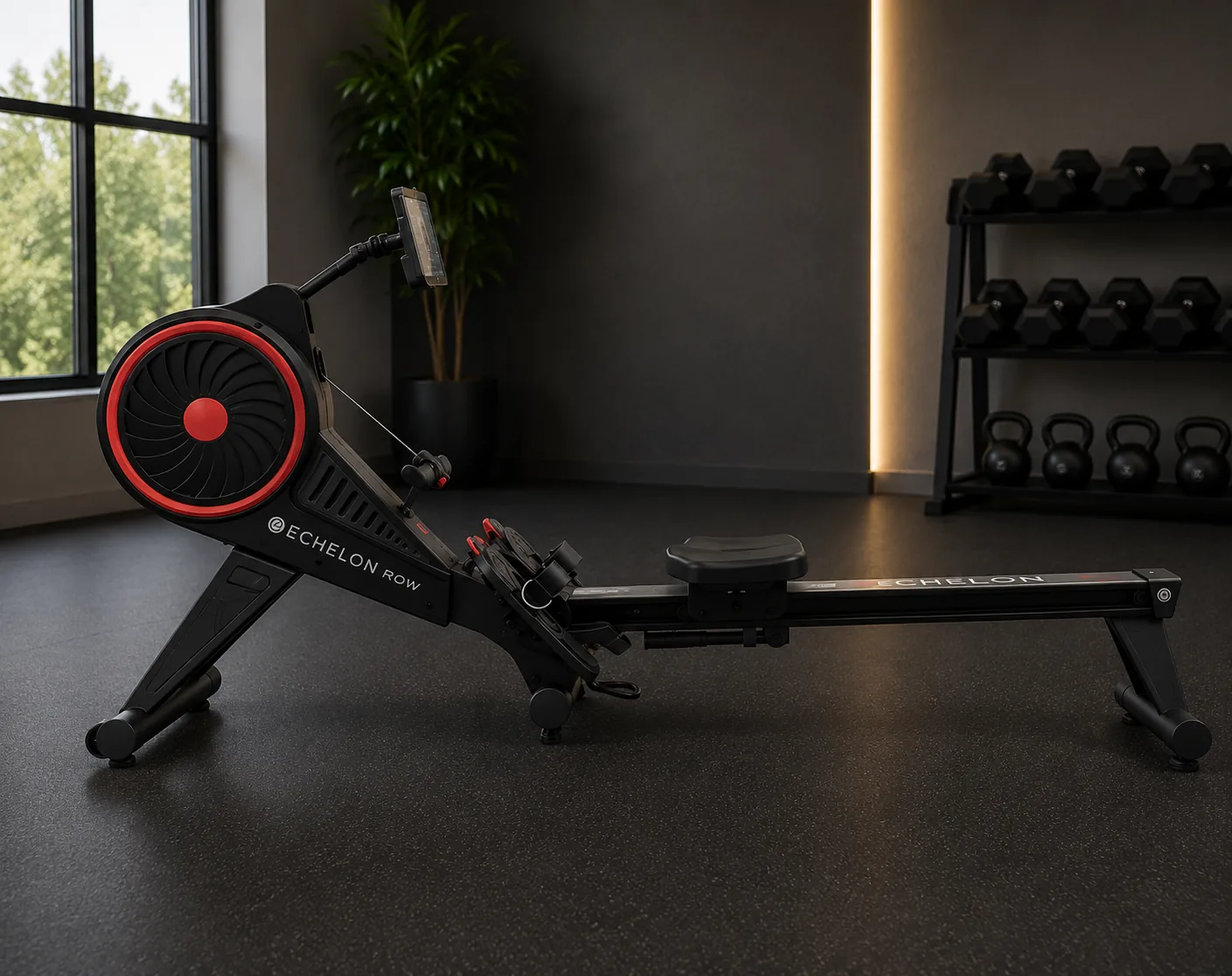
The Echelon Smart Row, sold as the Row-S, is the connected version of Echelon's rowing line. It pairs a 32-level magnetic resistance system with a large 22-inch swiveling HD touchscreen and ties the whole experience to the Echelon Fit app, which streams live and on-demand rowing classes. Like Echelon's bikes, the appeal here is less about raw rowing performance and more about a guided, screen-led workout in your living room.
It is aimed at home exercisers who value quiet operation, a foldable footprint and instructor-led motivation over the bare-bones efficiency of a traditional erg. Buyers should go in understanding that the smart features depend on an Echelon membership, and that the magnetic resistance feel differs meaningfully from the air and water machines that competitive rowers tend to prefer.
Specifications at a glance
| Resistance type | Magnetic, 32 electronic levels |
|---|---|
| Resistance control | Handlebar-mounted Bluetooth controller |
| Monitor | 22" HD swivel touchscreen (Row-S); device holder on base Row |
| Connectivity | Bluetooth, Echelon Fit app |
| Assembled dimensions | Approx. 84-85" L x 21-24" W x 45" H |
| Machine weight | Approx. 108-114 lbs |
| Max user weight | 300-350 lbs (varies by source) |
| Folding/storage | Folds for storage |
| Warranty | 1-2 yr standard; up to 5 yr with Premier membership |
| Subscription | Echelon Premier ~$39.99/mo for classes (optional) |
| Price | ~$799.99 (often discounted from higher MSRP) |
Pros
- Quiet 32-level magnetic resistance with convenient handlebar-mounted adjustment
- Large 22-inch swiveling HD touchscreen for immersive class-based workouts
- Folds for storage, making it manageable in apartments and shared spaces
- Generous weight capacity (up to 350 lbs on some listings) and a cushioned, adjustable seat
Cons
- The connected experience leans heavily on a paid Echelon subscription to be worthwhile
- Magnetic resistance lacks the dynamic, stroke-matched feel of air or water rowers
- Plastic shrouding around the internals undercuts the otherwise sturdy frame
- Specifications and warranty terms vary across listings, and full MSRP pricing is high
Best for: Home exercisers who want a quiet, foldable rower with guided on-screen classes and don't mind paying for an ongoing membership.
What the Row-S actually is (and isn't)
It helps to be precise about which machine you are buying, because Echelon sells a confusing family of rowers under similar names. The Smart Row, often listed as the Row-S, is the touchscreen flagship: a magnetic rower built around a 22-inch swiveling HD display and a soundbar, designed to drop you straight into Echelon's class library without reaching for your own tablet. The cheaper base Row (around a thousand dollars) ships without that screen and expects you to mount a phone. The Row-S commands roughly an extra nine hundred dollars for the integrated display, which is the single biggest decision point in the whole purchase.
That framing matters because the Row-S is fundamentally a content-delivery device with a rowing machine attached, not a serious erg with a screen bolted on. The hardware is competent and quiet, but its reason to exist is the studio-class experience on that big panel. If you are not going to use the classes, you are paying a steep premium for a screen you will largely ignore.
Resistance and feel: smooth and silent, but not a true rowing stroke
The 32-level magnetic system is the Row-S's most consistently praised hardware trait. Reviewers and owners repeatedly describe it as near-silent even at the top of the range, which is genuinely valuable in an apartment, a shared room, or anywhere a roaring air flywheel would be a problem. The handlebar-mounted resistance buttons are a nice touch, letting you bump levels mid-stroke without breaking rhythm, and they pair well with the way instructors call out resistance changes during classes.
What magnetic resistance cannot do is replicate the dynamic, effort-matched feel of air or water. On a Concept2 or a water rower, pulling harder is met with proportionally more resistance, which is what makes the stroke feel like rowing. On the Row-S, each level is a fixed setting, so the catch and drive feel more like a smooth machine than a boat in the water. For class-based interval work this is perfectly fine, and most subscription-minded buyers will never notice. But if you came from on-water rowing or you care about authentic stroke mechanics, the feel will read as artificial, and no amount of screen polish changes that.
The subscription is the product, and that is the catch
This is where the Row-S earns its caveats. The connected experience leans almost entirely on Echelon's paid membership (commonly cited around forty dollars a month for the Premier tier). Without it you still get the 32 levels of resistance, but the immersive class content that justifies the screen disappears, and owners report that even basic metrics like distance, splits, and resistance level can be gated or unreliable outside the subscription. Buying the touchscreen model and then not paying monthly is close to self-defeating.
Two things deepen the lock-in. First, the extended five-year warranty that makes Echelon look competitive is tied to maintaining the subscription; the standalone warranty is a thin twelve months. So the moment you stop paying, you also lose your long-term coverage. Second, the recurring complaint across owner forums and review aggregators is not the price of the membership but the reliability of the software around it: a glitchy app, confusing live-versus-on-demand navigation, occasional connection failures, and customer service that scores poorly (Echelon sits near 1.7 stars on Trustpilot, driven largely by support and cancellation friction). When the whole value proposition routes through software and that software is the weak link, it is a real risk worth pricing in.
Build, comfort, and storage: the practical wins
On the physical side the Row-S does most things right for its intended buyer. The frame is sturdy, the seat is cushioned and contoured, the foot straps grip well, and the generous weight capacity (up to 350 pounds on some listings) makes it usable for a wide range of bodies. Owners single out comfort and quiet as the day-to-day strengths.
The folding design is the standout. The footprint collapses dramatically when stored, roughly to the size of a coffee table, and transport wheels make it easy to roll out of the way. For the apartment-and-shared-space crowd this is arguably the second-best reason to buy after the classes. The honest blemish is the plastic shrouding around the internals, which undercuts the otherwise solid feel and is the kind of thing that can rattle or age less gracefully than the metal frame it surrounds. It is a cosmetic-and-confidence issue more than a structural one, but at this price it stands out.
Echelon Row-S versus the obvious alternatives
The two machines that should give any Row-S buyer pause are the Concept2 RowErg and the Hydrow. They bracket the Row-S from opposite directions. The Concept2 (around a thousand dollars) is the value and longevity king: air resistance with an authentic stroke, the bulletproof PM5 monitor with real performance data, no mandatory subscription, and a reputation for lasting a decade-plus in commercial gyms. It has no big screen and no glossy classes, so if you want guided, instructor-led workouts you will be propping up a tablet. But for pure training, durability, and total cost of ownership, the Concept2 wins decisively and is the machine to buy if performance and independence from a subscription matter to you.
Hydrow attacks from above. It costs more, but it is widely regarded as the stronger connected experience: electromagnetic resistance that more convincingly mimics on-water feel, more cinematic production, and a more polished platform. Against both, the Row-S's pitch is that it is the cheaper way into a touchscreen class rower than Hydrow while offering more immersion than a bare Concept2. That is a real, defensible niche, but it is a middle position. You are accepting magnetic feel that is less authentic than either rival's strengths, and software that is less reliable than Hydrow's, in exchange for a lower entry price than Hydrow and a built-in screen the Concept2 lacks.
Our take
Buy the Echelon Smart Row (Row-S) if you are a subscription-minded home user who genuinely wants instructor-led, leaderboard-style rowing on a big screen, you value near-silent operation and easy folding for a small space, and you intend to keep paying the membership for the foreseeable future. For that exact person, it is a comfortable, quiet, space-friendly machine that makes cardio feel less like a chore, and the lower price than Hydrow is a fair trade.
Skip it if any of these describe you: you want real rowing data and authentic stroke feel (get the Concept2 RowErg), you resent recurring fees or expect the machine to be fully useful without one (the subscription gates both classes and your long warranty, and the app reliability is a known sore spot), or you are chasing the best connected experience regardless of price (Hydrow does it better). Above all, do not buy the screen-equipped Row-S and then plan to cancel the membership; at that point you have overpaid for a quiet folding rower whose best features are switched off. Our 3.4 out of 5 reflects exactly this split: good, likable hardware tethered to a paid ecosystem and shaky software that you have to fully commit to for the math to work.
Our verdict
The Echelon Smart Row (Row-S) is a likable piece of hardware wrapped around a demanding business model. The magnetic resistance is impressively quiet, the seat is comfortable, the folding design is genuinely apartment-friendly, and the 22-inch swiveling screen makes class-based rowing immersive. But almost everything that justifies the Row-S's premium over the base Row, and over a Concept2, lives inside a paid subscription that also happens to gate your long-term warranty, and the software running that experience is the most consistently criticized part of the whole package. This is a machine you have to fully buy into to enjoy.
Our recommendation is narrow but clear. If you want guided, screen-led rowing in a small space and you are happy paying monthly indefinitely, the Row-S is a reasonable, cheaper-than-Hydrow way to get it. If you care about authentic stroke feel, real training data, or independence from a subscription, buy a Concept2 RowErg instead; if you want the best connected experience and can spend more, look at Hydrow. The 3.4 out of 5 is earned: good bones, real convenience, but tethered to an ecosystem and a software experience that ask for more trust than they have yet earned.
Frequently asked questions
- Do I have to pay for a subscription to use the Echelon Row-S?
- You can row without a membership and the 32 magnetic resistance levels still work, but the entire reason to buy the touchscreen Row-S, the live and on-demand classes, is locked behind the paid Premier membership (commonly around forty dollars a month). Owners also report that some metrics can be limited or unreliable without it, and the extended five-year warranty is tied to keeping the subscription active. Practically, the Row-S only makes sense if you plan to pay monthly.
- What is the difference between the Echelon Row and the Row-S?
- The base Echelon Row (around a thousand dollars) has no built-in display and expects you to mount your own phone or tablet to follow classes. The Row-S adds the integrated 22-inch swiveling HD touchscreen and soundbar for roughly nine hundred dollars more. The rowing hardware is broadly similar, so the premium is almost entirely for the screen and the all-in-one experience.
- How does the Row-S compare to the Concept2 RowErg?
- They serve different buyers. The Concept2 is cheaper, lasts longer, has an authentic air-resistance stroke, includes the PM5 monitor with real performance data, and needs no subscription, but it has no screen or built-in classes. The Row-S is quieter, folds smaller, and offers instructor-led touchscreen workouts, but its magnetic feel is less authentic and it depends on a paid app. Choose Concept2 for training and value, Row-S for guided class motivation.
- Is the magnetic resistance good enough for serious training?
- For interval and class-style fitness work, yes, the 32 levels and handlebar controls are plenty. For dedicated rowing training, the fixed magnetic levels do not match effort the way air or water resistance does, so the stroke feels less like real rowing and the data depth trails a Concept2. Performance rowers will likely find it limiting; general fitness users probably will not.
- What are the most common complaints from Row-S owners?
- The recurring themes are software reliability (a glitchy app, confusing navigation, occasional connection problems), heavy reliance on the paid subscription, poorly rated customer service and cancellation friction, a short twelve-month base warranty, and plastic shrouding around the internals that feels cheap relative to the frame. The hardware itself is generally liked; the ecosystem around it draws the criticism.
References
- Echelon Row-s Smart Rowing Machine (official product page) - Echelon Fitness
- Echelon Row Review (2026) - BarBend
- Echelon Row-s Connected Rowing Machine - Garage Gym Reviews
Jordan Lockwood (BSc, CPT)
Certified personal trainer (CPT), sports-science graduate, and lifelong rower. Jordan writes and reviews every guide on Rowing Machine Nerd.