 Rowing Machine Nerd
BodyCraft VR500 Pro Review
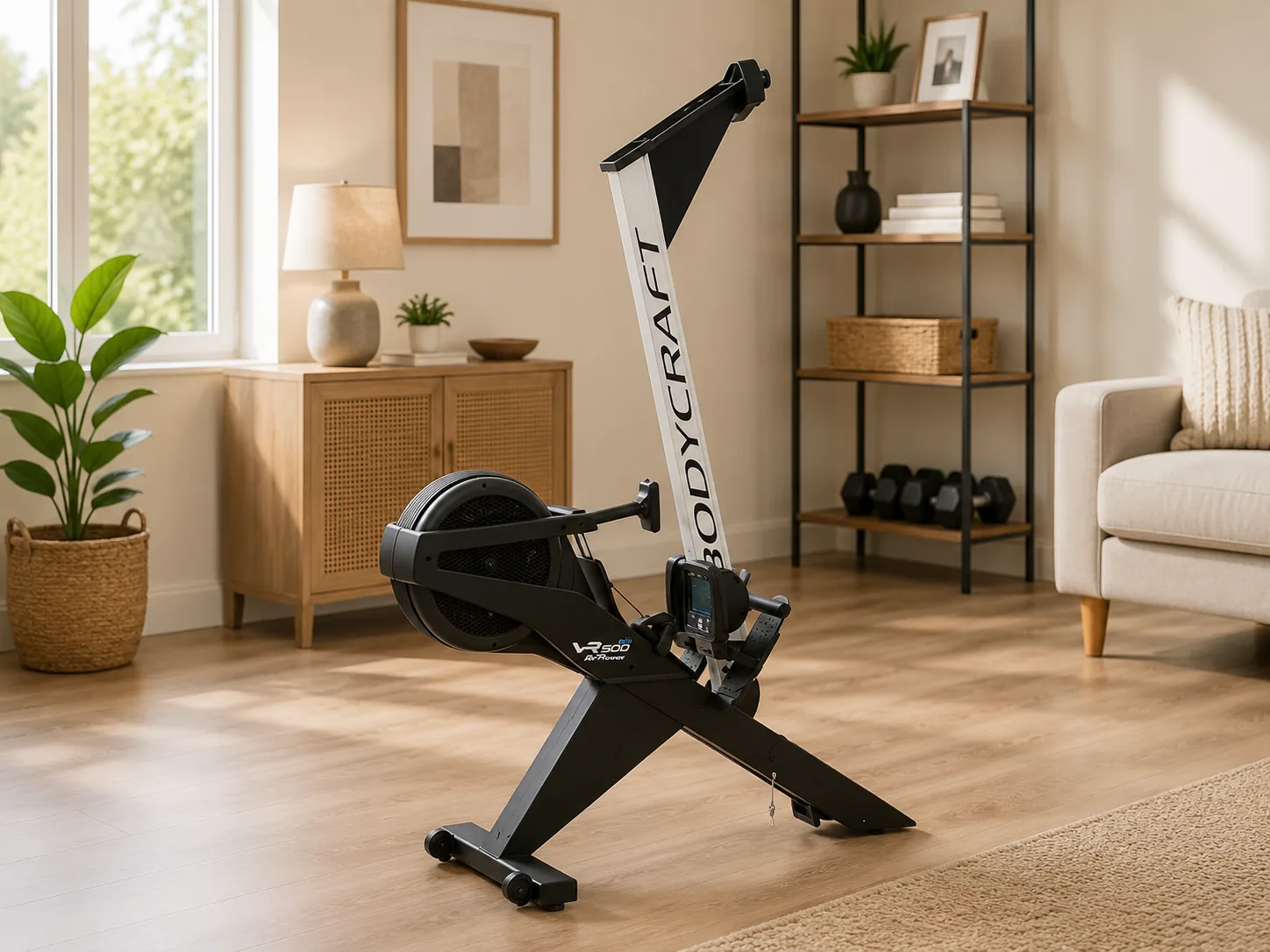
Air + magnetic rower · ~$1,799
BodyCraft VR500 Pro
A well-built air-plus-magnetic rower with 32 electronic levels and a strong warranty, but priced well above the Concept2 benchmark.

How we review
Every rower is scored on the same six weighted criteria - resistance & feel, build, monitor, comfort, footprint, and value - from verified specifications, expert consensus, and aggregated long-term owner feedback. Our reviews are independent: we never accept payment for placement or a higher score. Reviewed by Jordan Lockwood (BSc, CPT). See our full methodology.
The BodyCraft VR500 Pro is a premium home and light-commercial rower that pairs an air flywheel with eddy-current magnetic resistance, a combination that is relatively rare in this segment. Where most rowers commit to a single resistance type, the VR500 layers magnetic control on top of air so the resistance can be dialed electronically through 32 levels rather than simply rising with stroke speed. The result is a machine aimed at users who want repeatable, programmable workouts rather than the variable, wind-driven feel of a pure air rower.
It sits firmly in the upper price tier, typically selling between roughly $1,500 and $1,999 depending on retailer and configuration. That places it in direct competition with the widely recommended Concept2 RowErg, which costs far less, so the VR500 needs its dual-resistance design, programmability and warranty to justify the gap. This research-based assessment looks at how it stacks up on feel, build, monitor, comfort, footprint and value.
Specifications at a glance
| Resistance type | Air + magnetic (eddy current), 32 electronic levels |
|---|---|
| Console | Backlit LCD on adjustable pivoting arm |
| Metrics shown | Time, distance, calories, watts, SPM, strokes, meters, level, pulse |
| Programs | 12 profiles incl. race, interval, heart-rate control; manual and custom |
| Connectivity | Bluetooth FTMS; optional Connect-22 Android touchscreen |
| Assembled dimensions | 98.5" L x 20" W x 38.5" H |
| Folded dimensions | 58.5" L x 20" W x 77" H |
| Machine weight | 101 lbs |
| Max user weight | 350 lbs |
| Max user height | Up to 6'8" |
| Drive | Premium nylon belt rated 580 lb / 500,000 reps |
| Folding | Fold-and-roll with safety child lock |
| Warranty | Lifetime frame, 7-yr parts, 2-yr labor, 1-yr wear (residential) |
| Street price | ~$1,500-$1,999 |
Pros
- Air + magnetic resistance gives a smooth, adjustable stroke with 32 electronic levels
- Robust build: aluminum mono-rail, steel legs, lifetime frame warranty and 350 lb capacity
- Handlebar-mounted resistance control lets you change levels mid-stroke
- Comprehensive program set (race, interval, heart-rate control) with no subscription required
- Comfortable contoured seat and adjustable footrests, plus fold-and-roll storage
Cons
- Expensive relative to the gold-standard Concept2 RowErg
- LCD console is functional but dated next to app-driven touchscreen rivals
- True app/streaming experience requires the costly optional Connect-22 tablet
- Long (98.5") footprint and a tall 77" folded profile still demand real space
Best for: Home users who specifically want the combined air-and-magnetic feel with adjustable electronic resistance and a long warranty, and don't mind paying a premium for it.
Resistance and feel: the dual system is the whole point
The VR500 Pro pairs a fan with an eddy-current magnetic brake, and the 32 electronic levels are what justify its existence. At low settings the air fan does most of the work, and as you climb the dial the magnet steps in to add load that air alone could not provide. The practical result owners describe is a stroke that feels smoother and more consistent than a pure air rower, with less of the soft, easing-in feel at the catch and a heavier, more controllable pull at the top end.
Whether that consistency is a feature or a flaw depends on what you want from a rower. Air purists value the way fan resistance scales with how hard you yank the handle; the harder you pull, the more it pushes back, which feels alive and self-correcting. The VR500's magnetic component flattens some of that dynamic response in exchange for a setting you can dial in precisely and repeat. For steady-state cardio, mixed-ability households, or anyone who finds raw air rowers harsh, the trade is worth it. For someone chasing the classic erg feel, it is a different animal.
The handlebar-mounted level control is the underrated highlight here. Being able to bump resistance up or down mid-stroke, without breaking rhythm or reaching for a damper, is genuinely useful for intervals and is something the Concept2 simply does not offer.
The monitor is the weak link, and you should price that in
The base console is a backlit LCD that tracks the usual time, distance, calories, strokes per minute, watts and split data, and it ships with a deep program set: auto resistance profiles, interval, race and heart-rate-control modes, plus user profiles, all with no subscription. On paper that is more onboard programming than a Concept2 gives you out of the box.
In daily use, though, the console is the part that feels its age. It is functional but dated next to the app-driven touchscreens on connected rowers, and reviewers are blunt that its data is not in the same league as the Concept2 PM5 for accuracy or trust. There is no native way to pull workouts into third-party apps or race other people online. If you want a real streaming and app experience, you are buying the optional Connect-22 Android tablet, which pushes an already premium machine toward the $2,500 range. That is a meaningful asterisk on the otherwise appealing no-subscription pitch.
Build, comfort and the space it demands
This is where the VR500 earns its keep. The T13 aluminum I-beam mono-rail, steel legs, 350 lb capacity and lifetime frame coverage on the residential warranty signal a machine built to outlast its electronics. The belt drive runs quieter than a chain, and owners consistently report it is quiet enough to use near a TV or in a shared room despite the air component. The contoured seat draws repeated praise for letting people row longer without the lower-back fatigue that plagues thinner seats, and the adjustable heel rests with quick foot straps fit a wide range of users, up to roughly 6 foot 8.
The catch is footprint. At 98.5 inches long this is a big machine, and folding it does not so much save floor space as trade it for height: the folded profile stands around 77 inches tall. Plan for a dedicated spot or a room with ceiling clearance. Also budget time and patience for assembly, which several owners describe as fiddly and on the longer side, and note that a heart-rate chest strap is not included despite the price.
Value: you are paying a comfort-and-build premium
At around $1,799 the VR500 Pro sits roughly $700 to $900 above a Concept2 RowErg, and there is no getting around that gap. What the extra money buys is tangible: a heavier, more commercial-grade frame, a plusher seat, electronically adjustable dual resistance you can change from the handle, and a stronger frame warranty. What it does not buy is a better monitor, app ecosystem or resale value, the three areas where Concept2 quietly dominates.
So the value case is narrow but real. If the things you care about are comfort, quiet operation, adjustable resistance and a tank-like build, the premium is defensible. If you care about data fidelity, online racing, app compatibility or simply getting the most rowing per dollar, the premium is hard to justify and the machine starts to look overpriced for what the console delivers.
How it compares to the Concept2 RowErg
The Concept2 RowErg is the inescapable benchmark, and the honest summary is that it out-points the VR500 on the metrics serious rowers obsess over while losing on the ones casual home users actually feel. The RowErg's PM5 monitor is the gold standard for accuracy, logbook integration and online racing, it is the machine used in competition, and it costs hundreds less. Its resale value is famously strong. If you ever want to compare splits with the rowing world or train against a verified standard, it is the only real answer.
The VR500 counters with comfort and convenience rather than data. Its seat is more forgiving for long sessions, the belt drive is a touch quieter than the RowErg's chain, and the handlebar resistance control plus dual air-magnetic system give it a smoother, more adjustable stroke that some users genuinely prefer. The RowErg's single fan and damper are simpler and more honest, but they ask more of the user. Put simply: buy the Concept2 if you are a data-driven or competitive rower, and consider the VR500 if you are a comfort-driven home user who will pay extra to enjoy the sit.
Our take
The VR500 Pro is a genuinely good rower carrying a price that only some buyers should pay. Buy it if you want a commercial-grade, quiet, supremely comfortable machine for steady home training, if the handlebar-controlled dual resistance appeals to you, and if a dated but capable LCD console plus a lifetime frame warranty matter more to you than competition-grade data. Households where multiple people of different fitness levels share one rower are a particularly good fit, thanks to the precise, repeatable resistance levels.
Skip it if your priorities are data accuracy, online racing, app integration or maximum value per dollar; in those cases the Concept2 RowErg is the smarter, cheaper choice. Also think twice if floor space or ceiling height is tight, or if you assumed app streaming was included, since that really requires the costly Connect-22 add-on. At 3.7 out of 5, this is a strong machine held back from a higher score by its price relative to the benchmark and a console that has not kept pace with the market.
Our verdict
The BodyCraft VR500 Pro is a well-built, quiet and unusually comfortable rower whose biggest enemy is its own price tag. The dual air-plus-magnetic system with 32 electronic levels and handlebar control gives it a smooth, precisely adjustable stroke that many home users will prefer to a raw air erg, and the commercial-grade aluminum mono-rail, 350 lb capacity and lifetime frame warranty back up the premium feel. The seat alone will win over anyone who has suffered through long sessions on a thinner pad.
But at around $1,799 it sits well above the Concept2 RowErg while trailing it on the things competitive and data-minded rowers care about: monitor accuracy, app integration, online racing and resale value. Add a dated console and a real app experience locked behind the costly Connect-22 tablet, and the value case narrows. Buy it if comfort, quiet and build quality top your list and you will pay for them; choose the Concept2 if you want the benchmark monitor and more rowing per dollar. A solid 3.7 out of 5 - excellent hardware, priced ahead of what its electronics deliver.
Frequently asked questions
- Is the BodyCraft VR500 Pro worth it over a Concept2 RowErg?
- Only for specific buyers. The VR500 is roughly $700 to $900 more and does not match the Concept2's monitor accuracy, app ecosystem or resale value. It is worth the premium if you specifically want a plusher seat, quieter belt drive, a heavier commercial-grade frame and adjustable air-plus-magnetic resistance you can change from the handle. For data, racing or value, the Concept2 wins.
- Do I need the Connect-22 tablet to use the VR500?
- No. The machine works fully on its built-in LCD console with a complete set of onboard programs and no subscription. The optional Connect-22 Android touchscreen is what adds app streaming, virtual rowing and coaching video, and it pushes the total cost toward $2,500. If you want a touchscreen and app experience, budget for it; if you just want to row, the base console covers the essentials.
- How quiet is the VR500 Pro?
- Quieter than most pure air rowers. Because it is belt-driven and uses magnetic resistance alongside the fan, owners consistently say it is quiet enough to watch TV or hold a conversation while rowing. There is still some fan noise, so it is not silent, but it is reasonable for an apartment or shared room.
- How much space does it need?
- A lot. It is 98.5 inches long in use, so it needs a dedicated stretch of floor. Folding it does not shrink the floor footprint dramatically; instead it stands roughly 77 inches tall, so you also need ceiling clearance for storage. It rolls on front transport wheels once folded.
- Does it come with a heart rate monitor?
- No. Despite the premium price, the chest strap is not included, even though the console supports heart-rate-control programs. You will need to buy a compatible strap separately to use those modes, which several owners flag as a disappointing omission at this price.
References
- VR500 Pro Rowing Machine - BodyCraft (manufacturer)
- BodyCraft VR500 Rower - Garage Gym Reviews
- BodyCraft VR500 Rowing Machine Review - Rowing Machine King
Jordan Lockwood (BSc, CPT)
Certified personal trainer (CPT), sports-science graduate, and lifelong rower. Jordan writes and reviews every guide on Rowing Machine Nerd.