 Rowing Machine Nerd
Kettler R220 Review
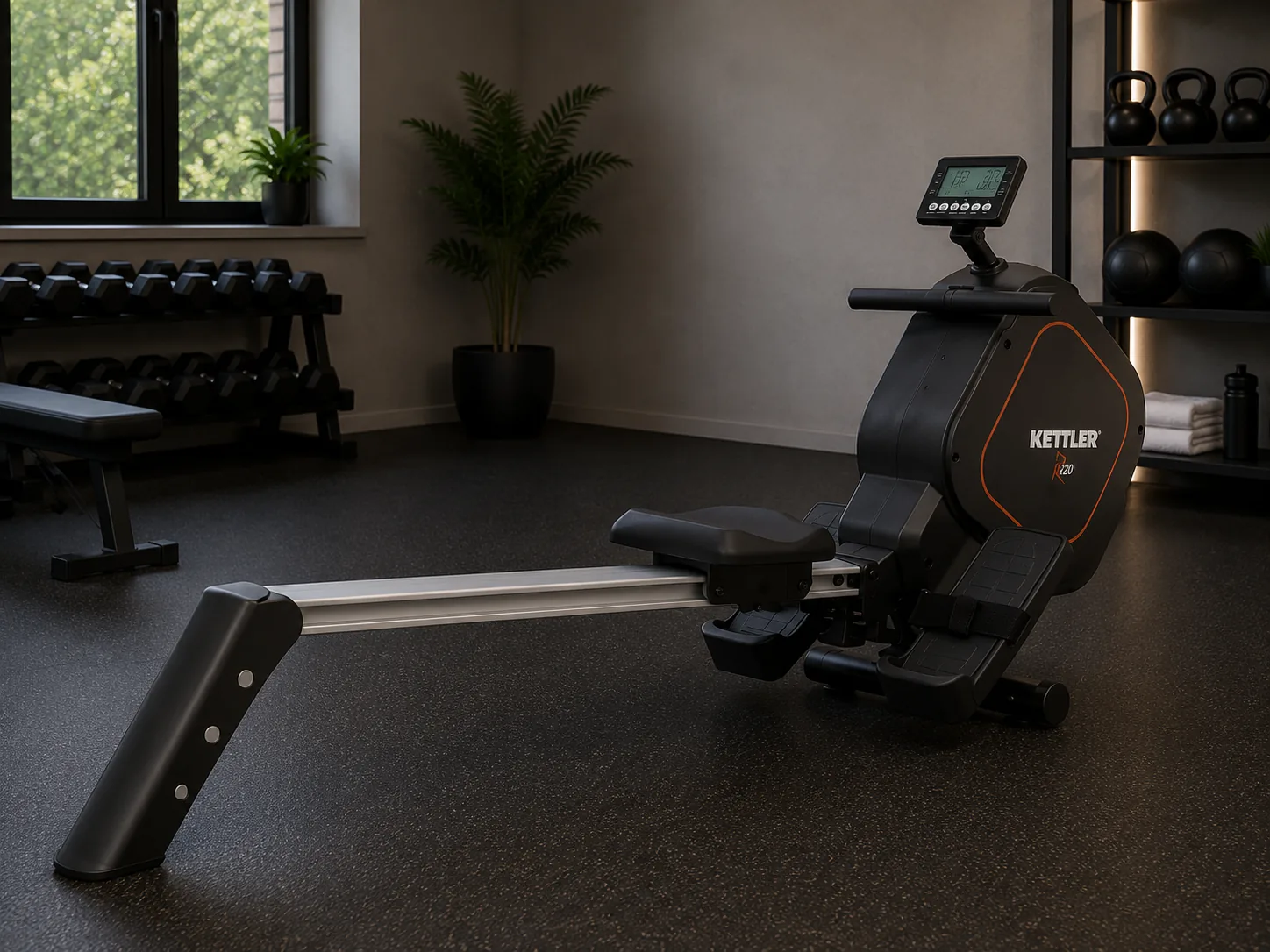
Magnetic rower · ~$500 (often discontinued)
Kettler R220
A quiet, folding magnetic rower with motorized 16-level resistance and 18 programs, but no app support and a rail that's cramped for taller users.

How we review
Every rower is scored on the same six weighted criteria - resistance & feel, build, monitor, comfort, footprint, and value - from verified specifications, expert consensus, and aggregated long-term owner feedback. Our reviews are independent: we never accept payment for placement or a higher score. Reviewed by Jordan Lockwood (BSc, CPT). See our full methodology.
The Kettler R220 is a programmable magnetic rowing machine aimed at the home-fitness market, built around a motor-adjusted resistance system with 16 levels and an LCD console offering 18 workout programs. Kettler positioned it as a quiet, low-maintenance alternative to air and water rowers, with a folding frame and transport wheels for buyers who need to store the machine between sessions. It is a budget-to-mid-range product rather than a performance trainer.
It suits someone who values quiet operation and structured, console-driven workouts over the authentic feel and competitive metrics that draw athletes to machines like the Concept2. Notably, the R220's resistance is motorized and adjusted only from the console, so the unit must be plugged in to function. It has been largely discontinued, so availability is now limited to remaining stock and the secondhand market.
Specifications at a glance
| Resistance type | Magnetic, 16 motor-adjusted levels (requires AC power) |
|---|---|
| Monitor | LCD console; 18 programs |
| Metrics shown | Time, strokes, strokes/min, distance, 500m pace, resistance level, heart rate, calories |
| App / Bluetooth | Not specified (no app connectivity; Polar HR-strap compatible, strap not included) |
| Assembled dimensions | 70.5 in L x 20.5 in W x 31.5 in H |
| Machine weight | 81 lb |
| Max user weight | 245 lb |
| Folding / storage | Folding frame with transport wheels |
| Warranty | Lifetime frame, 1 year parts |
Pros
- Quiet, smooth magnetic resistance suitable for apartments and shared living spaces
- 16 selectable resistance levels plus 18 onboard programs give structure without an app
- Folding frame and transport wheels make storage in tight spaces practical
- Lifetime frame warranty reflects Kettler's traditionally solid build quality
- Console shows useful metrics including a 500m pace readout and heart-rate support
Cons
- Motorized resistance must be plugged into AC power and can only be changed from the console
- Magnetic system does not replicate the dynamic catch and feel of air or water rowers
- No Bluetooth or app connectivity for syncing workouts or third-party apps
- Short rail is cramped for users over roughly 6 feet tall
- Now largely discontinued and hard to buy new, with limited parts support
Best for: Shorter-statured home users who want a quiet, programmable magnetic rower for light-to-moderate cardio and don't need app connectivity.
Resistance and feel: smooth and silent, but emotionally flat
The R220's selling point is also its ceiling. The motorized magnetic brake is genuinely quiet, close to silent, which is the single best reason to own this machine. If you row early in the morning in a thin-walled apartment or next to a sleeping baby, that matters more than any spec sheet, and the R220 delivers it better than almost any air rower can.
The trade-off is that the feel never changes. With magnetic resistance, each of the 16 levels is a fixed wall of effort: pull harder or faster and the load does not climb with you the way it does on an air or water rower. Owners who have rowed on a dynamic erg consistently describe the R220 as feeling mechanical rather than like moving a boat. For steady-state cardio and general fitness this is fine, but anyone chasing the responsive, build-as-you-pull sensation of real rowing will find it muted.
There is one ergonomic catch worth flagging: because the resistance is motorized, you can only change levels at the console, and the console needs to be plugged into AC power. There is no battery fallback. That rules out mid-stroke micro-adjustments and means the unit must live near an outlet.
Monitor and the missing app
The console covers the basics competently. You get time, distance, 500m pace, strokes per minute, total strokes, calories, resistance level and heart rate, plus 18 onboard programs that give your sessions some structure without needing a phone. For someone who wants to follow a preset interval or hill profile and just row, that is a reasonable amount of guidance built in.
What is conspicuously absent is any modern connectivity. There is no Bluetooth and no app, so nothing syncs to Strava, Kinomap, Apple Health or Kettler's own software. In 2018 that was a minor gap; today it is a real one, because the budget-and-mid market has largely moved to app-connected machines and the structured, gamified workouts they unlock. Note also that the heart-rate readout is telemetric only - the chest strap is Polar-compatible but is not included in the box, so budget for that separately if you care about accurate cardio zones.
Build, comfort and the tall-user problem
Kettler's reputation was built on metalwork, and the R220 reflects it: a steel-and-aluminum frame, a lifetime frame warranty, and a folding design with transport wheels that make it realistic to tuck away in a small space. Assembly is painless, with most owners finishing in 15 to 20 minutes out of the box.
Comfort is where daily-use friction shows up. The seat is padded with firm, fairly narrow foam that several owners say gets uncomfortable on longer sessions, and the footplates are fixed rather than pivoting, so they do not flex with your ankle through the stroke. The bigger structural limit is the rail. It is short, and users over roughly six feet repeatedly report running out of slide and feeling cramped at the catch. If you are tall, treat this as a likely dealbreaker rather than a quirk you will adapt to.
Value and the discontinuation question
At around $500 when it was current, the R220 was priced like a serious mid-tier rower while behaving more like a quiet apartment machine. The build quality and lifetime frame warranty argued for the price; the lack of connectivity and the cramped rail argued against it.
The harder issue now is simply buying one. Kettler's corporate history is messy - the parent went bankrupt in 2010, the fitness brand passed through Switzerland's Trisport and was acquired by the retailer Fitshop in late 2024 - and in the US the R220 is largely discontinued and hard to find new. Parts do still exist through Kettler USA and third-party specialists like fitnessrepairparts.com, but support is fragmented and you may be on your own for troubleshooting. Buying used can be reasonable if the price is right and you can inspect the motorized resistance working, but paying anything near original retail today does not make sense.
Kettler R220 versus the Concept2 RowErg
The R220's natural rival at this price is the Concept2 RowErg, and the comparison is unflattering. The RowErg uses air resistance that scales with your effort, so it actually feels like rowing; it ships with the PM5 monitor that gives you watts, accurate pace and Bluetooth/ANT+ syncing to ErgData and third-party apps; its rail comfortably fits tall rowers; and it is the de facto training standard that competitive rowers and CrossFit gyms use. It needs no wall outlet because the monitor runs on batteries.
The R220 wins on exactly one axis that the RowErg cannot match: noise. The RowErg's flywheel produces a noticeable whoosh, while the R220 is near-silent. So the decision is narrow. If silence in a shared living space is your top, non-negotiable priority and you are not tall, the R220 has a genuine reason to exist. For literally every other buyer - feel, data, durability of resale value, tall-user fit, app ecosystem - the Concept2 is the better machine and the smarter money.
Our take
Buy the Kettler R220 only if you fit a specific profile: you live somewhere noise is a hard constraint, you are under six feet, you do steady-state cardio rather than performance training, you do not care about apps, and you can find one used at a genuine bargain. For that narrow buyer it is a quiet, well-built, fold-away machine that does its job.
Everyone else should skip it. Tall rowers will be cramped, data-driven trainers will be frustrated by the lack of Bluetooth, and anyone wanting the authentic dynamic feel of rowing will be underwhelmed by the constant magnetic load. Combined with its near-discontinued status and fragmented parts support, the R220 is hard to recommend in 2026 when a Concept2 RowErg sits at a similar price and outclasses it almost everywhere. Our 2.9 out of 5 reflects a capable but dated machine that has been overtaken by its competition.
Our verdict
The Kettler R220 is a quiet, solidly built magnetic rower that solves one problem extremely well: rowing without disturbing anyone. For an apartment dweller under six feet who wants simple steady-state cardio and does not care about apps, it is a perfectly serviceable machine, and the near-silent resistance plus folding frame are real advantages. But that is a narrow profile, and almost everything else has aged poorly.
The constant, non-dynamic magnetic feel, the absence of any Bluetooth or app support, the cramped rail for taller rowers, the mandatory wall outlet, and a now-discontinued status with fragmented parts support all weigh it down. At a price where the Concept2 RowErg - with dynamic air resistance, a connected PM5 monitor and a rail that fits everyone - is within reach, the R220 is hard to justify unless silence is your single overriding requirement. We rate it 2.9 out of 5: capable, but comprehensively outclassed.
Frequently asked questions
- Does the Kettler R220 work without being plugged in?
- No. The resistance is motorized and the console requires AC power, with no battery option. The unit has to sit near an outlet, and you cannot change resistance levels without the powered console.
- Is the R220 suitable for tall users?
- Not really. The rail is short, and owners over roughly six feet consistently report running out of slide and feeling cramped at the catch. If you are tall, this is likely a dealbreaker rather than something you will adapt to.
- Can I connect the R220 to apps like Strava or Kinomap?
- No. There is no Bluetooth or app connectivity at all. You get 18 onboard programs and an LCD console showing pace, distance and heart rate, but nothing syncs to your phone or third-party fitness apps.
- Is the heart-rate monitor included?
- No. The console reads heart rate telemetrically and is Polar-compatible, but the chest strap is sold separately. Budget for one if you want accurate heart-rate zones.
- Should I buy the R220 new or used?
- It is largely discontinued and hard to buy new in the US, so used is usually the only realistic option. A used unit can make sense at a low price if you confirm the motorized resistance works, but paying near the original $500 retail does not, especially with a Concept2 RowErg available at a comparable price.
References
- Kettler R220 Programmable Magnetic Rower (product listing) - Amazon
- Kettler R220 Rowing Machine Review - Rowing Machine Guide
- Kettler R220 Programmable Magnetic Rower Review - BestFitnessEq
Jordan Lockwood (BSc, CPT)
Certified personal trainer (CPT), sports-science graduate, and lifelong rower. Jordan writes and reviews every guide on Rowing Machine Nerd.