 Rowing Machine Nerd
Fitness Reality 4000MR Review
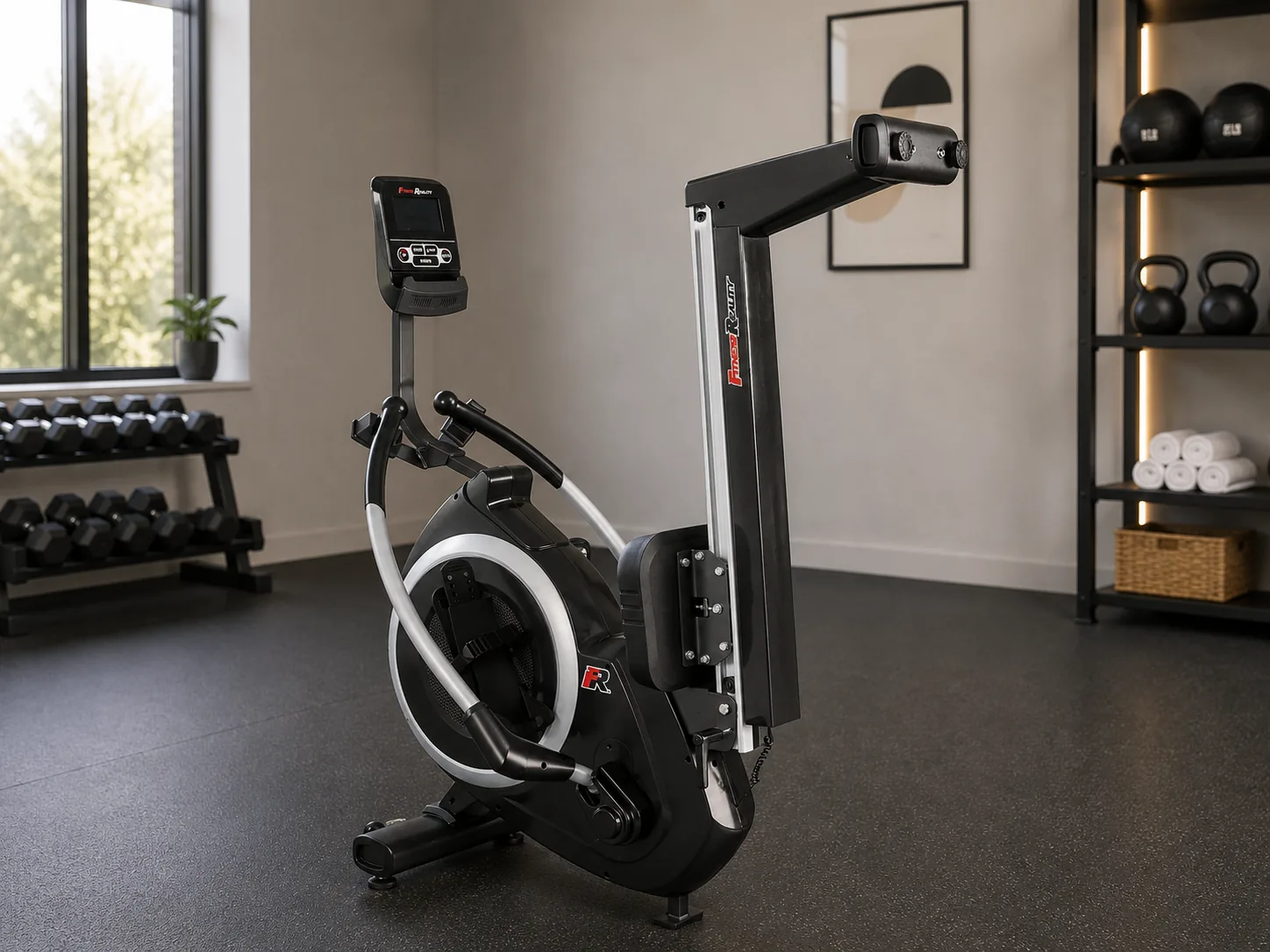
Magnetic rower · ~$349
Fitness Reality 4000MR
A sturdy mid-budget magnetic rower whose dual oar-style handles deliver an unusual sculling motion, but it skips app connectivity and stays bulky when stored.

How we review
Every rower is scored on the same six weighted criteria - resistance & feel, build, monitor, comfort, footprint, and value - from verified specifications, expert consensus, and aggregated long-term owner feedback. Our reviews are independent: we never accept payment for placement or a higher score. Reviewed by Jordan Lockwood (BSc, CPT). See our full methodology.
The Fitness Reality 4000MR is a magnetic rowing machine that sets itself apart from the typical single-handle design with two independent oar-style handles. Instead of pulling a central handle on a strap or chain, you draw two separate grips outward and back, mimicking the sculling motion of a sweep- or sculling-style boat. It uses a chain-driven, magnetically braked system with 16 selectable resistance levels and a 5-inch backlit LCD console, and it carries a 300 lb user capacity.
Priced around $349, it sits in the crowded mid-budget bracket between bare-bones hydraulic and air rowers and the connected, app-driven machines that cost two to three times as much. It is aimed at home users who want something quieter and more durable than an entry-level rower, who like the idea of a more upper-body-focused stroke, and who are not concerned about streaming classes, Bluetooth pairing, or chasing precise split times the way a Concept2 owner would.
Specifications at a glance
| Resistance type | Magnetic, 16 levels (button-controlled) |
|---|---|
| Drive system | Chain-driven, dual independent oar-style handles |
| Monitor | 5" backlit LCD; shows distance, time, count, calories, RPM, watts |
| Programs | 15 total (10 preset, 5 customizable) |
| Connectivity | Not specified (no app/Bluetooth noted); smartphone holder included |
| Heart rate | Not specified (no chest-strap support noted) |
| Assembled dimensions | 72 L x 25 W x 51-52 H in |
| Machine weight | 116.4 lb |
| Max user weight | 300 lb |
| Storage | Folds with transport wheels (still large folded) |
| Warranty | 5 yr frame / 3 yr parts / 2 yr electronics |
| Power | Requires external power adapter (included) |
Pros
- Dual independent oar handles create a sculling-style motion that engages more upper-body muscle than a single-handle rower
- Quiet magnetic resistance with 16 levels and a usefully wide range
- Sturdy build with a comfortable contoured seat and an above-average warranty for the price
- 300 lb user capacity and tall seat height suit larger and taller users (up to roughly 6'5")
Cons
- No app or Bluetooth connectivity and no chest-strap heart rate support
- Large footprint that remains bulky even when folded, plus a heavy 116 lb frame
- The dual-oar motion is unconventional and does not replicate a Concept2-style single-handle stroke
- Requires an external power outlet to operate
Best for: Home users who want a quiet, sturdy magnetic rower with a distinctive dual-oar motion and don't need app connectivity or competition-style metrics.
The sculling motion is the whole pitch - and it is genuinely different
The dual independent oar handles are what set this rower apart from nearly everything else under $400, and they are not a gimmick. Because each oar moves on its own arc rather than being yoked to a single fixed bar, the stroke recruits more of the upper back, rear delts and arms, and several owners who have logged years on a Concept2 at the gym say they actually prefer the fuller, sweeping feel here. If you rowed crew or sculled on water, the muscle memory will click immediately.
The flip side is that this motion does not transfer to standard erg technique. A Concept2-style stroke is a single linear drive with a strict legs-core-arms sequence, and that is the movement competitive rowing, CrossFit benchmarks and most rowing classes are built around. The 4000MR teaches a different pattern. For general fitness and upper-body engagement that is fine, even a plus, but if your goal is to train for on-water sculling form or to benchmark against erg times, this is the wrong tool.
Magnetic resistance is quiet and broad, but watch the resistance ceiling
Sixteen levels of eddy-current magnetic resistance give this rower an unusually wide and quiet range for the price, with noticeable steps between settings and near-silent operation thanks to the chain-driven mechanism and ball-bearing seat rollers. That quietness is a real selling point if you row early mornings in an apartment or next to a sleeping household. The console-button resistance adjustment is also more convenient than the manual tension knobs on cheaper rowers.
Magnetic resistance behaves differently from air, though: it does not ramp up the harder you pull. Strong, heavy rowers chasing a true high-intensity power ceiling may find even level 16 tops out below what an air rower or a serious erg delivers under an explosive drive. For interval cardio, weight loss and steady-state work it is more than enough; for a competitive athlete who wants resistance that scales infinitely with effort, it will feel capped.
A basic but readable monitor - and a deliberate skip on connectivity
The 5-inch backlit LCD covers the fundamentals well: time, distance, stroke count, calories, RPM and watts, plus 10 preset and 5 customizable programs and a phone shelf. It is clear and legible, and the watts readout is more than many budget rowers bother to show. For someone who just wants honest feedback on their session, it does the job.
What it pointedly lacks is any app or Bluetooth connectivity and any chest-strap heart rate support, which is the single biggest reason this machine sits where it does on our scale. There is no Kinomap, no ErgData-style logging, no automatic workout history beyond what the screen shows in the moment. The phone holder is just a shelf, not an integration. If you are the type who lives in a fitness app, syncs to Strava or wants guided on-screen rowing classes, you will outgrow this console fast and should look at a connected rower instead.
Built like a tank, but plan your floor space and your assembly
At roughly 116 lb the 4000MR is reassuringly solid; owners consistently describe it as rock-steady with no wobble mid-stroke, and the contoured seat sitting about 22 inches off the floor genuinely suits taller and larger users up to around 6'5" with a 300 lb capacity. The above-average warranty (commonly 5 years frame, 3 years parts, 2 years electronics) backs up the build claim. This is not a flimsy rower.
The trade-offs are real, though. The footprint is large at roughly 72 inches long, and folding it does not shrink it nearly as much as a Concept2 that separates into two pieces - it stays bulky and that 116 lb mass makes repositioning a chore even with the transport wheels. Assembly runs close to an hour or two and is much easier with two people. One recurring owner tip worth heeding: after folding, make sure the rail pin is fully tightened before rowing again, or the frame can rock.
Quality control is the wildcard
The most important thing a prospective buyer should know is that owner experiences are bimodal. When the unit arrives right, people are delighted - smooth, quiet, sturdy, better-than-expected. But there is a recurring thread of quality-control complaints: resistance that fails to engage on or shortly after assembly, scraping or grinding noises, vibration felt through the arms, and reports of weak chains or damaged wiring out of the box. Several owners also mention slow or unresponsive customer service and even missing manuals.
None of this is universal, and a working unit can last for years, but it means you should buy from a retailer with an easy return path and test the resistance and full range of motion thoroughly within your return window. Treat the warranty as a backstop, not a guarantee of painless support.
Versus the Concept2 RowErg, the obvious alternative
The Concept2 RowErg is the default recommendation in this category for good reason: air resistance that scales infinitely with effort, a near-bulletproof reputation with units running a decade-plus in commercial gyms, the PM5 monitor with Bluetooth, ANT+ and the ErgData ecosystem, and a frame that splits in two for genuinely compact storage. It is the benchmark for technique, data and longevity.
The catch is price and feel. The RowErg runs meaningfully more than the 4000MR's roughly $349, it is louder under air resistance, and its single-handle stroke is the opposite of what the 4000MR is selling. So the comparison really comes down to priorities. Want proven durability, real data, app connectivity and resale value, and willing to pay for it? Buy the Concept2. Specifically want the wider, oar-style sculling motion, quiet magnetic resistance and a lower entry price, and you do not care about apps? That is the narrow lane where the 4000MR makes sense.
Our take
Buy the Fitness Reality 4000MR if the dual-oar sculling motion is the specific thing you want - a former rower who misses the feel of oars, or someone who simply prefers a wider upper-body stroke and values quiet magnetic resistance in a shared living space. Taller and heavier users are also well served by the high seat, 300 lb capacity and genuinely sturdy frame, and the warranty is better than most rivals at this price.
Skip it if you want app connectivity, heart-rate integration, on-screen classes or any kind of synced workout history - it offers none of that. Skip it too if you are training toward Concept2-style erg performance, if floor space is tight (it stays bulky folded and is heavy to move), or if you cannot tolerate the risk of a quality-control dud and a return process. At 3.1 out of 5 this is a capable, well-built niche machine for the right buyer, not an all-rounder, and most people shopping a rower at this price will be happier saving up for a Concept2.
Our verdict
The Fitness Reality 4000MR is a one-trick rower, but it is a good trick if it is the one you want. The dual independent oars deliver a genuine sculling-style motion that works the upper body harder than a single handle, the magnetic resistance is quiet and broad, and the frame is sturdy enough to flatter tall and heavier users while undercutting the obvious alternative on price. For a former rower or anyone who specifically craves that oar feel in a quiet home setup, it earns its keep.
For everyone else the caveats stack up. There is no app, no Bluetooth and no heart rate support, it stays bulky and heavy even folded, it must be plugged in, its stroke will not train you for Concept2-style erging, and quality control is a real gamble. At roughly $349 and our 3.1 out of 5 rating, it is a capable niche pick rather than a confident recommendation - most buyers shopping this price will get more long-term satisfaction stretching to a Concept2 RowErg, and only those sold on the sculling motion should choose the 4000MR over it.
Frequently asked questions
- Does the Fitness Reality 4000MR connect to apps or track heart rate?
- No. It has no Bluetooth, no app connectivity and no chest-strap heart rate support. The 5-inch console shows time, distance, strokes, calories, RPM and watts in the moment, but it does not sync to Strava, Kinomap or any fitness app, and the phone holder is just a shelf. If app integration matters to you, this is the wrong rower.
- How is the dual-oar motion different from a normal rower or a Concept2?
- Each oar moves independently on its own arc, mimicking sculling on water and engaging more of the upper back and arms than a single fixed handle. Some owners who trained on a Concept2 actually prefer it. The downside is it does not replicate a standard linear erg stroke, so it will not prepare you for on-water erg technique or Concept2-based benchmark workouts.
- Does it need to be plugged in?
- Yes. The magnetic eddy-current resistance system and console require an external power outlet to operate, so you cannot use it untethered. Plan placement near a wall socket, unlike a Concept2 RowErg, which runs its monitor on batteries and needs no power for resistance.
- Is it good for tall or heavier users?
- Yes, this is one of its strengths. It has a 300 lb user capacity, a sturdy 116 lb frame, and a seat that sits about 22 inches off the floor, which comfortably suits taller users up to roughly 6'5". The contoured seat is well padded for longer sessions.
- How reliable is it, and what should I check on arrival?
- Build quality is solid when the unit arrives correct, but there are recurring reports of resistance failing after assembly, grinding noises, arm vibration and occasional weak chains or wiring, along with patchy customer service. Buy from a retailer with easy returns, and within your return window test the full resistance range and stroke motion, and make sure the rail folding pin is fully tightened so the frame does not rock.
References
- Fitness Reality 4000MR - Garage Gym Reviews
- Fitness Reality 4000MR Rowing Machine Review - Rowing Machine Guide
- Fitness Reality 4000MR Magnetic Rowing Machine - Costco
Jordan Lockwood (BSc, CPT)
Certified personal trainer (CPT), sports-science graduate, and lifelong rower. Jordan writes and reviews every guide on Rowing Machine Nerd.