 Rowing Machine Nerd
Peloton Row Review
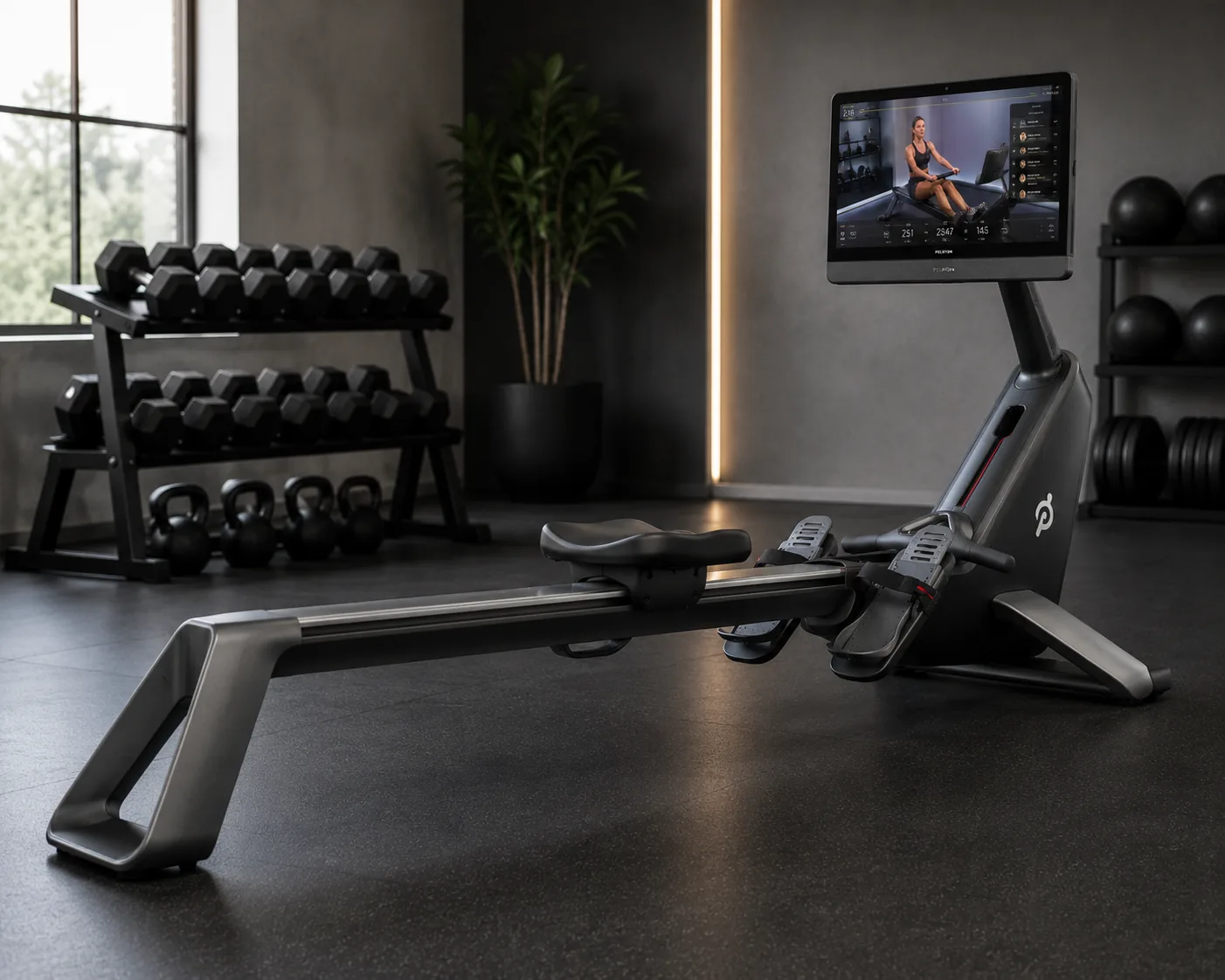
Smart/connected rower · ~$3,295
Peloton Row
A premium connected rower with a swiveling HD touchscreen and real-time form coaching, held back by a high price and required membership.

How we review
Every rower is scored on the same six weighted criteria - resistance & feel, build, monitor, comfort, footprint, and value - from verified specifications, expert consensus, and aggregated long-term owner feedback. Our reviews are independent: we never accept payment for placement or a higher score. Reviewed by Jordan Lockwood (BSc, CPT). See our full methodology.
The Peloton Row is the company's entry into indoor rowing, applying the same connected-fitness formula that made its bike and tread popular: a large swiveling HD touchscreen, instructor-led classes, and software that turns the machine into a coaching platform. It pairs electronically controlled magnetic resistance with a real-time Form Assist system that tracks your stroke and flags technique issues, which is something most rowers cannot do.
It is squarely a premium, subscription-driven product. At roughly $3,295 plus an All-Access membership of around $44 per month for the full content library, it competes less with bare-bones rowers and more with other connected machines. It is best understood as a guided coaching experience built around a rower, rather than a tool aimed at competitive athletes chasing 2K splits.
Specifications at a glance
| Resistance type | Electronically controlled magnetic resistance |
|---|---|
| Monitor/console | 23.8" HD swiveling touchscreen (front and rear speakers) |
| Connectivity | Wi-Fi, Bluetooth, ANT+ |
| Assembled dimensions | 94" L x 24" W |
| Machine weight | 156.5 lbs |
| Max user weight | 300 lbs |
| User height range | 4'11" to 6'5" |
| Folding/storage | Does not fold; vertical storage via separate wall anchor (8' ceiling) |
| Warranty | 5-year frame; 12 months parts and labor / touchscreen |
| Membership | All-Access membership required (~$44/mo) for full content |
Pros
- Real-time Form Assist technique tracking is genuinely useful for beginners
- Large 23.8" swiveling HD touchscreen with strong production-quality classes
- Quiet, smooth electronically controlled magnetic resistance with auto-adjusting levels
- Heavy, stable frame and refined build quality
- Delivery and professional setup typically included
Cons
- Very expensive, and full functionality requires an ongoing ~$44/month membership
- Does not fold flat; upright storage needs a separately sold wall anchor and 8' ceiling
- Short 12-month parts/labor and touchscreen warranty for the price
- Less suited to competitive rowers who prefer the dynamic feel of air resistance
Best for: Beginner-to-intermediate home exercisers who want guided, instructor-led rowing with form feedback and are willing to pay a premium plus a monthly subscription.
What the Form Assist coaching actually does for you
Form Assist is the single feature that justifies the Peloton Row existing as its own product rather than a Concept2 with a tablet bolted on. Sensors in the seat rail and handle track your stroke and grade the sequence of legs-core-arms in real time, flagging the classic beginner mistakes like opening the back too early or rushing the catch. Reviewers consistently report meaningful improvement within the first week of use, which matters because rowing is one of the few cardio movements where bad technique is both common and genuinely counterproductive.
If you already row well, this is a novelty you will outgrow in a month. Its value is squarely for the beginner or the deconditioned returner who has no coach and would otherwise grind out thousands of sloppy strokes. For that buyer it is the closest thing to a personal trainer that a connected rower offers, and it is the strongest single argument for paying the Peloton premium over a cheaper screen-equipped rower.
The membership math is where the enthusiasm cools
The roughly 44 dollar monthly membership is not optional in any meaningful sense. Form Assist, the guided classes, scenic rows and the leaderboard all live behind it, and without it you own an expensive magnetic rower with a touchscreen that mostly shows your live metrics. Budget for the subscription as a permanent line item, because the moment you stop paying, the machine loses most of what you paid the premium for.
The harder pill is what the subscription buys on the rowing side specifically. Owners repeatedly note the rowing catalogue is thin relative to Peloton's cycling and strength libraries, with only around a hundred classes running 30 minutes or longer. If you intend to do long steady-state sessions, you will cycle through the deep content quickly and lean on scenic rows or just-row mode. The screen does pull double duty for off-rower yoga, strength and stretching, which softens the blow and is a real reason existing Peloton members find the ecosystem worth it.
Build, feel and the storage caveat nobody mentions upfront
The frame is heavy, planted and refined, and the electronically controlled magnetic resistance is quiet and smooth with levels that auto-adjust to the class. It feels premium because it is built like a premium appliance. The trade-off is that magnetic resistance does not give you the dynamic, accelerating bite of air or water resistance, so harder pullers and competitive rowers will find the feel a little flat and disconnected from how a real boat or a Concept2 loads up.
Storage is the practical gotcha. The Row does not fold flat. It stands upright to save floor space, but that requires a separately sold wall anchor and roughly an 8-foot ceiling, and the gas-spring lift mechanism is something a few long-term owners report softening after years of daily folding. Treat the marketing image of a tidy vertical rower as conditional on your room, not a given.
Warranty is the other sore spot for the money. The 12-month parts, labor and touchscreen coverage is short for a 3,000-dollar-plus machine, and out-of-warranty screen failures are not cheap to resolve. Buyers should factor that risk in rather than assume a premium price brings premium coverage.
Peloton Row versus Hydrow: the real decision for most buyers
Hydrow is the obvious cross-shop, and the two split cleanly. Hydrow films its classes on real water with its Live Outdoor Reality approach and carries a deeper, more rowing-focused class library with coaches many consider the best in the category. The Wave model also undercuts the Peloton Row substantially on hardware price while charging the same roughly 44 dollar membership. If rowing is the whole point and you want the most authentic on-water feel and the most classes, Hydrow is the stronger rowing-first buy.
Peloton's counterargument is Form Assist, which Hydrow has no answer to, plus the swiveling screen and the much broader non-rowing ecosystem. If you want real technique coaching, or you are already in the Peloton world and want one screen for rowing, cycling-adjacent strength, yoga and stretching, Peloton wins on breadth and on coaching. Choose Hydrow if you are buying a rower; choose Peloton if you are buying a coached fitness platform that happens to be a rower.
Peloton Row versus a Concept2 RowErg: premium screen versus pure tool
The other honest comparison is against the Concept2 RowErg, which costs a fraction of the price, uses air resistance with a feel that serious rowers prefer, weighs little, separates for storage and is famous for lasting a decade-plus with trivial maintenance. The Concept2 gives you better data credibility and a feel competitive rowers trust, with no mandatory subscription. What it does not give you is a coach, production-quality classes or any motivation beyond your own discipline.
This is really a question of personality. If you are self-motivated, performance-minded or budget-conscious, the Concept2 makes the Peloton look like an expensive way to get coaxed into exercising. If you know you need the screen, the instructor energy and the on-screen form feedback to actually show up, the Peloton's premium is buying adherence, and adherence is the only spec that burns calories.
Our take
Buy the Peloton Row if you are a beginner or returning exerciser who genuinely needs coaching and accountability, you can comfortably absorb both the 3,000-dollar-plus hardware cost and the permanent 44 dollar monthly membership, and you value Form Assist plus the broader Peloton class ecosystem over rowing-specific depth. It is at its best as the centerpiece of a connected-fitness habit, not as a standalone erg.
Skip it if you are a competitive or experienced rower who wants the dynamic feel of air or water resistance, if you mostly want long steady-state sessions the thin long-form rowing library will frustrate you, if subscription lock-in bothers you, or if you simply want the most rowing for your money. In those cases a Concept2 RowErg or a Hydrow will serve you better. Our 3.8 out of 5 reflects exactly this: excellent hardware and uniquely useful coaching, dragged down by price, mandatory membership, a short warranty and storage that is less convenient than the brochure implies.
Our verdict
The Peloton Row is a beautifully built, genuinely smart connected rower whose Form Assist coaching is the most compelling reason in the category to spend big on a screen. For a beginner who needs technique help and the motivation of instructor-led classes, it is close to the best on-ramp into rowing money can buy, and the swiveling display earns its keep as a platform for off-rower strength, yoga and stretching. But the value case is fragile: the price is steep, the roughly 44 dollar membership is effectively mandatory and permanent, the long-form rowing library is thin, the warranty is short for the money, and upright storage comes with strings the brochure does not advertise.
Our verdict at 3.8 out of 5: recommended, but only for the right buyer. If you want a coached fitness habit and can stomach the ongoing cost, buy it and you will likely use it. If you are an experienced or competitive rower, a long steady-state devotee, or simply want the most rowing per dollar, a Concept2 RowErg or a Hydrow is the smarter purchase.
Frequently asked questions
- Do I really need the membership to use the Peloton Row?
- For all practical purposes, yes. The roughly 44 dollar monthly membership unlocks Form Assist, guided and scenic classes, and the leaderboard. Without it you still get basic live metrics in a just-row mode, but you lose nearly everything you paid the premium for. Treat the subscription as a permanent cost, not an optional add-on.
- Is Form Assist accurate and worth it?
- It is genuinely useful and reasonably accurate at catching common errors like opening the back too early or rushing the catch, with most reviewers reporting clear improvement within a week. Its value is highest for beginners; experienced rowers will likely outgrow it within a month or two.
- Can the Peloton Row be folded or stored upright easily?
- It does not fold flat. It stands vertically to save floor space, but that requires a separately sold wall anchor and roughly an 8-foot ceiling. The gas-spring lift makes it manageable day to day, though some long-term owners report the mechanism softening over years of frequent folding.
- How does it compare to the much cheaper Concept2 RowErg?
- The Concept2 costs far less, uses air resistance with a feel serious rowers prefer, is lighter, stores easily and has no required subscription. What it lacks is coaching, classes and on-screen form feedback. Pick the Peloton if you need the screen and accountability to stay consistent; pick the Concept2 if you are self-motivated or performance-focused.
- Is the rowing class library big enough?
- It is the weakest part of the subscription for rowing purists. The catalogue is solid for shorter sessions but thin on classes 30 minutes and longer, and noticeably smaller than Peloton's cycling and strength libraries. If you plan long steady-state rows, expect to lean on scenic rows or just-row mode and consider Hydrow for deeper rowing content.
References
- Peloton Row Dimensions, Specifications, Power Requirements, and Storage - Peloton Support
- Peloton Rower Review, From A CPT - Garage Gym Reviews
- Peloton rower review: The Row is one of the best rowing machines we've tested - Reviewed
Jordan Lockwood (BSc, CPT)
Certified personal trainer (CPT), sports-science graduate, and lifelong rower. Jordan writes and reviews every guide on Rowing Machine Nerd.