 Rowing Machine Nerd
Stamina 1333 Precision Rower Review
Hydraulic rower · ~$300
Stamina 1333 Precision Rower
A compact, affordable hydraulic rower suited to light, occasional workouts, but limited by piston fade, no connectivity, and a short rail.

How we review
Every rower is scored on the same six weighted criteria - resistance & feel, build, monitor, comfort, footprint, and value - from verified specifications, expert consensus, and aggregated long-term owner feedback. Our reviews are independent: we never accept payment for placement or a higher score. Reviewed by Jordan Lockwood (BSc, CPT). See our full methodology.
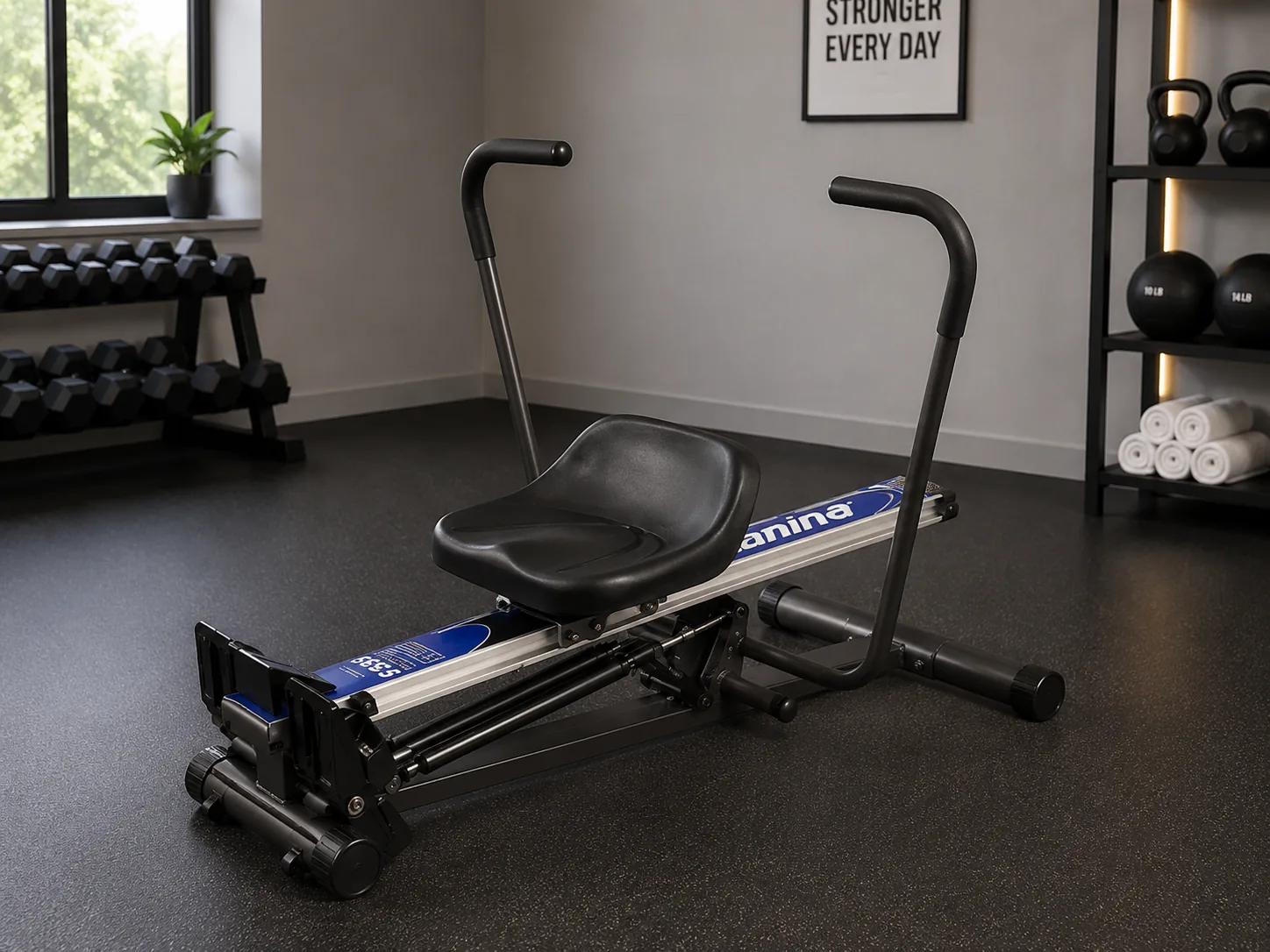
The Stamina 1333 Precision Rower sits firmly at the budget end of the indoor rowing market. Rather than the air, water, or magnetic flywheels found on performance machines, it uses dual hydraulic cylinders attached to two independent handles linked by an aluminum center beam, giving a rowing motion that resembles a swimming or sculling stroke more than a unified pull. With 12 adjustable resistance settings, a basic LCD monitor, and a footprint that stands on end for storage, it is built for convenience and price rather than long-distance training.
This is a machine for occasional, light-to-moderate cardio in a home where space and budget are the main constraints. It will appeal to beginners, returning exercisers, and smaller users who want something they can roll out, use for 15 to 20 minutes, and tuck away. Anyone planning long sessions, structured interval work, or app-based tracking should look at a flywheel rower instead.
Specifications at a glance
| Resistance type | Hydraulic (dual piston cylinders) |
|---|---|
| Resistance levels | 12 adjustable levels |
| Monitor | LCD console: strokes, strokes/min, time, distance, calories |
| App / Bluetooth | Not specified (no connectivity) |
| Assembled dimensions | 48.5" L x 34.25" W x 18" H |
| Machine weight | Approx. 49-55 lbs |
| Max user weight | 250 lbs |
| Storage | Does not fold; stands on end with transport wheels |
| Warranty | 1 year frame / 90 days parts (per manufacturer listings) |
Pros
- Compact footprint and stands on end with wheels for easy storage in small homes
- Low entry price relative to flywheel rowers
- Padded seat with back support and pivoting footplates aid comfort for casual users
- 12 hydraulic resistance levels with no batteries or power needed for resistance
Cons
- Hydraulic pistons heat up and lose consistency after 15-20 minutes of use
- No Bluetooth, app connectivity, or PM-style performance tracking
- Short rail and dual-handle design limit stroke length for taller rowers
- 250 lb user cap and short-term warranty point to light-duty use only
Best for: Budget-minded beginners or smaller users wanting a compact, low-cost rower for short, occasional cardio sessions rather than serious training.
How the hydraulic resistance actually feels
The 1333 uses hydraulic shock pistons rather than a flywheel, and that single design choice shapes everything about how it rows. The action is quiet and pulls without the whoosh of an air rower or the splash of a water unit, which is genuinely pleasant in an apartment or a shared room. But hydraulics behave differently from a flywheel in two ways that matter. First, the resistance is fixed per level rather than responsive to how hard you pull, so you never get the self-scaling feel that makes a Concept2 reward effort. Second, the fluid heats up. Owner and reviewer reports consistently put the fade at the 15 to 20 minute mark, after which the pistons soften and can pull unevenly side to side. For a 15-minute beginner session this is a non-issue; for anyone doing 30-plus minute steady-state work it is a real ceiling, not a quirk.
The dual-handle layout is the other thing to understand before buying. Instead of one bar on a single cable, the 1333 gives you two independent arms, more like a hydraulic gym machine than a sliding-seat erg. It works, but it changes the stroke and it is part of why taller users feel cramped: you are not getting a long, single, water-style drive.
The monitor is the weakest link, and it is not close
On paper the LCD covers the basics: strokes, stroke rate, time, distance and a calorie estimate, and it runs without batteries or a plug, which is a nice touch. In practice this is the part of the machine that draws the most owner frustration. Reviewers note the readout sits where it is awkward to glance at mid-stroke, and there are repeated complaints of the stroke and timer counts failing to increment correctly. More damning are the long-running reports of monitors simply dying and being near-impossible to replace, with owners describing months or even years of back-and-forth to source a working unit.
There is no Bluetooth, no app, and no Concept2-style PM performance data, so the numbers you do get are rough estimates rather than training metrics you would log or chase. If you care about tracking progress, racing a benchmark, or following an app-guided class, this machine cannot do it and was never built to. Treat the monitor as a basic motivational counter, and assume it may not survive heavy use.
Build, comfort and the storage trick that sells it
The 1333's strongest practical argument is its size. At roughly four feet long, around 50 pounds, and able to stand on end with transport wheels, it disappears into a closet or a corner in a way no Concept2 or water rower will. For someone in a small home whose alternative is no rower at all, that footprint is the whole point. The padded seat with pelvic and lower-back support and the pivoting footplates make casual sessions comfortable, and the aluminum beam feels solid in use.
The caveats are real, though. Beyond the aluminum beam, a fair amount of the hardware is plastic, the 250 lb user cap and short parts warranty (frequently cited as just 90 days) both signal light-duty intent, and at 6 feet and above most reviewers find the rail and stroke too short to row comfortably. This is equipment engineered to be stored easily and used gently, and it is honest about that if you read the spec sheet closely.
Stamina 1333 versus the Sunny SF-RW1205
The obvious cross-shop is the Sunny Health & Fitness SF-RW1205, the default budget hydraulic rower in the same aisle and often a fair bit cheaper. The two are more alike than different: both are compact single-piston-class hydraulic units with 12 resistance levels, a simple self-contained monitor, and the identical 15-to-20-minute heat fade. The Sunny carries a slightly lower 220 lb capacity but a notably better-on-paper 3-year frame warranty, and it typically undercuts the 1333 on price. The Stamina counters with a marginally higher 250 lb cap and the genuinely useful stand-on-end storage.
Honestly, neither is a performance machine, and the choice usually comes down to price and storage rather than rowing quality. If the Sunny is meaningfully cheaper where you shop, it is hard to justify paying up for the 1333. The 1333 earns its small premium mainly on footprint and the upright storage. And it is worth saying the bigger comparison: anyone who can stretch the budget toward a used or entry flywheel rower, or save for a Concept2, will get a fundamentally better and longer-lasting machine than either hydraulic unit.
Who this machine is genuinely good for
There is a real, narrow user for whom the 1333 makes sense. If you are a beginner or returning exerciser, you live somewhere tight, you plan to row two or three short sessions a week for general cardio or rehab, and your alternative is buying nothing, this rower lowers the barrier to entry better than almost anything at the price. The quiet action suits TV-watching and shared spaces, the no-power resistance is foolproof, and the storage means it will not become furniture you trip over.
It is the wrong machine if you are tall, heavier than about 250 pounds, planning daily or long steady-state sessions, chasing measurable progress, or hoping for app classes and connectivity. For those buyers the hydraulic fade, the short rail, the flaky monitor, and the light-duty warranty will turn into daily friction fast.
Our take
Buy the 1333 only if compact storage and a low entry price genuinely outrank rowing quality for you, and if your honest usage is light and occasional. For a small-apartment beginner doing short, casual cardio it does a specific job competently, and the stand-on-end design is a real convenience that pricier rowers cannot match.
Skip it if you are tall, plan to train seriously or daily, want trustworthy performance data, or have any path to a flywheel rower. The recurring monitor failures and the difficulty of getting replacement parts are the part that would give us the most pause; they turn a cheap purchase into a frustrating one when something breaks. Our 2.5 out of 5 reflects that split: a useful tool for a narrow buyer, and a poor fit for everyone else.
Our verdict
The Stamina 1333 Precision Rower is a niche tool that does one thing well: it gets a space-strapped beginner rowing for around 300 dollars without needing power, batteries, or much floor space, and it tucks away on end when you are done. For light, occasional cardio in a small home, that is a legitimate value. But it is not a rower you grow into. The hydraulic resistance fades after 15 to 20 minutes, the rail is too short for taller users, there is no connectivity or real performance data, and the monitor and parts-support story is the kind of thing that turns a cheap buy into a regret.
Our recommendation is narrow on purpose. If you are a smaller, casual user who values storage over performance and would otherwise buy nothing, go ahead. Everyone else, especially taller rowers, daily trainers, and data-driven users, should either step up to a used or entry flywheel rower or save toward a Concept2 RowErg, which will outrow and outlast this machine many times over. At 2.5 out of 5, the 1333 is a fair pick for the right person and the wrong machine for most.
Frequently asked questions
- How long can you actually row on the Stamina 1333 before the resistance fades?
- Plan on solid, consistent resistance for roughly the first 15 to 20 minutes. After that the hydraulic fluid heats up and the pistons soften and can pull unevenly side to side. That is fine for short beginner or rehab sessions but a real limitation for longer steady-state workouts.
- Is the Stamina 1333 suitable for tall users?
- Not really. The machine is only about four feet long with a short stroke and a dual-handle layout, and most reviewers say users at or above 6 feet feel cramped. Taller rowers will be happier on a longer flywheel or water rower with a full sliding-seat stroke.
- Can I connect it to an app or track my workouts?
- No. There is no Bluetooth, no app, and no Concept2-style performance monitor. The built-in LCD shows rough estimates for time, strokes, distance and calories, but owners report the counts can be inaccurate and the monitor itself is prone to failure. It is a basic counter, not a training tool.
- What is the weight capacity and warranty?
- The user weight limit is 250 lb. Warranty coverage is light for the price: the frame is covered for up to three years but parts are commonly cited at just 90 days, which signals this is light-duty equipment. Owners have also reported real difficulty sourcing replacement parts and monitors.
- Should I buy the Stamina 1333 or the Sunny SF-RW1205 instead?
- They are very similar hydraulic rowers with the same 15-to-20-minute fade. The Sunny is often cheaper with a better on-paper frame warranty but a lower 220 lb capacity; the Stamina offers a 250 lb cap and the handy stand-on-end storage. If price is your priority the Sunny usually wins; if upright storage matters most, the 1333 edges it.
References
- Stamina 1333 Precision Rowing Machine Review - RowingMachine-Guide.com
- Stamina 1333 Rower Review - RowingReviews.com (FitRated)
- Stamina 1333 Precision Rower - Stamina Products (Amazon listing)
Jordan Lockwood (BSc, CPT)
Certified personal trainer (CPT), sports-science graduate, and lifelong rower. Jordan writes and reviews every guide on Rowing Machine Nerd.