 Rowing Machine Nerd
WaterRower Natural Review
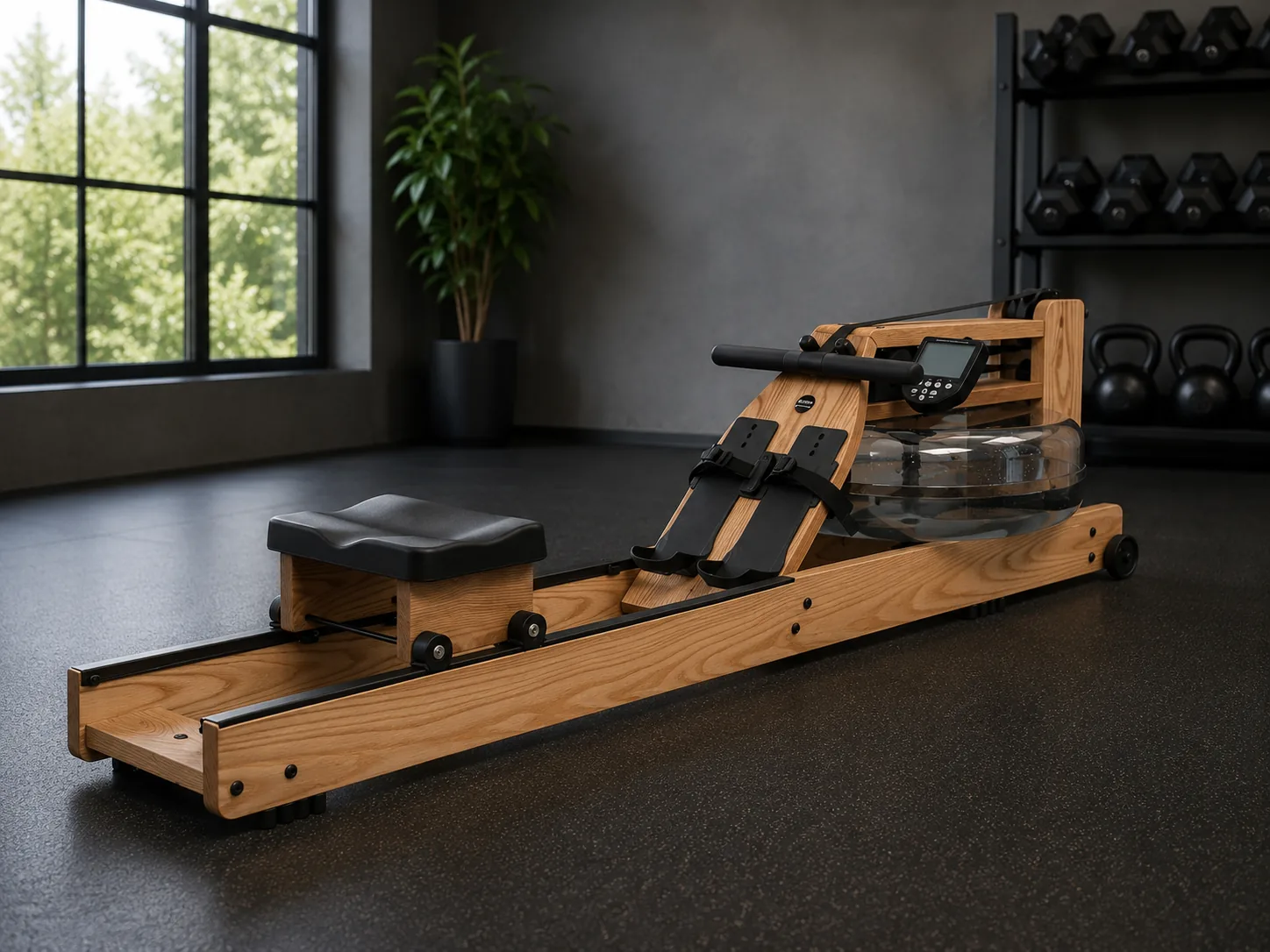
Water rower · ~$1,200
WaterRower Natural
A handcrafted ash water rower that's as much furniture as fitness - beautiful and quiet, with a smooth natural stroke, but a basic monitor for the money.

How we review
Every rower is scored on the same six weighted criteria - resistance & feel, build, monitor, comfort, footprint, and value - from verified specifications, expert consensus, and aggregated long-term owner feedback. Our reviews are independent: we never accept payment for placement or a higher score. Reviewed by Jordan Lockwood (BSc, CPT). See our full methodology.
The WaterRower Natural is the machine that launched a thousand living-room workouts - quite literally the design featured in films and boutique studios. Handcrafted from solid ash and powered by a water flywheel, it's pitched as much on aesthetics and feel as on performance.
The question for a buyer is whether the experience justifies a price well above a Concept2. Against our methodology, it's a machine of clear strengths and one clear weakness.
Specifications at a glance
| Resistance | Water (variable; self-regulating tank) |
|---|---|
| Monitor | S4 (pace, distance, watts, calories, HR) |
| Connectivity | S4; optional Bluetooth (Connect module) |
| Max user weight | 375 lb (170 kg) |
| Weight | ~67 lb empty / ~104 lb filled (20 L) |
| Footprint | ~84" × 22" × 21" (213 × 56 × 53 cm) |
| Seat height | ~12" (30 cm) |
| Storage | Stands upright on end; front wheels |
| Warranty | 5-yr frame / 3-yr parts (home use) |
Pros
- Genuinely beautiful - handcrafted hardwood that suits a living room
- Smooth, natural water stroke with a pleasant 'whoosh'
- Quieter than an air rower; good for shared spaces
- Stores vertically, taking up little floor space
- Made in the USA with a strong frame warranty
Cons
- The S4 monitor is basic for the price - no split-rich training data or built-in screen
- Premium cost relative to the data you get
- Heavy and less easily moved when filled with water
- Tank needs occasional purification tablets; resistance ceiling can be low for very powerful rowers
Best for: Home users who want a beautiful, quiet machine and an immersive feel more than lab-grade data.
The water stroke: feel and sound, not raw resistance
The Natural's appeal starts the moment you take a stroke. Water resistance is self-scaling, so the harder you pull the more it pushes back, and the catch builds gradually instead of slamming you the way a damper-set air fan can. The result is a connected, low-impact feel that flatters longer steady-state sessions and tends to be kinder to cranky knees and lower backs. The signature 'whoosh' of the paddles churning the tank is a genuine selling point and not just marketing - owners consistently describe it as soothing rather than mechanical.
There is a ceiling, though, and it is worth being honest about it. Water rowers ramp resistance with stroke rate and tank fill level, but very powerful or competitive rowers can pull past the point where the tank meaningfully loads up. If you train for raw watts and want a wall you can lean into at any stroke rate, an air rower with an adjustable damper gives you more usable top end. For everyone doing fitness rowing rather than racing, the Natural's resistance is plenty.
Build and design: this is the reason to buy it
The Natural is built from solid hand-finished ash and sits on the floor horizontally like a piece of furniture, which is the whole point. Most rowing machines are something you hide; this one people leave out in a living room on purpose. The wood is not just cosmetic either - solid timber damps vibration and sound, and the polycarbonate water tank is close to indestructible. Long-term owner reports back this up, with people running the same frame for a decade and replacing little more than the monitor battery.
The trade-off is that wood is a living material. It expands and contracts with humidity, so you should expect to snug up the structural bolts every few months, and the machine is heavier and more awkward to reposition once the tank is filled. None of this is a dealbreaker, but it means the Natural rewards a permanent home more than it rewards constant moving around.
The S4 monitor and app: the weak link
This is where the Natural earns its criticism. The S4 monitor covers the basics - time, distance, pace, strokes per minute, watts, calories, heart rate with a strap - but it is a small backlit LCD, not a rich screen, and it does not give you the split-by-split training depth that serious rowers expect at this price. Compared to the data experience you get from a Concept2 PM5, the S4 feels a generation behind.
The connected side is rougher still. The WaterRowerConnect app draws frequent owner complaints for buggy behavior, spotty Bluetooth pairing, and quirks like folding rest periods into your average pace. Some owners have had app updates drop a sync mid-workout and lose data. The S4 does broadcast over Bluetooth FTMS, so you can route it into third-party apps, and there is a paid SmartRow add-on (around $275) that bolts on far better accuracy and a force curve. But the fact that the best data experience on a $1,200 machine is an extra purchase is exactly why this is the product's soft spot.
Living with it: noise, footprint and maintenance
For shared walls and late sessions, the Natural genuinely delivers. The water swish is softer and lower-pitched than an air rower's fan, and the wood absorbs vibration, so owners in apartments report comfortably rowing at night without complaints - though on a suspended floor rather than a concrete slab you will still feel some movement. Storage is a real strength too: tip it up and it stands vertically against a wall in roughly the footprint of a dining chair.
Maintenance is light but not zero. Plan on a water purification tablet every six to twelve months to keep the tank clear, the occasional bolt check as the wood moves, and a top-up or change of water if it goes cloudy. There are no moving metal parts to wear out, which is a large part of why these machines last. The honest summary: the upkeep is trivial, but it is not literally nothing, and the filled tank makes the machine commit to a spot.
WaterRower Natural versus the Concept2 RowErg
This is the comparison that matters, because the RowErg sits at almost the same price (often a little cheaper) and is the default recommendation for anyone who shops on performance. The RowErg wins decisively on data and training: its PM5 monitor is the category benchmark for accurate splits, logged workouts, racing and a deep connected ecosystem. It is also lighter, easier to move, and the air resistance gives a higher usable ceiling for powerful rowers. The catch is that it looks like gym equipment and the chain is noticeably louder.
The Natural wins on exactly the things the RowErg ignores: it is quiet enough for shared spaces, it is beautiful enough to live in a main room, and the water stroke is smoother and more forgiving for steady fitness work. It also has a much higher stated weight capacity (around 700 lb versus 500 lb). So the decision is genuinely about priorities, not quality. If you want the best training tool, buy the Concept2. If you want a machine you will actually keep out and use because it does not feel like an erg, buy the Natural - just go in knowing you are paying partly for the wood and the silence, not the monitor.
Our take
Buy the WaterRower Natural if aesthetics, quiet and feel are what will keep you rowing - apartment dwellers, people who want the machine in a shared living space, and anyone doing steady-state fitness who finds air rowers harsh or loud. For that buyer the Natural is close to ideal, and the long-term durability makes the premium easier to swallow. At 4.1 out of 5 it loses points almost entirely on the monitor and connected experience, not on the hardware.
Skip it if you train by the numbers. Competitive rowers, CrossFitters, and data-driven athletes will be better served by a Concept2 RowErg, which costs about the same and gives you a far better screen, more accurate splits, and a higher resistance ceiling. And if budget is the main constraint, understand that a chunk of the Natural's price is craftsmanship and silence - you are not paying for class-leading training tech, and budgeting another $275 for SmartRow to close the data gap pushes the total higher still.
Our verdict
The WaterRower Natural is the rare piece of fitness gear you buy partly because it is lovely to look at, and that is exactly the right reason to choose it. The handcrafted ash build, the soothing water stroke and the genuinely apartment-friendly noise level make it a machine people leave out and actually use, and owner reports of decade-long lifespans justify a lot of the premium. At 4.1 out of 5 it is a strong recommendation for the buyer who values feel, quiet and aesthetics over raw training data.
Where it stumbles is the price-to-data ratio: the S4 monitor is basic and the companion app is genuinely frustrating, so a chunk of your money buys craftsmanship rather than class-leading tech. If you train by splits and watts, the similarly priced Concept2 RowErg is the smarter tool. But if you want a rower that suits a living room, stays quiet on shared walls, and rewards long steady sessions, the Natural earns its place - just budget for SmartRow if the numbers turn out to matter to you.
Frequently asked questions
- Is the WaterRower Natural quiet enough for an apartment?
- Yes, this is one of its strongest points. The water swish is softer and lower-pitched than an air rower's fan, and the solid ash absorbs vibration, so owners report rowing late at night without disturbing neighbors. On a concrete slab it is genuinely quiet; on a suspended upper floor you will still feel some movement, but it remains far quieter than an air rower.
- How much maintenance does the water tank need?
- Very little. Drop in a water purification tablet roughly every six to twelve months to keep the tank clear, and only drain and refill with fresh tap water if it turns cloudy. Because the wood moves with humidity, you should also snug up the structural bolts every few months. There are no moving metal parts to wear out, which is why these machines routinely last a decade or more.
- How does the S4 monitor compare to the Concept2 PM5?
- The S4 covers the essentials - time, distance, pace, stroke rate, watts, calories and heart rate - but it is a small LCD without the split-rich data, logging and connected ecosystem of the PM5. For serious data-driven training the PM5 is clearly ahead. The S4 can broadcast over Bluetooth to third-party apps, and a paid SmartRow upgrade (around $275) sharply improves accuracy if data matters to you.
- Can powerful or competitive rowers get enough resistance?
- For fitness rowing, yes. Water resistance self-scales with effort and you can raise the ceiling by adding water to the tank. But very strong or competitive rowers can pull past the point where the water meaningfully loads up. If you want a high, adjustable resistance wall at any stroke rate, an air rower with a damper gives you more usable top end.
- Is it hard to move once it's filled?
- It stores upright against a wall in about the footprint of a dining chair, so floor space isn't an issue. Moving it around the house is the harder part - the filled tank adds significant weight and makes it awkward to reposition. The Natural is happiest with a permanent spot rather than being shuffled between rooms.
References
- WaterRower Natural with S4 Monitor - official product page - WaterRower
- WaterRower Natural Ash with S4 Monitor - specifications & review - Treadmill Review Guru
Jordan Lockwood (BSc, CPT)
Certified personal trainer (CPT), sports-science graduate, and lifelong rower. Jordan writes and reviews every guide on Rowing Machine Nerd.