 Rowing Machine Nerd
WaterRower Club Review
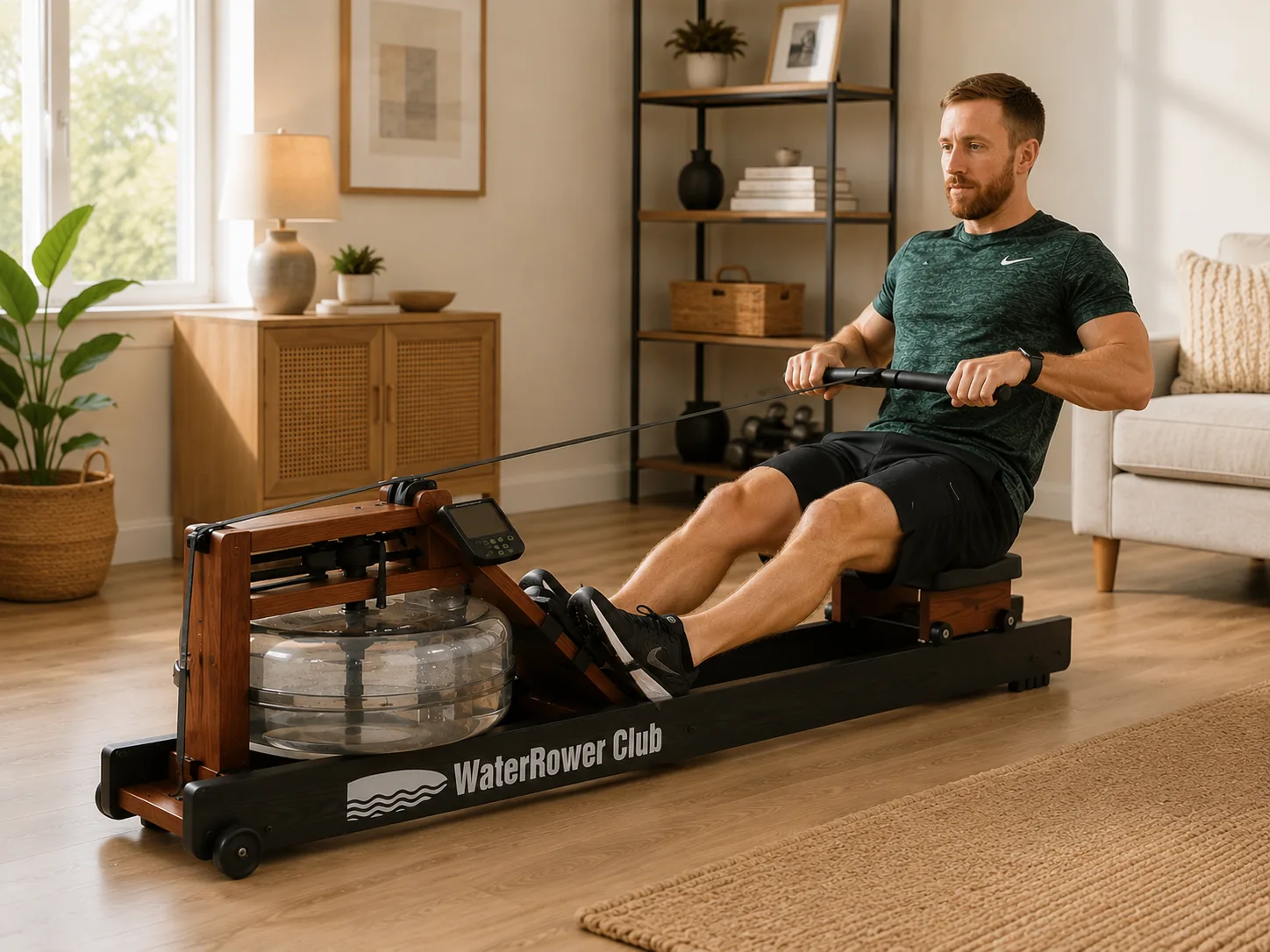
Water rower · ~$1,399
WaterRower Club
A commercial-grade solid-ash water rower with authentic feel and BLE connectivity, held back by a dated S4 console and premium price.

How we review
Every rower is scored on the same six weighted criteria - resistance & feel, build, monitor, comfort, footprint, and value - from verified specifications, expert consensus, and aggregated long-term owner feedback. Our reviews are independent: we never accept payment for placement or a higher score. Reviewed by Jordan Lockwood (BSc, CPT). See our full methodology.
The WaterRower Club is the heavier-duty sibling in WaterRower's wooden-rower lineup, built around the same water-flywheel mechanism that made the brand famous but specified for high-traffic environments such as gyms, studios and rehab clinics. It pairs a solid ash frame with the Series 4 (S4) BLE monitor and a self-regulating water resistance system, aiming to deliver the closest possible approximation of rowing on real water.
It competes in the premium tier alongside connected machines and the ubiquitous Concept2, but its pitch is different: rather than an app ecosystem and a bright touchscreen, the Club sells craftsmanship, a natural stroke feel and furniture-grade looks. This review is a research-based assessment drawn from WaterRower's specifications and reputable retailer and review sources rather than hands-on testing.
Specifications at a glance
| Resistance type | Water flywheel (self-regulating, speed-dependent) |
|---|---|
| Monitor | Series 4 (S4) BLE performance monitor |
| Monitor metrics | Intensity, stroke rate, heart rate, zone bar, duration, distance |
| Connectivity | Bluetooth Low Energy (BLE); optional heart-rate strap |
| Assembled dimensions | 82.25" L x 22.25" W x 20" H |
| Machine weight | 117 lb (filled with water) |
| Maximum user weight | 1,000 lb |
| Storage | Stands upright on end |
| Warranty | 1 year standard; upgradeable to 5 yr frame / 3 yr parts on registration |
| Construction | Solid ash hardwood, made in the USA |
Pros
- Smooth, quiet, self-regulating water resistance that closely mimics on-water rowing
- Robust solid-ash construction rated for commercial use and up to 1,000 lb user weight
- Stands upright on end for a compact storage footprint despite its length
- S4 monitor now includes Bluetooth (BLE) for connecting to WaterRower Connect and similar apps
Cons
- S4 console is dated and basic next to the touchscreen consoles on connected rivals
- Heavy at ~117 lb filled, so repositioning mid-room is awkward
- Resistance can't be set numerically; it varies only with how hard you pull
- Premium price for relatively modest onboard tech
Best for: Buyers who want an authentic, quiet water-rowing feel in a handsome, commercial-grade wooden machine and don't need a large app-driven touchscreen.
The water feel is the whole reason to buy this
The Club's appeal lives and dies on its resistance system, and on that count owner sentiment is overwhelmingly positive. The water flywheel produces a fluid, self-regulating catch that genuinely mimics pulling a blade through water, and because resistance scales with effort, there is no abrupt wall at the end of the stroke the way air rowers can feel at low damper settings. The trade-off, which is real and worth understanding before you buy, is that you cannot dial resistance to a number. You make it harder by pulling harder or by adding water to the tank for a denser baseline. Most people adapt within a week, but anyone who wants to program precise interval loads will find it imprecise by design.
The sound is the other half of the experience and it is divisive in a good way. Instead of the whoosh of a fan, you get a swishing tank that owners frequently describe as calming, and at conversational and music-listening volumes it is quiet enough for shared living spaces and apartments. If you want a machine you actually look forward to using rather than tolerate, the feel and the sound are what win people over.
Why pay more for the Club over the Natural
The Club and the cheaper WaterRower Natural share the same solid-ash frame, same water tank, and the same S4 monitor, so on water feel and core mechanics they are functionally identical. What the Club adds is a darker, harder-wearing finish (a stained espresso-toned ash protected by urethane and oil) designed to shrug off the scuffs and grime of gym traffic, plus a commercial-use rating that the home-oriented Natural does not carry. That commercial pedigree is the real story: this is the machine you see in boutique studios, and the build is rated to extreme user weights well beyond what a home buyer needs.
Practically, if this is going in a home and you simply prefer the lighter honey-oak look, the Natural saves you money for the same row. The Club earns its premium when you want the tougher finish, the heavier-duty commercial validation, or you just prefer the darker aesthetic. Do not pay the difference expecting a better workout, because the stroke is the same.
The S4 console is the weak link, and you should plan around it
The S4 is a competent numbers display. It is larger and more readable than many basic rowing consoles, shows splits, distance, time, and intensity all at once without scrolling, and runs on AA batteries so there is nothing to charge. But it is monochrome, button-driven, and visibly a generation or two behind the bright touchscreens on connected rivals, which is exactly why this review docks it. Treat the S4 as a metrics readout, not an entertainment system.
Bluetooth changes the math somewhat. With BLE you can pipe data into WaterRower Connect and third-party apps such as Kinomap for guided and scenic rows, effectively bolting a modern screen onto the machine via your own tablet. Two caveats from the research worth knowing: on many S4 units the Bluetooth capability comes from a plug-in ComModule accessory rather than being native to every console, so confirm what your specific unit includes, and WaterRower's own scores do not map onto the Concept2 leaderboard ecosystem, so cross-machine ranking is not on the table.
Living with it: storage, weight, and maintenance
Storage is a genuine strength. The Club stands on end and takes up roughly the footprint of a dining chair against a wall, which is a real advantage over machines that only break down or lie flat. The catch is weight: filled, it is around 117 lb, and while standing it up is manageable, sliding it across a room mid-session to mop or vacuum is awkward and a two-handed chore. If you want true grab-and-move portability, this is not it.
Maintenance is light but not zero, and it is different from an air rower. You add a single purification tablet to the tank roughly every six months to keep the water clear, and the research repeatedly warns against overdosing tablets or ever using chlorine bleach, both of which can damage the tank seal. There are scattered owner reports of tank-seal weeping after years of heavy use, though WaterRower covers repair kits under warranty. The wooden frame itself is essentially maintenance-free and ages well.
How it stacks up against the Concept2 RowErg
The Concept2 RowErg is the unavoidable comparison, and it wins on almost every rational metric. It is cheaper (around the high-900s versus roughly 1,399 here), lighter at about 57 lb, splits into two pieces tool-free, ships with the excellent PM5 monitor, has dirt-cheap and widely available parts, and holds its resale value because it is the universal competition standard used at world championships and in CrossFit. If your priorities are data depth, durability per dollar, and a machine you could resell in a weekend, the Concept2 is the smarter buy and it is not close.
The WaterRower Club wins on the things spreadsheets do not capture: it is quieter, it looks like furniture rather than gym equipment, it stores upright in a small footprint, and the stroke feels organic in a way the air flywheel does not. The honest framing is that these are different purchases. The Concept2 is a performance tool; the Club is a beautiful, quiet machine you are happy to leave in your living room. Buy the Club because you want this specific feel and look, not because you expect it to out-train the erg.
Our take
Buy the Club if you value the rowing experience as much as the workout: you want the calming water sound, an authentic on-water stroke, a machine that doubles as living-room furniture, and the toughness of a commercial-rated build. It is also a sound choice for a studio or shared space where the darker, scuff-resistant finish and commercial rating actually matter. Owners who buy for these reasons tend to love it for years.
Skip it if you are a data-driven or competitive rower, if you want numeric resistance settings and a modern touchscreen out of the box, or if value and resale are top priorities. Those buyers should put the savings toward a Concept2 RowErg and never look back. And if you simply want the WaterRower feel for less and do not need the commercial finish, the near-identical Natural is the cheaper path to the same row. At roughly 1,399 the Club asks a premium for a dated console, which is precisely why it lands at four out of five rather than higher, but the fundamentals are genuinely excellent.
Our verdict
The WaterRower Club is one of the most enjoyable rowing machines you can own, and that is exactly the point of it. The water flywheel delivers a smooth, authentic, self-regulating stroke with a calming swish instead of a fan roar, the solid-ash commercial-grade build is gorgeous and rated to take real abuse, and it stores upright in a tiny footprint. If you want a machine you genuinely look forward to using and are happy to leave on display, it delivers.
It is held back by a dated S4 console and a premium price, and the near-identical Natural undercuts it unless you specifically want the tougher finish or commercial rating. Performance-first and value-first buyers should take the Concept2 RowErg, which is cheaper, lighter, better instrumented, and easier to resell. But for the buyer who wants water feel, quiet operation, and furniture-grade looks, the Club earns its keep. A confident four out of five.
Frequently asked questions
- Does the WaterRower Club connect to apps, or do I need an extra accessory?
- The S4 monitor supports Bluetooth so it can stream to WaterRower Connect and third-party apps like Kinomap. On many units that BLE capability comes from a plug-in ComModule rather than being native to every console, so confirm exactly what your specific S4 includes before assuming app connectivity works out of the box.
- How is the Club different from the cheaper WaterRower Natural?
- They share the same ash frame, water tank, and S4 monitor, so the row feels identical. The Club adds a darker, harder-wearing stained finish and a commercial-use rating. If you are buying for home use and like the lighter look, the Natural gives you the same workout for less money.
- How much maintenance does the water tank need?
- Very little. Add one purification tablet roughly every six months to keep the water clear, and refill with fresh tap water if it ever clouds. Never overdose tablets and never use chlorine bleach, as both can damage the tank seal. The ash frame itself is essentially maintenance-free.
- Can I set a specific resistance level like on an air or magnetic rower?
- No. Resistance is self-regulating and scales with how hard you pull. You can raise the baseline by adding water to the tank, but there is no numeric resistance setting, so precise programmed interval loads are not really possible.
- Is it quiet enough for an apartment?
- Yes for most situations. It produces a soft swishing water sound rather than the loud fan whoosh of an air rower, and owners report it is quiet enough to listen to music or hold a conversation. The main caveat is floor vibration in older buildings, which is an environmental issue rather than a flaw in the machine.
References
- WaterRower Club Rowing Machine in Ash Wood with S4 Monitor - Gronk Fitness Products
- WaterRower Club Rowing Machine Review - Fit&Me
- WaterRower Original Club with S4 Monitor - WaterRower (manufacturer)
Jordan Lockwood (BSc, CPT)
Certified personal trainer (CPT), sports-science graduate, and lifelong rower. Jordan writes and reviews every guide on Rowing Machine Nerd.