 Rowing Machine Nerd
Assault AirRower Elite Review
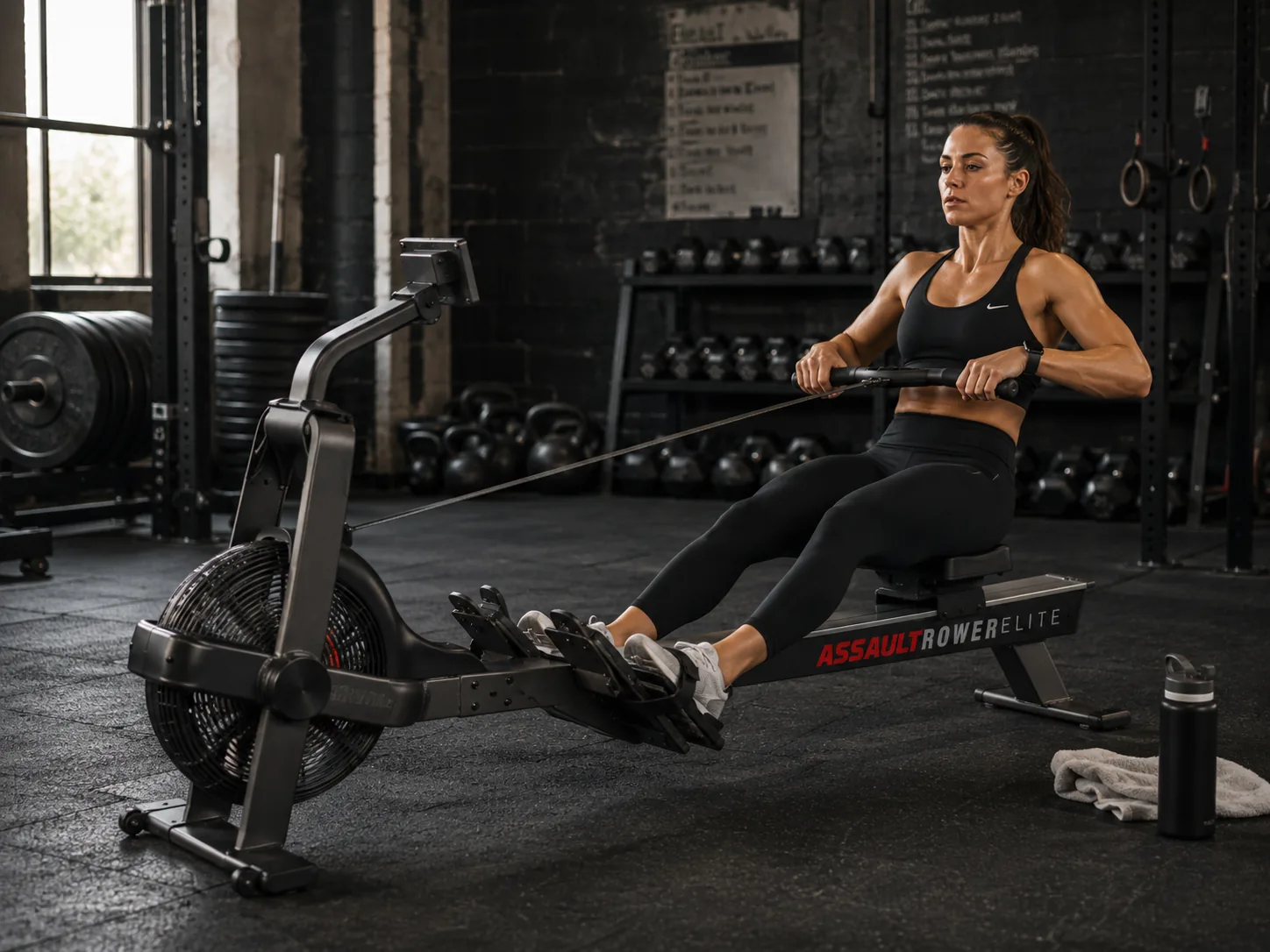
Air rower · ~$1,499
Assault AirRower Elite
A rugged, commercial-grade air rower with a comfortable seat and smooth feel, held back by a basic console and a price above the Concept2 RowErg.

How we review
Every rower is scored on the same six weighted criteria - resistance & feel, build, monitor, comfort, footprint, and value - from verified specifications, expert consensus, and aggregated long-term owner feedback. Our reviews are independent: we never accept payment for placement or a higher score. Reviewed by Jordan Lockwood (BSc, CPT). See our full methodology.
The Assault AirRower Elite is the rowing machine in Assault Fitness's lineup of air-resistance cardio equipment, a brand best known for the AssaultBike. Like its stablemates, it uses a fan flywheel so that resistance scales with how hard you pull rather than relying on a manual setting, and it needs no power outlet. It is positioned as a commercial-grade machine, with a steel frame, a 350 lb user rating, and a build clearly intended to survive gym-floor use rather than occasional home sessions.
At roughly $1,499, it sits above the category benchmark, the Concept2 RowErg, which makes the comparison unavoidable. The Elite answers that with sturdier construction and a more cushioned, contoured seat, but it does not bring the connected software, app ecosystem, or large user community that many buyers now expect. It is best understood as a tool for people who want a tough, no-nonsense air rower for high-intensity training, and who are willing to trade modern connectivity for durability and comfort.
Specifications at a glance
| Resistance type | Air (6-blade fan, 19-inch steel flywheel, dual chain + belt drive) |
|---|---|
| Damper / resistance adjustment | None (resistance scales entirely with effort) |
| Console | Battery-powered high-contrast LCD with push buttons |
| Metrics shown | Time, distance, speed, RPM, watts, calories, heart rate |
| Programs | Preset HIIT and heart-rate programs; competition mode |
| Connectivity | Bluetooth / ANT for heart-rate chest strap; no fitness app or subscription |
| Assembled dimensions | 92.5 x 20.1 x 48.6 in (235 x 51 x 123 cm) |
| Machine weight | 124.6 lb per manufacturer spec sheet (one review lists ~157 lb) |
| Max user weight | 350 lb (158.8 kg) |
| Folding / storage | Non-folding; stores vertically or horizontally; front transport wheels |
| Frame | Powder-coated steel frame, aluminum monorail |
| Warranty | 5-year frame, 3-year non-wear parts, 1-year labor |
| Price | ~$1,499 USD |
Pros
- Commercial-grade steel frame rated to a 350 lb user, built to handle heavy daily use
- Comfortable contoured, moisture-resistant seat and a wide multi-grip handle
- Smooth, responsive air resistance from a dual chain-and-belt drive that is quieter than many air rowers
- No electrical outlet needed; the flywheel helps power the console
- Front transport wheels and vertical storage option make it easier to move and stand up
Cons
- Basic console with no companion app, subscription content, or third-party app integration at this price
- More expensive than a Concept2 RowErg while offering fewer software features
- Non-folding design with a long 92.5-inch footprint
- Air resistance is audibly loud at high intensity, and there is no damper to adjust airflow
Best for: Buyers wanting a rugged, commercial-grade air rower for hard interval training who care more about durability and comfort than connected apps or coaching content.
Resistance and feel: a steady, single-gear engine
The AirRower Elite's dual chain-and-belt drive is the heart of its appeal. Owners consistently describe the catch as smooth and the recovery as quietly assisted, because the machine keeps good tension in the chain so the handle returns without slack or slap. That gives the stroke a connected, almost rope-like feel that many find more comfortable than a pure belt rower, and the air flywheel scales infinitely with effort, so there is no resistance ceiling to outgrow.
The catch, and it is a real one, is that there is no damper. On a Concept2 you can dial the airflow from a light, fast spin to a heavy, grinding pull; here you get one setting and you live with it. For most steady-state and HIIT rowing that is fine, but athletes who like to simulate a heavy boat or who chase very specific drag factors will feel boxed in. The fixed gearing also tends to reward a strong, deliberate pull over a frantic high stroke rate, which suits conditioning work more than sprint racing.
The console is where the money does not go
This is the Elite's weakest link, and it is the single biggest reason the rating sits at 3.6 rather than higher. The monitor covers the basics competently: time, distance, pace, stroke rate, calories and heart rate, with a handful of preset programs and tactile buttons that are easy to operate mid-row. Some units add Bluetooth heart-rate pairing, but there is no companion app, no subscription content, no guided video workouts, and no meaningful way to export or sync your training history.
At roughly $1,499 that omission stings. Reviewers repeatedly flag the console as basic for the price, and it is the kind of thing that matters more over months than minutes. If you are a data-driven rower who wants to log every piece, watch a trend line, or compete on a virtual leaderboard, the Elite simply does not play that game. If you treat the monitor as a glorified stopwatch with a pace readout, you will not be bothered at all.
Build, comfort and the footprint reality
Where the Elite earns its keep is the hardware. The commercial-grade steel frame is rated to a 350 lb user, and at roughly 143 to 157 lb the machine itself feels planted and dead-still even during aggressive pulls. Owners routinely call it a beast and expect it to outlast far more expensive connected rowers. The contoured, moisture-resistant seat with tailbone support and the wide multi-grip handle are genuine standouts; people report being willing to row longer simply because nothing pinches or numbs.
The trade-off is size. This is a non-folding machine with a roughly 92.5-inch footprint, and while it tips up for vertical storage thanks to a flat spot on the flywheel cover, it still demands real floor space and clearance behind you for a full slide. Front transport wheels help you reposition it, but nobody is tucking this into a closet between sessions. Treat it as a permanent fixture in a garage or dedicated room, not a living-room piece you stash away.
Noise: plan around it
Every air rower is loud, and the Elite is no exception. The chain-and-belt design is genuinely quieter than many single-chain competitors at an easy pace, but at high intensity the rush of air through the fan is unmistakable and carries through walls and floors. Reviewers are blunt that this is not an apartment machine.
If you have downstairs neighbors, thin walls, or a sleeping household, factor that in before you buy. In a garage, basement, or detached gym it is a non-issue and the sound is just the familiar whoosh of a hard interval. In a shared building it can become the reason the rower goes unused.
How it compares to the Concept2 RowErg
The RowErg is the obvious alternative and, frankly, the tougher buy to argue against. It typically costs several hundred dollars less, weighs a fraction as much for easy moving and storage, splits into two pieces, carries a higher user-weight rating, and ships with the PM5 monitor that is the gold standard for data, app connectivity, and online racing. Independent testers have even clocked faster time-trial splits on the Concept2, partly because its ten-setting damper lets you tune the feel.
So why consider the Assault at all? It comes down to feel and furniture. The Elite's heavier frame and assisted-recovery stroke win over people who find the Concept2 a touch utilitarian, and its plush seat and grippy handle are more comfortable out of the box. If you value rock-solid stability and creature comfort over data, software, and portability, the Elite is defensible. If you weigh software, resale value, and proven longevity, the RowErg is the smarter spend and it is hard to fault anyone who buys it instead.
Our take
Buy the AirRower Elite if you want a tank of an air rower that feels great to pull and you genuinely do not care about apps, leaderboards, or exporting data. It is best for conditioned athletes doing HIIT and steady-state work in a garage or dedicated space, for heavier or taller users who want a planted frame and a comfortable seat, and for anyone who plans to keep the same machine for a decade and never look at a phone while rowing.
Skip it if you live in an apartment, need to fold or stow your rower, or care about training software and data in any serious way. At this price the basic console and the missing damper are real concessions, and the Concept2 RowErg does more for less. The Elite is a good machine sold above its competitive value, which is exactly why it lands at 3.6 out of 5: excellent bones, underwhelming brains.
Our verdict
The Assault AirRower Elite is a genuinely excellent piece of hardware wrapped around a disappointing brain. The commercial-grade steel frame, the planted 350 lb-rated stability, the assisted-recovery stroke, and one of the most comfortable seat-and-handle combinations in its class make it a joy to pull and a strong bet to outlast pricier connected rowers. Owners call it a beast for good reason.
But at roughly $1,499 the basic console, the missing damper, and the non-folding footprint are hard to forgive when the Concept2 RowErg costs less and does more, with better data, app support, and easy storage. Buy the Elite if you want a tank of an air rower for a garage or dedicated room and you truly do not care about software. If data, portability, or apartment-friendliness matter, save your money and get the RowErg. A solid 3.6 out of 5: great bones, underwhelming everything-around-them.
Frequently asked questions
- Does the Assault AirRower Elite have an adjustable resistance or damper?
- No. It uses unlimited air resistance that scales with how hard you pull, but there is no damper to change the airflow or drag factor. You effectively get one gear, which is fine for conditioning but limiting if you like to tune the feel the way you can on a Concept2.
- Is it too loud for an apartment?
- For most apartments, yes. The chain-and-belt drive is quieter than many air rowers at an easy pace, but the fan is clearly audible at high intensity and carries through walls and floors. It is best suited to a garage, basement, or detached space rather than shared living.
- Can I connect it to an app or track my workouts over time?
- Not in any meaningful way. The console shows live metrics like pace, distance, stroke rate, calories and heart rate, and some units offer Bluetooth heart-rate pairing, but there is no companion app, no subscription content, and no reliable way to export or sync your history. If logging and trends matter to you, this is the wrong machine.
- How does it compare to the Concept2 RowErg for the money?
- The RowErg generally costs less, is far lighter and more storable, has a higher weight rating, includes the superior PM5 monitor with app and racing support, and offers a ten-setting damper. The Elite counters with a heavier, more stable frame and a more comfortable seat and handle. You are paying more for feel and build, not features.
- Will it fold or store easily?
- It does not fold. The footprint is about 92.5 inches long, but a flat spot on the flywheel cover lets you stand it upright, and front wheels help you move it. Plan for a permanent spot with clearance behind it; this is not a machine you tuck away after each session.
References
- AssaultRower Elite Specifications - Assault Fitness
- AssaultRower Elite product page - Assault Fitness
- Assault Fitness AirRower Elite Rower Review - Treadmill Review Guru
Jordan Lockwood (BSc, CPT)
Certified personal trainer (CPT), sports-science graduate, and lifelong rower. Jordan writes and reviews every guide on Rowing Machine Nerd.