 Rowing Machine Nerd
Hydrow Rower Review
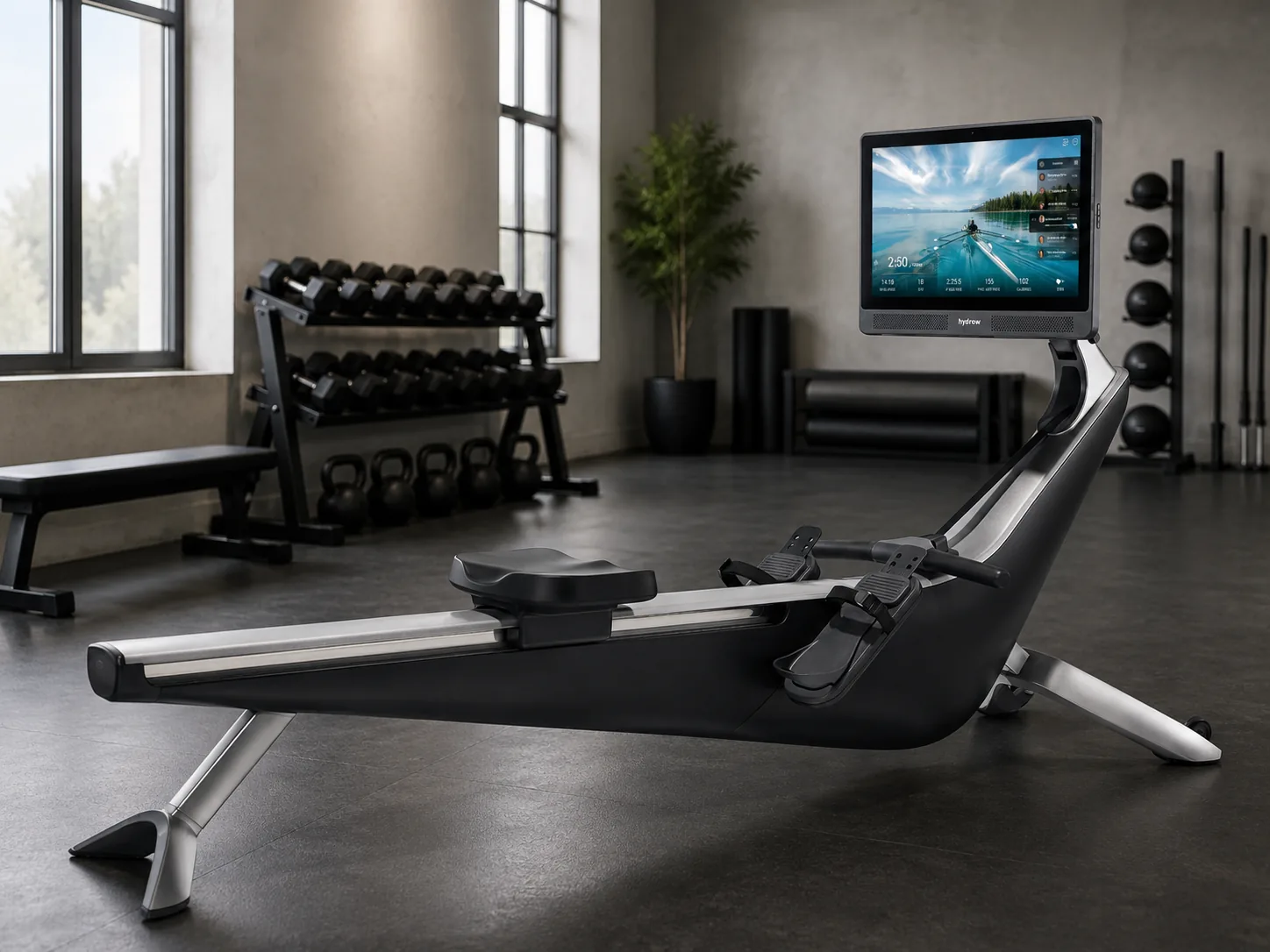
Smart/connected rower · ~$2,195
Hydrow Rower
A premium connected rower with a 22-inch screen and silent electromagnetic resistance, strong on content but reliant on an ongoing subscription.

How we review
Every rower is scored on the same six weighted criteria - resistance & feel, build, monitor, comfort, footprint, and value - from verified specifications, expert consensus, and aggregated long-term owner feedback. Our reviews are independent: we never accept payment for placement or a higher score. Reviewed by Jordan Lockwood (BSc, CPT). See our full methodology.
The Hydrow Rower is the brand's flagship connected machine, built around a large 22-inch pivoting touchscreen and a content library of on-water and studio rowing classes. Unlike a traditional rower that you buy once and use indefinitely, Hydrow is sold as an experience: the hardware is the entry point, and the guided workouts, scenic rows and leaderboards delivered through the screen are the main draw. It uses a computer-controlled electromagnetic resistance system rather than air or water, which makes it almost completely silent in use.
That positioning makes the Hydrow easiest to recommend to a specific type of buyer. If you are motivated by instructor-led classes, want a quiet machine for an apartment or shared living space, and don't mind a recurring membership, it delivers a genuinely polished package. If you are a value-focused rower or a competitive athlete who mainly cares about durability, raw resistance feel and resale, the comparison with established options like the Concept2 becomes much harder for Hydrow to win.
Specifications at a glance
| Resistance type | Electromagnetic (computer-controlled, adjustable 50-300) |
|---|---|
| Monitor | 22" Full HD (1920x1080) pivoting touchscreen |
| Metrics shown | Split, stroke rate, output, calories, total meters, heart rate, leaderboard |
| Connectivity | ANT+ and Bluetooth (heart rate and audio); Wi-Fi required |
| Assembled dimensions | 86"L x 25"W x 47"H |
| Machine weight | 145 lbs |
| Max user weight | 375 lbs |
| Storage | Upright storage with separately purchased wall kit |
| Warranty | 5 years frame / 1 year monitor & labor |
| Subscription | Hydrow All-Access ~$50/month (required for full content) |
| Price | ~$2,195 (rower only) |
Pros
- Near-silent electromagnetic resistance that suits apartments and shared spaces
- Large 22-inch pivoting HD touchscreen with a polished, immersive content library
- Sturdy build with a 375 lb user capacity and a generous 5-year frame warranty
- Computer-controlled resistance offers consistent, repeatable settings for structured workouts
Cons
- High upfront price plus a roughly $50/month subscription to unlock most content
- Long 86-inch footprint, and vertical storage needs a separately purchased wall kit
- Electromagnetic feel is smooth but does not replicate the dynamic catch of an air or water flywheel
- Much of the value is locked behind the membership rather than the hardware itself
Best for: Buyers who want an immersive, instructor-led connected rowing experience in a quiet home and are comfortable paying an ongoing subscription.
The resistance feel: smooth, silent, but not a flywheel
Hydrow's electromagnetic drag is the quietest stroke you can buy. There is no fan roar, no water swish, just a soft mechanical hum, which is exactly why it works in apartments, nurseries-adjacent rooms and pre-dawn living rooms where an air rower would be a non-starter. The resistance is computer-controlled across a wide range and adjustable on the fly, so it scales from a deconditioned beginner to someone who also lifts. Owner sentiment on the feel is genuinely positive: most describe it as glassy-smooth and consistent.
Where it falls short is authenticity. Electromagnetic resistance is even and predictable by design, and that is the catch (so to speak). It does not load up dynamically the way an air flywheel does when you accelerate, and it lacks the progressive, fluid build of a water rower. If you have rowed on water or on a Concept2, the Hydrow stroke can feel slightly synthetic and lacking in the lively connection at the catch. For most home users chasing fitness and immersion, that is a fair trade; for purists chasing stroke realism, it is the machine's defining compromise.
The screen and software are the real product
The 22-inch pivoting HD touchscreen is the centerpiece, and it earns its keep. Reviewers and owners consistently call it crisp, responsive and immersive, and the pivot is a genuinely useful touch because it lets you turn the display toward the floor for the yoga, Pilates, strength and mobility classes that round out the membership. The content library is large (Hydrow advertises well over 5,000 on-demand workouts) and well produced, with live and on-demand rows filmed on real water and coached by accomplished athletes.
This is the part worth being clear-eyed about: you are buying a content subscription that happens to ship with a rower attached. The hardware is good, but the day-to-day experience, the metrics tracking, the leaderboards and essentially every guided workout live behind the membership. That is fine if you want a coached, gamified routine and will actually use it. It is a poor fit if you imagined a screen full of free programs out of the box, because there are none.
Build, footprint and the storage caveat
The frame is steel and aluminum, rated to a 375 lb user capacity and backed by a 5-year frame warranty, which signals confidence in the chassis. In practice owners describe it as solid and stable under hard pulls. But it is a big, heavy machine at roughly 86 inches long and around 145 lb, so it is not something you casually shuffle around a room.
Storage is the asterisk buyers miss. The Hydrow can stand vertically to save floor space, but doing so safely requires the upright storage kit, which is sold separately and must be anchored to a wall stud. If you are tight on space, budget for that accessory and a suitable wall, and do not assume it tucks away as easily as a Concept2, which folds and rolls without tools. This is a machine that wants a semi-permanent home.
What the long-term owner reports actually say
Aggregate ratings are high (in the 4.7 to 4.8 range across thousands of reviews), and the loudest praise is for the programming, the quiet stroke and the screen. The recurring negatives are consistent enough to take seriously. The biggest is the subscription model: a steady stream of buyers feel the mandatory roughly $44 to $50 per month membership was not made obvious enough at purchase, and that the machine is hobbled without it.
Two other themes show up. Customer service draws complaints for slow responses (Hydrow itself flags multi-day reply times) and for friction around repairs and replacement parts. And while reliability is good overall, there are scattered reports of expensive out-of-warranty fixes, including brake encoder or brake assembly failures running into several hundred dollars because those resistance components are sealed and not user-serviceable. These are not common, but they are the kind of failure that is cheap to shrug off on a $900 machine and painful on a $2,000-plus one.
Hydrow versus the Concept2 RowErg
This is the comparison that matters, because the two machines answer opposite questions. The Concept2 RowErg is roughly $900 with no subscription, weighs about 57 lb, separates into two pieces without tools, is famously close to indestructible, holds its resale value, and uses the air-resistance stroke that every erg test and indoor race is standardized on. Its weakness is the experience: the PM5 monitor is a data screen, not a coach, with no video classes and a plain look.
The Hydrow costs more than twice as much up front and adds an ongoing fee, but it buys immersion, coaching, cross-training content and near silence. Over a few years the gap widens dramatically because of the subscription; multiple comparisons put the three-year cost of ownership at three to four times the Concept2. The honest split: if you are self-motivated, data-driven, ever competitive, or budget-conscious, the Concept2 is the smarter machine and it is not close. If you know you need a screen, a voice in your ear and a quiet stroke to actually keep rowing, the Hydrow's premium can be worth it.
Our take
Buy the Hydrow if you are honest with yourself that adherence is your real problem and a premium, coached, near-silent experience is what gets you on the seat several times a week, and if you are genuinely willing to pay the membership indefinitely. It suits apartment dwellers who need quiet, households that will use the yoga, strength and Pilates content beyond rowing, and beginners who want technique coaching from day one. For that buyer it comfortably justifies a 3.8 out of 5.
Skip it if you bristle at recurring fees, if you want stroke realism, if you might want to resell, or if you are an experienced or competitive rower who cares about standardized data. In any of those cases the subscription dependence and the synthetic-feeling catch will nag at you, and your money is better spent elsewhere. The single biggest mistake is buying the hardware while underestimating that the content (and its monthly cost) is the actual product.
Our verdict
The Hydrow is a genuinely excellent connected-fitness experience strapped to a competent, near-silent rower, and at 3.8 out of 5 it earns its place for the right buyer. The 22-inch screen, the polished content library and the apartment-friendly quiet are real strengths, and beginners in particular benefit from the coaching. But there is no escaping that this is a subscription product first and a piece of hardware second: most of the value is locked behind a roughly $44 to $50 per month membership, and without it the machine is a shadow of what the marketing sells.
Buy it if you need immersion and coaching to stay consistent, you want cross-training beyond rowing, and you are comfortable paying the fee for years. Skip it if you want stroke authenticity, hate recurring costs, value resale, or row seriously, in which case a Concept2 RowErg delivers more of what actually matters for a fraction of the long-term spend. Go in knowing the screen and subscription are the product, and the Hydrow makes a lot more sense.
Frequently asked questions
- Can I use the Hydrow without paying for the membership?
- Technically yes, through a basic Just Row mode that lets you row, adjust drag and see live stats on screen. But you get no classes, no scenic rows, no leaderboards, and your metrics are not tracked or saved. In practice the machine is built around the roughly $44 to $50 per month membership, and Hydrow itself does not recommend buying it if you do not plan to subscribe.
- How loud is the Hydrow compared to an air or water rower?
- Very quiet. The electromagnetic resistance produces only a soft hum with none of the fan roar of an air rower or the swish of a water rower, which makes it one of the best options for apartments, shared walls and early-morning sessions. The trade-off is that the stroke feels smoother and more uniform rather than dynamically loading up like an air flywheel.
- Is the Hydrow good for serious or competitive rowers?
- Less so. The electromagnetic stroke does not replicate the dynamic catch competitors train on, and the machine is not the standardized platform used for erg tests and indoor racing. Serious and competitive rowers are almost always better served by a Concept2 RowErg, which offers comparable data, the standard feel and a large competitive community.
- What does the membership include beyond rowing classes?
- Quite a lot, which is part of the value case. Alongside live and on-demand rows coached by accomplished athletes, the library spans yoga, Pilates, strength, circuit and mobility training, plus structured programs and leaderboard racing. The membership also covers the companion app, so you can do non-rowing workouts away from the machine and sync to Strava and Apple Health.
- How reliable is the Hydrow over time?
- Overall ratings are high and most owners report a sturdy, stable machine backed by a 5-year frame warranty. The cautions from real owners are scattered reports of expensive out-of-warranty repairs to sealed resistance components such as the brake encoder, and complaints about slow customer service and parts replacement. These issues are not widespread but are costlier to absorb on a machine at this price.
References
- Hydrow Rower Review: Origin, Wave & Arc Compared - Rowing Related
- Hydrow Rower Review (2026): A Beautiful Rowing Experience - Garage Gym Lab
- Hydrow Origin Rower | Classic & Pure Rowing Machine Experience - Hydrow
Jordan Lockwood (BSc, CPT)
Certified personal trainer (CPT), sports-science graduate, and lifelong rower. Jordan writes and reviews every guide on Rowing Machine Nerd.