 Rowing Machine Nerd
WaterRower S1 Review
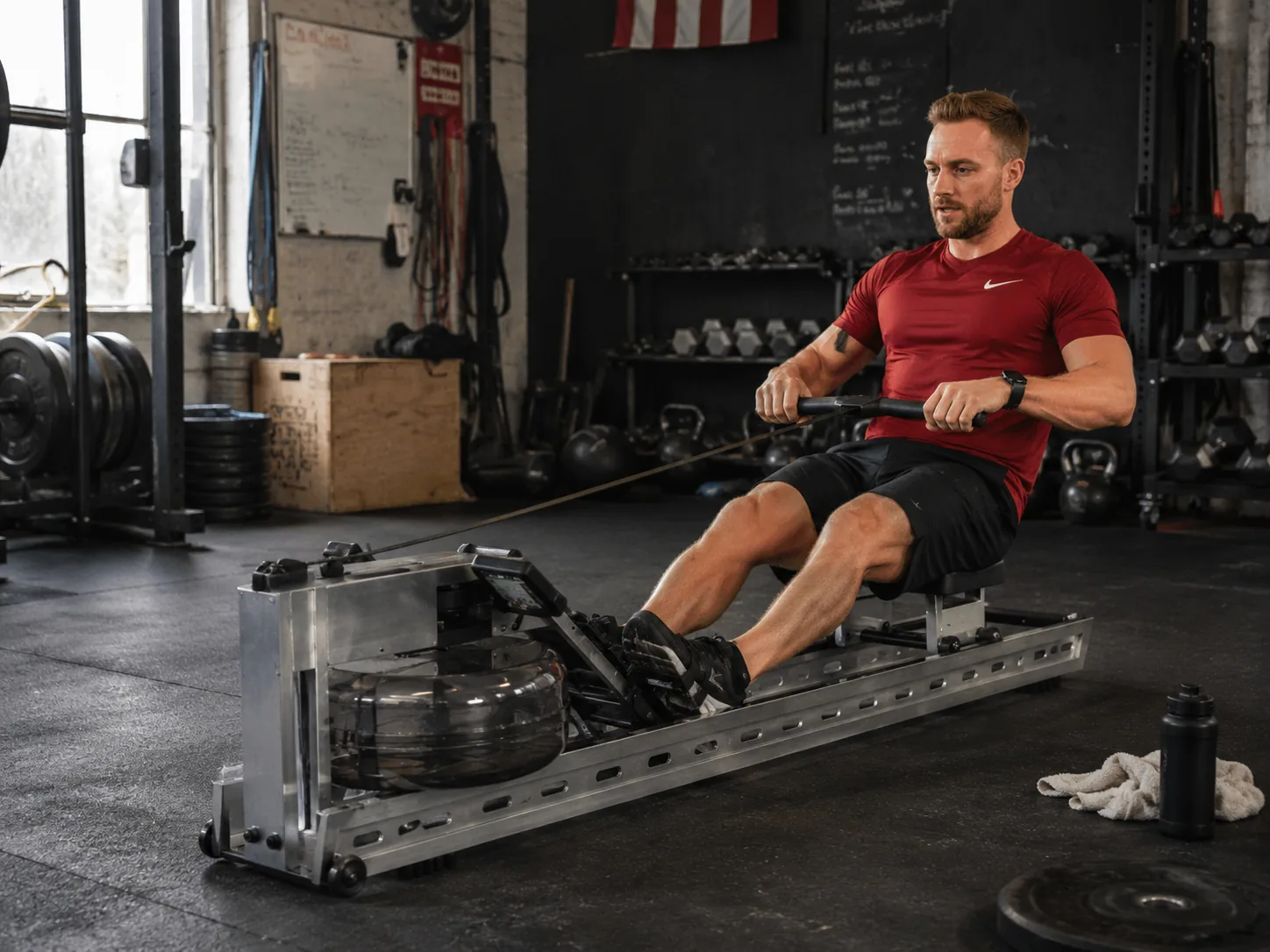
Water rower · ~$3,100
WaterRower S1
A stainless steel WaterRower with smooth water resistance and elite build, but a basic S4 monitor and high price temper the value.

How we review
Every rower is scored on the same six weighted criteria - resistance & feel, build, monitor, comfort, footprint, and value - from verified specifications, expert consensus, and aggregated long-term owner feedback. Our reviews are independent: we never accept payment for placement or a higher score. Reviewed by Jordan Lockwood (BSc, CPT). See our full methodology.
The WaterRower S1 is the brand's stainless steel flagship in its metallic lineup, pairing the company's signature water-flywheel resistance with a brushed steel frame instead of the wood used in WaterRower's better-known models. It carries the standard S4 Performance Monitor and the same patented WaterFlywheel that gives every WaterRower its distinctive, on-the-water feel. The result is a machine aimed as much at design-conscious buyers and commercial settings as at dedicated home rowers.
At a street price hovering around $3,100 to $3,400, the S1 sits firmly in premium territory and competes more on craftsmanship and aesthetics than on technology or outright value. It is best understood as a lifestyle and durability play: a near-indestructible frame and a quiet, fluid stroke, rather than a feature-packed connected machine. This research-based assessment draws on WaterRower's published specifications and reputable retailer listings.
Specifications at a glance
| Resistance type | Water (patented WaterFlywheel), self-regulating |
|---|---|
| Frame | Brushed stainless steel |
| Monitor | S4 Performance Monitor |
| Metrics shown | Intensity/500m split, distance, time, calories, watts; heart rate with belt |
| Connectivity | Bluetooth via optional ComModule accessory; PC link via USB |
| Assembled dimensions | ~83 in L x 22-23 in W x 21-22 in H |
| Machine weight | 88 lb dry / ~125 lb filled (17 L water) |
| Max user weight | ~1,000 lb (frame capacity) |
| Storage | Stands vertically on front wheels |
| Warranty | 1 year; upgradeable to 5 yr frame / 3 yr parts with registration |
| Country of manufacture | USA (German-designed S1 edition) |
| Approx. price | ~$3,100-$3,400 |
Pros
- Stainless steel frame is highly durable and visually distinctive
- Smooth, self-regulating water resistance that scales with effort
- Very high frame weight capacity (~1,000 lb) suits most users
- Stores upright in a small footprint
- Quiet, on-the-water rowing feel
Cons
- Premium price for a machine with a basic monitor
- S4 monitor lacks built-in Bluetooth; connectivity requires the extra-cost ComModule
- Heavier and longer than typical home rowers
- No backlit or touchscreen display
Best for: Buyers who want a premium, design-forward water rower with a near-indestructible stainless steel frame and prefer a quiet, natural rowing feel over screen-based features.
The resistance feel is the whole pitch, and it delivers
Water resistance is the reason anyone pays a premium for a WaterRower, and the S1 nails it. There are no resistance levels to fiddle with; the paddles spinning through the tank self-regulate so that pulling harder gives you more load and easing off gives you less, the same way water behaves behind a real shell. For anyone who has rowed on actual water, the catch-and-drive sensation is the closest a home machine gets, and the rhythmic slosh of the tank is genuinely pleasant to row to rather than a noise you tolerate.
The flip side of self-regulating resistance is that you cannot dial in a fixed, repeatable load the way you can on a damper-and-drag setup. The water gives you a soft, forgiving stroke that is easy on the joints and great for steady-state cardio, but it is less suited to the kind of precise, calibrated interval work that competitive rowers obsess over. If you want a meditative, low-impact, full-body session that feels like being on the river, this is exactly the feel you are buying. If you want to chase a fixed split at a fixed drag factor, the feel works against you.
The S4 monitor is the machine's weakest link
At roughly $3,100, the S1 ships with the same S4 monitor you get on a sub-$1,500 wooden Natural, and that mismatch is the single biggest knock against it. The S4 is a competent but dated unit: it shows the core metrics (time, distance, stroke rate, intensity, calories, heart rate with an added chest strap) on a small, non-backlit LCD with no touchscreen. It does the job for tracking a workout, but it looks and feels generations behind the bright tablets bundled with connected rowers in this price bracket.
Worse, the S4 has no built-in Bluetooth out of the box. To get your data into a phone or third-party app you have to buy the extra-cost ComModule, which clips onto the back of the monitor and presents the rower as a standard FTMS Bluetooth device that apps can read. It works once set up, but charging another battery and paying extra for connectivity that competitors include as standard stings on a machine this expensive. Budget for the ComModule from day one if app workouts matter to you, and know that it can be finicky to pair when multiple devices try to connect at once.
Stainless steel buys you durability and a look, at a real cost
The S1 takes WaterRower's normal hardwood frame and rebuilds it in brushed stainless steel, and this is where the money goes. The steel is essentially maintenance-free in a way wood is not: wooden WaterRowers periodically need their bolts retightened as the timber expands and contracts with humidity, whereas the steel frame is a one-and-done assembly that should outlast almost anything else in your home gym. The frame's quoted weight capacity sits around 1,000 lb, so user weight will never be the limiting factor.
The trade is weight, size, and price. The S1 is heavier and longer than a typical home rower, running over six feet on the floor, though it does stand upright on its end to reclaim space. At a few hundred dollars more than the equivalent wood model, you are paying a meaningful premium for steel durability and an industrial aesthetic that genuinely turns heads, not for any difference in the rowing itself. The actual stroke is identical to the cheaper wooden versions.
Comfort and ongoing upkeep
The seat and padded handle draw consistent praise; the seat is comfortable enough that owners joke about using it as a chair, and the grip helps stave off the blisters air rowers can cause. The one recurring ergonomic complaint is footrest spacing: the foot stretchers sit fairly close together beneath the handle, and rowers with larger, very muscular, or heavier legs sometimes find the position cramped. If that describes you, try the rowing position before committing.
Maintenance is minimal but not zero. The water tank needs a purification tablet added roughly every six months to keep the water clear; a pack of tablets lasts years, and that is essentially the whole maintenance routine. You will not be lubricating chains or replacing wear parts the way you eventually do on some machines, which suits the buy-it-for-life positioning.
How it compares to the Concept2 RowErg
The obvious alternative is the Concept2 RowErg, and the two machines answer different questions. The RowErg costs roughly a third of the S1, weighs far less, splits in two for storage, and is the undisputed standard for competitive rowing, CrossFit, and HYROX. Its air resistance with an adjustable damper gives you calibrated, repeatable loads and a drag factor you can set precisely, and its PM5 monitor has Bluetooth and ANT+ built in with no add-on required. For training data, racing, and pure dollar-for-performance value, the Concept2 wins outright.
The S1 wins on the things the Concept2 deliberately ignores: it is quieter, the water stroke feels more like real rowing, the stainless frame is a statement piece rather than a utilitarian erg, and it carries a much higher weight capacity. The honest summary is that the Concept2 is the better machine for athletes and the better value for almost everyone, while the S1 is for the buyer who wants a beautiful, near-silent, water-feel rower and is willing to pay for materials and aesthetics rather than data and price.
Our take
Buy the S1 if you want the best-built, best-looking water rower money can buy, you value a quiet, joint-friendly, on-the-water feel over precise training metrics, and the stainless steel aesthetic genuinely matters to you as a piece of furniture you will keep for decades. For that buyer, the maintenance-free steel frame, the smooth self-regulating resistance, and the lifetime durability justify the splurge.
Skip it if you are performance-driven, budget-conscious, or data-hungry. At this price the basic, Bluetooth-less-by-default S4 monitor is hard to defend, and a serious trainee gets more rower and more connectivity for far less from the Concept2 RowErg. If you love water resistance but not the bill, WaterRower's own wooden Natural delivers an identical stroke for well under half the cost, with the only sacrifices being seasonal bolt-tightening and a less striking finish. The S1 is a luxury choice, and it should be bought as one.
Our verdict
The WaterRower S1 is a luxury object that happens to be an excellent rowing machine. The stainless steel frame is durable, near maintenance-free, and genuinely beautiful, and the self-regulating water resistance gives the most authentic on-the-water feel you can get at home, quietly and gently enough for daily steady-state work. If aesthetics, build quality, and a meditative water stroke are what you are after, few machines compete.
But at around $3,100 it is hard to ignore that you are paying flagship money for a basic S4 monitor that does not even include Bluetooth without a paid add-on. Performance-minded and value-minded buyers will get more capable, better-connected rowing from a Concept2 RowErg at a fraction of the cost, and anyone who simply loves water resistance can get the same stroke from WaterRower's own wooden Natural for less than half the price. The S1 earns its 3.9 out of 5 as a superb but narrowly aimed machine: buy it for the steel and the feel, not for the value or the tech.
Frequently asked questions
- Does the WaterRower S1 have Bluetooth?
- Not out of the box. The included S4 monitor has no built-in Bluetooth, so to connect to a phone or third-party rowing app you need to buy the extra-cost ComModule, which clips onto the back of the monitor and makes the rower readable as a standard FTMS Bluetooth device. Plan to budget for it if app workouts matter to you.
- How is the S1 different from the wooden WaterRower Natural?
- The rowing experience is identical; both use the same water tank and S4 monitor. The S1 swaps the hardwood frame for brushed stainless steel, which is essentially maintenance-free (no seasonal bolt-tightening), more durable, and more striking to look at. It is also heavier and costs a few hundred dollars more, so you are paying for materials and aesthetics, not a better stroke.
- What maintenance does the S1 need?
- Very little. Add one water purification tablet to the tank about every six months to keep the water clear; a tablet pack lasts years. The stainless frame does not need the periodic retightening that wooden WaterRowers do, and there are no chains or wear parts to service.
- Is the S1 good for serious or competitive rowers?
- Less so. Its self-regulating water resistance gives a great natural feel but cannot be locked to a fixed, repeatable load and drag factor the way a Concept2 can, and the S4 monitor is basic. Competitive rowers, CrossFitters, and HYROX athletes are better served by the Concept2 RowErg, which is the training and racing standard.
- Will the footrests fit larger users?
- The frame's weight capacity is very high (around 1,000 lb), so weight is not the issue. The common complaint is that the footrests sit fairly close together under the handle, which some rowers with larger or very muscular legs find cramped. If that may apply to you, try the position before buying.
References
- WaterRower Metallic S1 (US) - Stainless Steel Rowing Machine - WaterRower / NOHrD
- WaterRower S1 Rowing Machine - The Fitness Outlet
- WaterRower S1 Stainless Steel Rowing Machine - Fitness Direct
Jordan Lockwood (BSc, CPT)
Certified personal trainer (CPT), sports-science graduate, and lifelong rower. Jordan writes and reviews every guide on Rowing Machine Nerd.