 Rowing Machine Nerd
First Degree Monaco Challenge AR Review
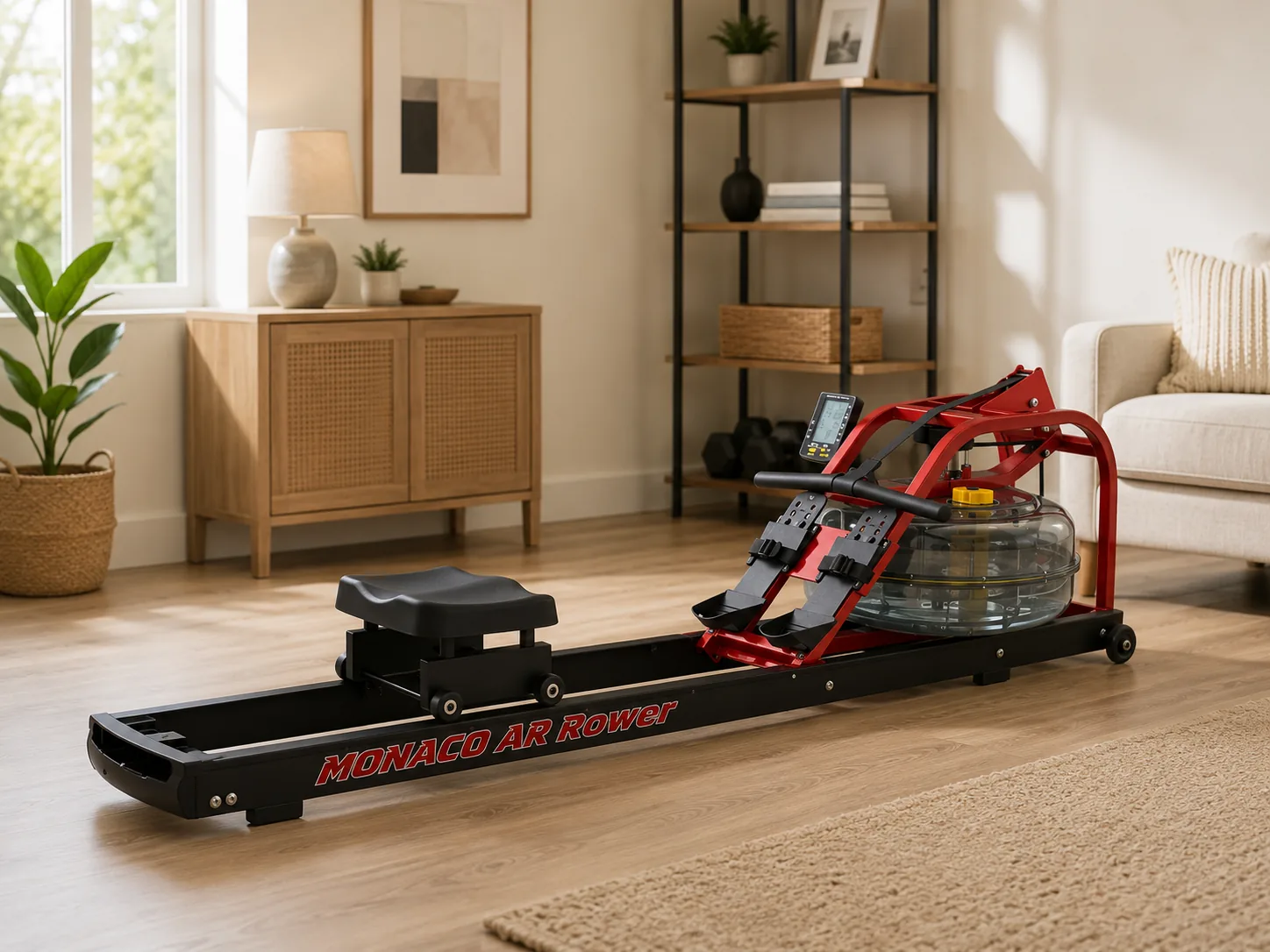
Water rower · ~$1,299
First Degree Monaco Challenge AR
A commercial-grade adjustable water rower with a smooth, quiet stroke, held back by dated connectivity and a price that bumps into Concept2 territory.

How we review
Every rower is scored on the same six weighted criteria - resistance & feel, build, monitor, comfort, footprint, and value - from verified specifications, expert consensus, and aggregated long-term owner feedback. Our reviews are independent: we never accept payment for placement or a higher score. Reviewed by Jordan Lockwood (BSc, CPT). See our full methodology.
The First Degree Monaco Challenge AR sits in First Degree Fitness's lineup of water (fluid) rowers, a brand that builds nothing but water-resistance machines. The defining feature here is the patented twin-tank impeller design paired with an adjustable resistance dial, which lets you change the feel of the stroke from light to sprint-level effort without adding or removing water. That combination aims to bridge the gap between the fixed feel of a classic WaterRower and the on-the-fly adjustability of an air-magnetic machine.
This is a mid-to-upper tier purchase rather than a budget pick. With a commercial-grade dual aluminum rail, a 330 lb user-weight rating, and a street price around $1,299 to $1,499, the Monaco is aimed at home users who want gym-quality construction and the soothing sound of water, plus anyone who prefers the look of a water rower in a living space. It competes directly with the Concept2 RowErg and premium WaterRower models, so the question is whether its strengths justify that company.
Specifications at a glance
| Resistance type | Water (fluid), adjustable via dial; twin-tank impeller design |
|---|---|
| Water tank capacity | 4.5 gal (17 L) |
| Monitor | Multi-panel LCD: time, distance, 500m split, strokes/min, watts, calories/hr |
| Heart rate | Compatible (chest strap not included) |
| Connectivity | USB port for performance recording and online racing; no native Bluetooth |
| Assembled dimensions | Approx. 81.5"L x 20.5"W x 23"H |
| Machine weight | ~78-80 lbs dry (~115 lbs filled) |
| Max user weight | 330 lbs |
| Storage | Stands vertically; can be stored without draining |
| Frame construction | Dual aluminum rail, commercial-grade |
| Warranty | 5 yr frame / 3 yr tank & seals / 2 yr mechanical / 1 yr wear parts |
| Approx. US price | ~$1,299-$1,499 |
Pros
- Adjustable water resistance via a dial, so you can dial in feel without changing tank water volume
- Smooth, quiet fluid stroke with a realistic on-water catch
- Commercial-grade dual-rail aluminum frame and a high 330 lb user-weight rating
- Stands vertically for storage and can be tipped up without draining the tank
- Console shows the key metrics rowers care about, including 500m split and watts
Cons
- No native Bluetooth or modern app ecosystem; connectivity relies on a dated USB/online-racing setup
- Console lacks the data accuracy and software depth of a Concept2 PM5
- At ~$1,300+ it costs as much as or more than a Concept2, which outperforms it on data and resale
- Filled unit is heavy (~115 lbs) and the footprint is long, so moving it is a two-step process
Best for: Buyers who want a quiet, good-looking water rower with adjustable resistance and a commercial-grade frame, and who care more about stroke feel than app connectivity.
What the adjustable resistance dial actually buys you
The headline feature here is the AR dial, and it is genuinely the Monaco's best argument for existing. On a standard WaterRower you change feel by adding or removing water from the tank, which is a fiddly, semi-permanent commitment. The Monaco lets you twist from feather-light to what First Degree markets as Olympic-sprint resistance in seconds, without touching the water. That matters most in two situations: a multi-user household where a 200 lb power rower and a lighter beginner share the same machine, and interval training where you want a heavier load on power pieces and a lighter one on recovery.
One caveat worth being clear-eyed about: water resistance is still self-regulating at its core, so the dial changes the ceiling and the character of the load more than it gives you a precise, repeatable drag number the way a Concept2 damper plus drag factor does. It is a feel adjustment, not a calibrated one. If you want to be able to say you trained at exactly the same setting as last month, that is not really what this dial is for.
Sound, feel and the on-water illusion
This is where water rowers earn their keep, and the Monaco delivers the part people actually buy a fluid rower for. The three-blade impeller spinning in the tank produces that swish that reviewers consistently describe as soothing rather than the industrial whoosh of an air rower, and the stroke has no dead spot at the catch. It feels connected from the first inch of the drive, which is the closest a machine gets to the sensation of moving a real boat.
The practical upshot is that this is a machine you can use early in the morning or in an apartment without waking anyone, and one that rewards a long, patient stroke rather than a frantic one. If your goal is a meditative, low-impact cardio habit you will look forward to, the feel and the sound are a real, daily-life advantage over an air erg. If your goal is squeezing out a faster 2k, the feel is pleasant but not the point.
The console and connectivity are the weak link
The monitor shows the metrics that matter day to day - time, distance, 500m split, stroke rate, calories and watts, all visible at once without scanning - and for steady-state training that is genuinely enough. The problem is everything around it. There is no native Bluetooth and no modern app ecosystem; tracking and online racing run through a dated USB and web-based logging setup that feels a decade behind what connected rowers and even the Concept2 PM5 offer out of the box. A heart-rate chest strap is not included either.
If you live in Strava, Kinomap, or a structured app-driven training plan, this will frustrate you. The data also carries the general water-rower caveat that these machines tend to report flattering, faster-than-Concept2 numbers, so the splits are useful for tracking yourself over time but are not a reliable yardstick against the wider rowing world. Treat the console as a competent dashboard, not a coaching platform.
Build, weight and the reality of moving it
The dual-rail aluminum frame with steel components and powder coating is the part of this machine that feels worth the money. It is stable even at high stroke rates, carries a high 330 lb user rating, and is built to a standard that holds up to years of regular use, which is consistent with the commercial-grade positioning. The contoured padded seat sits high for easy mounting and the footrests are wide and supportive.
Storage is a genuine strength with an asterisk. The metal tank casing means you can tip it vertical and even up-end it without draining the water, so the long roughly 81-inch footprint shrinks dramatically against a wall. But filled, the unit is around 115 lbs, and the length means getting it from rowing position to storage spot is a two-step shuffle rather than a one-handed fold. Plan its home before you buy it; this is not a machine you will casually relocate between rooms.
Versus the Concept2 RowErg
This is the comparison that defines the Monaco's value problem. At roughly 1,300 dollars and up, the Monaco costs as much as or more than a Concept2 RowErg, which sits closer to 1,000 dollars and is the machine serious rowers and most data-driven buyers default to. The Concept2 wins decisively on the things that are hard to argue with: the PM5 monitor is the data and software gold standard, its numbers are the sport's common currency, it has Bluetooth and the ErgData app, and its resale value is so strong that a decade-old unit still sells fast. On pure performance training and long-term value, the RowErg outclasses the Monaco.
So why buy the Monaco instead? Two honest reasons. First, feel and sound - the gliding water stroke and gentle swish are simply more pleasant than the Concept2's louder fan, and that is the difference between a machine you use and one you avoid. Second, the AR dial and the polished, furniture-adjacent aesthetic suit a household that wants something quieter and better looking in a shared living space. If you would happily pay a premium to enjoy the act of rowing more, the Monaco makes sense. If you are optimizing splits and dollars, the Concept2 is the smarter buy.
Our take
Buy the Monaco Challenge AR if you want a beautiful, quiet, commercial-grade water rower for a home or shared space, you value the connected on-water feel over precise data, and the dial-adjustable resistance solves a real problem for a multi-user household. It is built to last, genuinely pleasant to use, and the kind of machine that earns a permanent spot in a room rather than a closet.
Skip it if you are a data-focused or competitive rower, if you want a modern app and Bluetooth ecosystem, or if value and resale top your list - in all three cases the Concept2 RowErg does the job better for similar or less money. The Monaco is a very good water rower held back by a dated console and a price that bumps straight into a tougher competitor, which is exactly why it lands at a solid-but-not-class-leading 3.7 out of 5.
Our verdict
The First Degree Monaco Challenge AR is a genuinely lovely water rower: a commercial-grade dual-rail frame, a smooth dead-spot-free stroke, a soothing swish instead of a fan's roar, and a clever resistance dial that makes it the rare fluid rower that actually suits a multi-user household. If your priority is enjoying the daily act of rowing in a quiet, good-looking machine, it delivers and it will last for years.
But at roughly 1,300 dollars it runs straight into the Concept2 RowErg, which costs less and beats it on data accuracy, software, Bluetooth, and resale - and the Monaco's dated USB-and-web console only widens that gap. Recommended for feel-first buyers who want a water rower and will pay a premium for the experience; everyone chasing splits, modern apps, or value should buy the Concept2 instead. A solid 3.7 out of 5.
Frequently asked questions
- Do you have to drain the tank to move or store the Monaco?
- No. The metal tank casing lets you tip and store it vertically, and even up-end it, without draining the water. The catch is weight and length: filled it is around 115 lbs and the footprint is long, so moving it from rowing position to storage is a two-person-friendly, two-step process rather than a quick fold.
- Does the Monaco Challenge AR have Bluetooth and app support?
- No native Bluetooth and no modern app ecosystem. Workout tracking and online racing rely on a dated USB and web-based logging system through First Degree's site. If you want Strava, Kinomap, or app-driven training plans, this is its biggest weakness, and a Concept2 PM5 or a connected rower will serve you far better.
- How is the adjustable resistance different from a regular WaterRower?
- A standard WaterRower changes feel by adding or removing tank water, which is semi-permanent. The Monaco's AR dial lets you shift from feather-light to a heavy, sprint-style load in seconds without touching the water. It is excellent for multi-user homes and intervals, but it adjusts feel rather than giving a precise, repeatable drag number.
- Is it worth the price over a Concept2 RowErg?
- Only if you specifically want the water stroke. The Concept2 costs less, has far better data and software, includes Bluetooth, and holds resale value better. Buy the Monaco for its smoother, quieter on-water feel and nicer aesthetics in a shared space; choose the Concept2 if performance data, value, and longevity matter most.
- How much maintenance does the water tank need?
- Very little. Periodic bolt and fastener checks plus occasional water treatment (a chlorine or purification tablet) to keep the tank clear is essentially all it asks. The sealed metal-cased tank does not need regular draining, which makes upkeep lower than the casual buyer might expect.
References
- First Degree Monaco AR Challenge Review - Rowing Machine Guide
- First Degree Fitness Fluid Rower Monaco Challenge Review - Best Fitness Equipment
- First Degree Fitness Horizontal Monaco Challenge AR Fluid Rower - Gym Experts
Jordan Lockwood (BSc, CPT)
Certified personal trainer (CPT), sports-science graduate, and lifelong rower. Jordan writes and reviews every guide on Rowing Machine Nerd.