 Rowing Machine Nerd
Life Fitness Heat Row Review
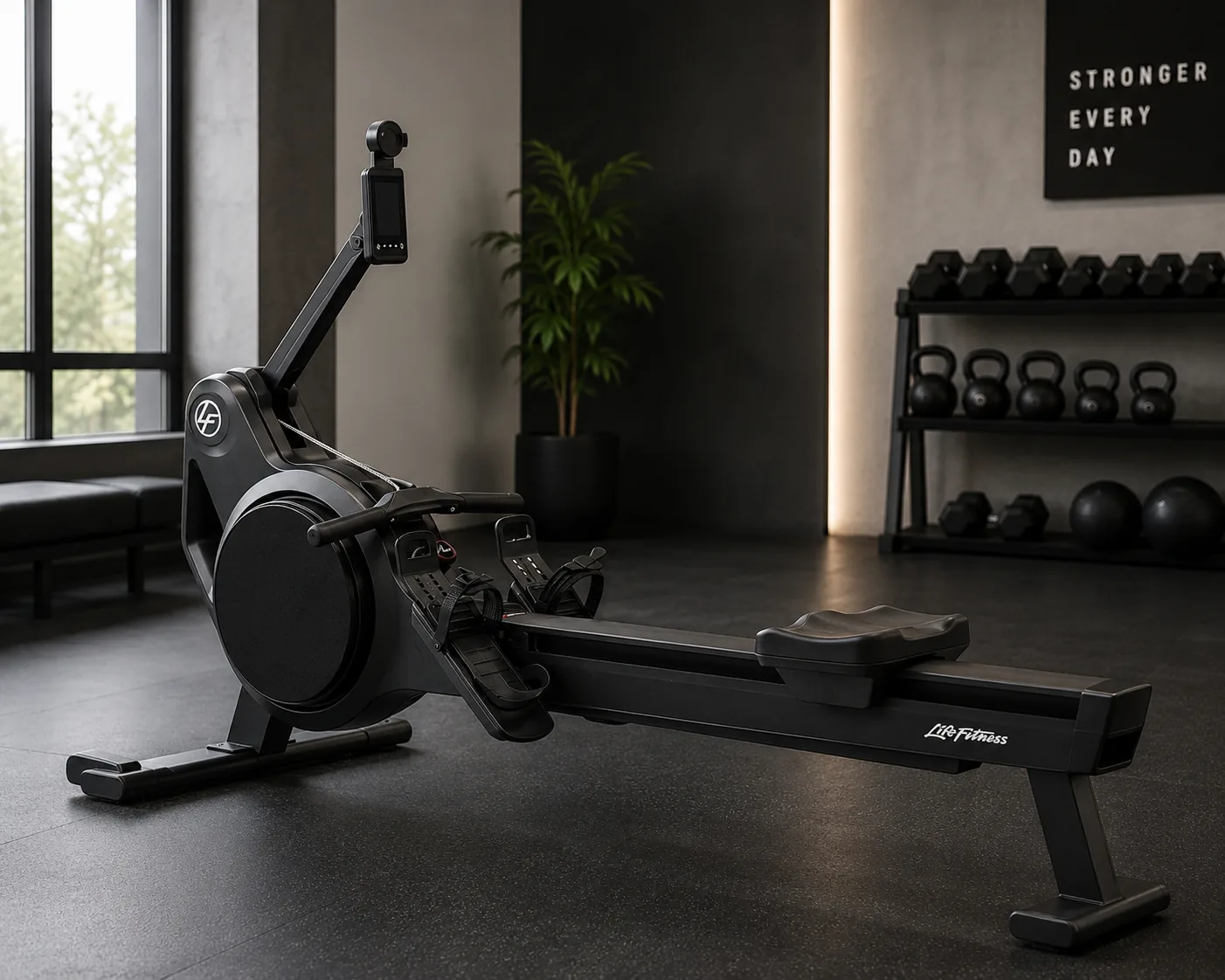
Air + magnetic rower · ~$3,200
Life Fitness Heat Row
A commercial-grade hybrid air-magnetic rower with excellent build and comfort, but a steep price and limited connectivity on the base model.

How we review
Every rower is scored on the same six weighted criteria - resistance & feel, build, monitor, comfort, footprint, and value - from verified specifications, expert consensus, and aggregated long-term owner feedback. Our reviews are independent: we never accept payment for placement or a higher score. Reviewed by Jordan Lockwood (BSc, CPT). See our full methodology.
The Life Fitness Heat Row is a premium indoor rower from a brand best known for supplying commercial gyms. It uses a combined static-air and magnetic resistance system with 100 levels adjusted through a 300-degree knob you can reach from the catch position, and it ships in two configurations: a standard LCD model and a higher-spec Performance model with a TFT 2.0 console. With a heavy steel frame, a 330 lb user rating and commercial-grade hardware, it is built to a durability standard most home rowers do not target.
That commercial pedigree comes at a commercial price. The standard Heat Row sits around $3,200 and the Performance version closer to $3,800, placing it several times above the cost of the most popular performance rowers. This review assesses the Heat Row from published manufacturer and retailer specifications rather than hands-on testing, and it is aimed at buyers deciding whether the build quality and feel justify the outlay over better-known alternatives.
Specifications at a glance
| Resistance type | Combined static air and magnetic, 100 levels via 300-degree knob |
|---|---|
| Console (standard) | LCD console: time, distance, SPM, 500m split, resistance level, calories, watts, estimated heart rate |
| Connectivity (standard) | Polar / analog heart rate; no Bluetooth or app on the standard LCD model |
| Performance variant | TFT 2.0 console with Bluetooth and ANT+, WattRate Direct Power Meter, Coach By Color |
| Assembled dimensions | 85 in L x 28 in W x 47 in H |
| Machine weight | 134 lbs (61 kg) |
| Maximum user weight | 330 lbs (150 kg) |
| Storage | Two transport wheels and transport handle; not specified as folding |
| Warranty | 3 yrs frame, 2 yrs mechanical/parts, 1 yr labor/electronics |
| Approx. price | ~$3,200 (standard LCD); ~$3,800 (Performance) |
Pros
- Commercial-grade build with a heavy, stable frame rated to 330 lb users
- Hybrid air-plus-magnetic resistance with 100 fine-grained levels and a catch-accessible adjustment knob
- Widely praised seat comfort and quick-release ratchet foot straps
- WattRate power metering gives accurate, repeatable watt readings for structured training
Cons
- Standard LCD model has no Bluetooth or app connectivity; you must step up to the pricier Performance/TFT version
- Large 85-inch footprint and 134 lb weight, with no true fold-flat storage
- Warranty is short for the price, especially 1-year labor/electronics
- Premium pricing well above performance benchmarks like the Concept2
Best for: Buyers who want a durable, commercial-quality rower with quiet hybrid resistance for a dedicated home gym or facility and don't mind paying a premium.
Resistance and feel: the quietest serious pull you can buy
The Heat Row's headline trick is layering a magnetic brake over a static air flywheel, and in practice that combination does two things most ergs cannot. It gives you a genuinely fine-grained resistance curve - 100 discrete levels set by a 300-degree dial you can reach from the catch - and it makes the machine remarkably quiet. Where a Concept2 announces every stroke with that signature fan roar, the Heat Row is closer to a whisper, which matters a great deal if you row at 5am next to a sleeping partner or in an apartment with thin floors.
The trade-off worth understanding is that this is not a pure air feel. On a damper-style air erg, the resistance you get is whatever you put in - pull harder, get more back. The magnetic overlay flattens and smooths that dynamic, so the stroke feels more consistent and controlled but slightly less alive and self-scaling than a Concept2 at high damper. Most owners describe the result as premium and effortless; a minority of hard-charging rowers find it a touch synthetic. For interval work and structured intensity it is excellent, and the responsiveness on harder pulls is one of the most consistently praised aspects.
Monitor and the connectivity tax
This is where you have to read the fine print before you buy. The base Heat Row ships with a basic LCD that shows your numbers but offers no Bluetooth, no app, and no real ecosystem - it is a metrics readout, not a connected experience. To get Bluetooth, the TFT 2.0 touchscreen, and the on-board program library you have to step up to the Performance/TFT model, which pushes the price meaningfully higher. That tiered approach is the single most important thing to grasp about this machine, and it is reflected in our cons.
The good news on the data front is real: the WattRate direct power meter is the standout feature for anyone who trains by watts. It produces accurate, repeatable power readings that hold up for structured intervals and benchmarking, which is genuinely useful for athletes who care about output over distance. The frustrating news is that even on the Performance model, the connectivity has drawn complaints - several owners report flaky Bluetooth pairing, including trouble holding a connection with Polar heart-rate straps. If a deep third-party app ecosystem is central to how you train, temper your expectations here; this is a beautifully built erg with competent data, not a connected-fitness platform on the level of a screen-first brand.
Build, comfort and the storage reality
Almost nobody disputes that this feels like commercial equipment in a home, because that is exactly what it is - a light-commercial Life Fitness chassis. The frame is heavy and planted, rated to 330 lb users, and it simply does not flex or skitter under a big drive. The contact points are a real highlight: the seat earns wide praise for comfort on long pieces, and the quick-release ratchet foot straps are fast and secure once set, which is the kind of detail you only appreciate after fighting cheap velcro straps on lesser machines.
The flip side of that solidity is mass and footprint. At roughly 85 inches long and around 134 lb, this is a big object that does not fold flat the way a Concept2 separates into two pieces or a WaterRower stands on end. It can be moved and stored upright, but you should plan for a permanent or semi-permanent home for it rather than something you tuck into a closet between sessions. Worth flagging too: loose foot straps are the most commonly recurring owner gripe, so dial them in properly and re-check them periodically.
Value and warranty: where the price gets hard to defend
At around $3,200 this is priced like a statement piece, and the warranty does not fully back up that positioning. Coverage of roughly three years frame, two years parts, and just one year on labor and electronics is short for the money, and it is the area where the Heat Row looks weakest against both its own price tag and the competition. When the most likely thing to fail on a modern erg is the electronics or console, a single year of electronics cover on a $3,000-plus machine is a genuine concern, and it is one of the clearer marks against an otherwise excellent product.
The broader value question is simple: you are paying a substantial premium over machines that match or beat it on the metrics that decide races and benchmarks. The build quality, the silence, and the seat comfort are real and you can feel them, but you are buying them at a price where the obvious alternative does the core job for less than half the cost. Whether that premium is worth it comes down to how much you value commercial-grade feel and quiet operation over pure cost-per-performance.
Heat Row versus the Concept2 RowErg
This is the comparison that matters, and it is not close on value. The Concept2 RowErg costs roughly a third of the Heat Row, is the de facto standard for competitive and serious training, separates for storage, and carries a longer, more reassuring warranty. For pure performance per dollar, data credibility, and resale value, the Concept2 wins decisively, and most serious rowers should at least try one before spending three times as much.
Where the Heat Row pulls ahead is exactly where the Concept2 is unapologetic about being a tool rather than a luxury good. The Heat Row is dramatically quieter, feels more substantial and refined, has a more comfortable seat and slicker foot straps, and on the Performance model offers a touchscreen the Concept2 does not pretend to provide. The honest framing: choose the Concept2 if performance, portability, and value drive your decision, and choose the Heat Row if near-silent operation, commercial-grade feel, and a polished home-gym aesthetic are worth a steep premium to you. They are aimed at different buyers despite landing in the same activity.
Our take
Buy the Heat Row if you want a premium, near-silent, commercial-grade rower as a permanent fixture and you genuinely value how it feels and looks over how much it costs - and if you go this route, strongly consider the Performance/TFT version, because the base LCD model's lack of any connectivity makes the price even harder to justify. It suits the buyer who would have bought a treadmill or bike from a high-end brand anyway, rows for fitness and intervals rather than competition, and is happy to pay for silence and refinement.
Skip it if you are performance-first, budget-conscious, or short on space. Competitive rowers, anyone who trains by standardized benchmarks, and shoppers who care about resale and warranty are better served by the Concept2 RowErg at a fraction of the price. Also skip it if you need fold-flat storage or a deep third-party app ecosystem - the footprint is large, it does not pack away, and the connectivity has been a recurring sore point even on the upgraded model. At 3.9 out of 5 this is a genuinely excellent machine held back by price, a short electronics warranty, and a base model stripped of the connectivity buyers at this price expect.
Our verdict
The Life Fitness Heat Row is a genuinely excellent rower wearing a price tag that asks a lot of you. The hybrid air-plus-magnetic resistance is smooth and almost silent, the commercial-grade frame is rock-solid to 330 lb, the seat and quick-release straps are among the most comfortable around, and the WattRate power meter gives serious athletes trustworthy data. If quiet operation and commercial feel are what you are paying for, it delivers them better than almost anything in a home.
But at around $3,200 the cracks show: the base model has no connectivity at all, forcing you up to the costlier Performance version; even that version draws Bluetooth complaints; the footprint is large and does not fold away; and a one-year electronics warranty is thin for the money. We rate it 3.9 out of 5 - a superb machine for the buyer who prizes refinement and silence over value, but one most performance-minded or budget-conscious rowers should pass on in favor of a Concept2 RowErg that does the core job for a third of the price.
Frequently asked questions
- What is the difference between the standard Heat Row and the Heat Performance Row?
- The standard Heat Row uses a basic LCD console with no Bluetooth or app connectivity. The Performance (TFT) model adds the TFT 2.0 touchscreen, on-board workout programs, and Bluetooth. If you want any connected features or screen-based programming, you must step up to the pricier Performance version - the base model is metrics-only.
- Is the Heat Row actually quieter than a Concept2?
- Yes, noticeably. The magnetic overlay on the static air flywheel makes it one of the quietest rowers available, far quieter than the fan roar of a Concept2. This is a real advantage for apartments, early-morning sessions, or shared spaces where noise is a concern.
- Does the Heat Row fold up for storage?
- Not flat. At about 85 inches long and roughly 134 lb it is a large, heavy commercial-style frame. You can move it and store it upright, but it does not separate into two pieces like a Concept2 or stand on end like a WaterRower. Plan for a fairly permanent spot.
- Is it worth the price over a Concept2 RowErg?
- Only if you specifically value near-silent operation, commercial-grade build, seat comfort, and a refined aesthetic. On pure performance, data credibility, portability, warranty, and value, the Concept2 wins at roughly a third of the cost. The Heat Row is a premium feel-and-finish purchase, not a value one.
- How good is the data and connectivity for structured training?
- The WattRate direct power meter is a genuine strength - accurate, repeatable watt readings ideal for interval and watt-based training. Connectivity is weaker: even on the Performance model, owners report flaky Bluetooth and occasional trouble pairing heart-rate straps like Polar, so do not expect a polished connected-app ecosystem.
References
- Heat Row - Life Fitness - Life Fitness
- Heat Row - Life Fitness Shop - Life Fitness Shop
- Life Fitness Heat Row Review - Rowing Machine Guide
Jordan Lockwood (BSc, CPT)
Certified personal trainer (CPT), sports-science graduate, and lifelong rower. Jordan writes and reviews every guide on Rowing Machine Nerd.