 Rowing Machine Nerd
WaterRower A1 Home Review
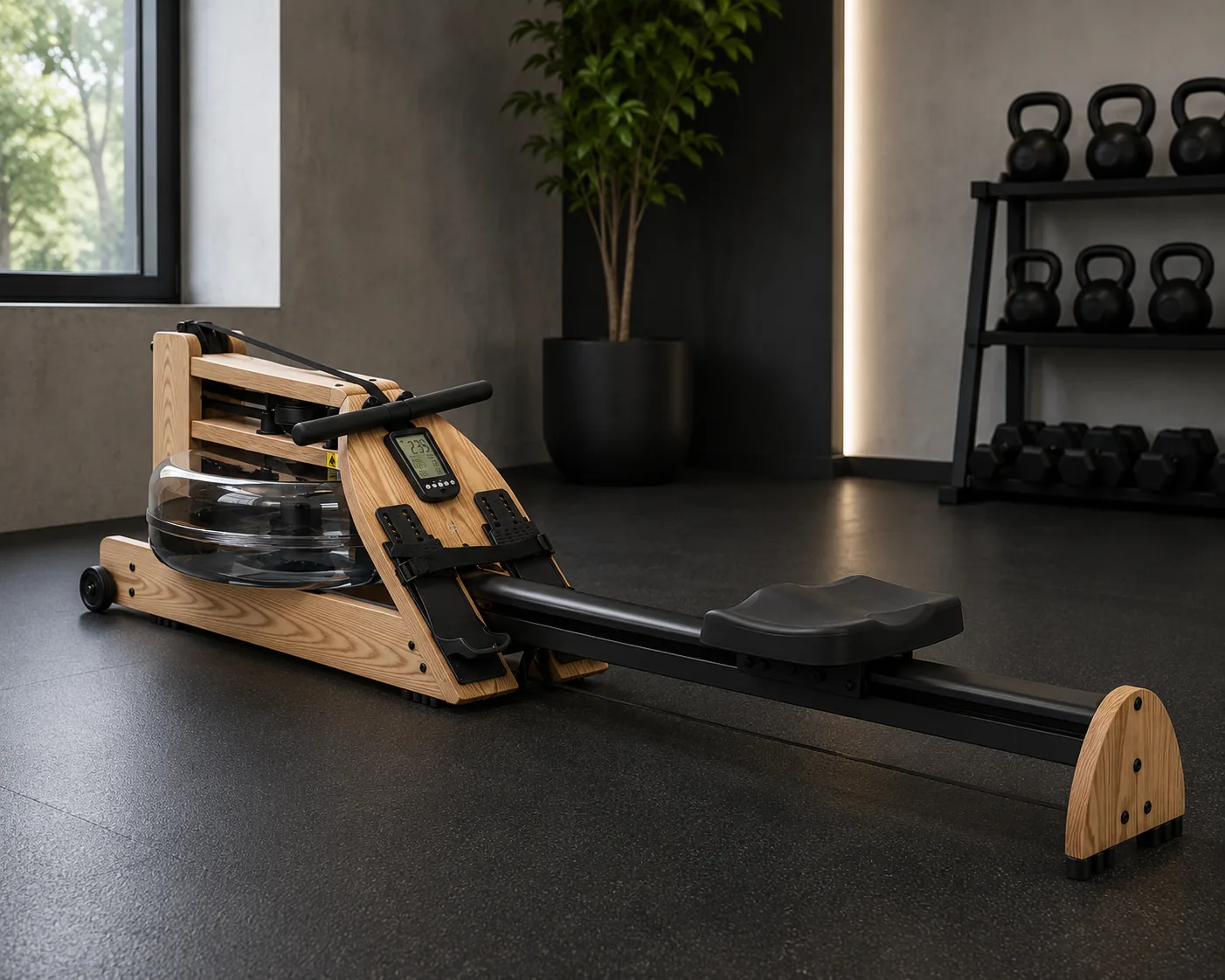
Water rower · ~$895
WaterRower A1 Home
A handsome, smooth-rowing entry WaterRower whose appeal is real but undercut by a bare-bones, app-less A1 monitor at a premium price.

How we review
Every rower is scored on the same six weighted criteria - resistance & feel, build, monitor, comfort, footprint, and value - from verified specifications, expert consensus, and aggregated long-term owner feedback. Our reviews are independent: we never accept payment for placement or a higher score. Reviewed by Jordan Lockwood (BSc, CPT). See our full methodology.
The WaterRower A1 Home is the most affordable model in WaterRower's lineup, built to bring the brand's distinctive wooden frame and water-resistance feel to buyers who don't want to pay for the flagship consoles. It pairs an ash hardwood body and aluminium monorail with the entry-level A1 monitor, trading the data-rich S4 unit found on dearer WaterRowers for a stripped-back display that covers only the essentials.
It is aimed squarely at the casual-to-intermediate home user who values the look, quiet operation and natural stroke of a water rower over training metrics, app integration or structured workouts. If you want a rower that feels alive under the pull, stands neatly upright in a living space and is built to last, the A1 Home delivers on that brief, though the basic console and premium price mean it isn't the obvious pick for everyone.
Specifications at a glance
| Resistance type | Water (paddle flywheel in a water tank) |
|---|---|
| Monitor | A1 monitor: intensity, time, distance; programmable time/distance workouts |
| App / Bluetooth | Not specified (no connectivity advertised on this model) |
| Frame material | Ash hardwood with aluminium monorail |
| Assembled dimensions | Approx. 82-84 in L x 21-22 in W x 20-22 in H (varies by source) |
| Weight | ~61 lb empty / ~98 lb filled with water |
| Max user weight | 275-300 lb (sources vary) |
| Max user height/inseam | Up to ~6 ft 4 in / inseam ~39 in |
| Storage | Stands upright on end for storage |
| Power | 2 AA batteries (monitor) |
| Warranty | 1 year; upgrades to 5 years frame / 3 years parts on registration |
| Price | ~$895 US (entry model in WaterRower line) |
Pros
- Smooth, quiet water resistance with a natural, self-paced stroke feel
- Handcrafted ash hardwood and aluminium build that is solid and attractive
- Comfortable ergonomic handle, padded seat and wide footrests
- Stands upright for relatively compact storage
- Generous warranty after registration (5-year frame / 3-year parts)
Cons
- A1 monitor is very basic: no heart rate, intervals, app or Bluetooth connectivity
- No backlight and limited data display compared with the S4 monitor on pricier models
- Premium price for an entry-level console
- Long fixed footprint; only the upright dimension is compact
Best for: Buyers who want WaterRower's signature wooden build and smooth water feel for steady-state home rowing and don't care about connected metrics or training apps.
The water-resistance feel is the whole reason to buy it
Strip away the spec sheet and the WaterRower A1 earns its keep on one thing: the stroke. The WaterFlywheel spins a paddle through an actual tank of water, so resistance scales with how hard you pull rather than sitting at a fixed level. The result is a self-paced, progressive catch and a swooshing sound owners consistently describe as meditative rather than mechanical. If you find air rowers harsh on the hands or grating to listen to, this is the antidote.
The flip side of water resistance is that you do not dial it in with a lever. There is no damper to flick between 1 and 10 the way you can on an air rower. The only way to change the baseline feel is to add or drain water in the tank, and most owners just set it once and forget it. That is fine for steady-state and endurance work, but anyone who wants to toggle quickly between a light recovery row and a heavy power session will find the A1 less flexible than the marketing implies. The resistance ceiling is genuinely high if you fill the tank, so the limitation is convenience, not strength.
The A1 monitor is the catch, and you should go in with eyes open
This is where our 3.6 rating gets dragged down. The A1 monitor shows the essentials - time, distance, intensity in watts, strokes per minute, a 500m split and calories - and for a beginner logging steady rows that is genuinely enough to train by. But the omissions are real and they are not subtle. There is no heart-rate support of any kind, no interval programming, no app, no Bluetooth, and no backlight, so you are reliant on room lighting to read it. In 2026, at this price, an app-less console with no heart-rate input feels at least one generation behind.
The saving grace is that the A1 console is not permanently welded to your future. WaterRower designed the monitor as a swappable unit, and owners who later want firmware updates, heart-rate pairing and projected-duration data can upgrade to the S4 monitor down the line. That softens the sting, but it also means you are effectively buying into a console you may pay to replace - which is worth factoring into the real cost before you commit.
Build, comfort and the monorail trade-off nobody mentions
The handcrafted ash hardwood and aluminium construction is the part of the A1 that lives up to every photo. It is solid, attractive, dampens vibration well, and looks like furniture rather than gym equipment - a real factor if it has to live in a lounge. The ergonomic handle, padded seat and wide footrests get steady praise from owners, and it stands upright with a footprint owners compare to a dining chair.
What buyers often miss is that the A1 uses a single-rail (monorail) frame, not the twin rails of the pricier Natural and Classic models. The monorail keeps the cost and weight down, but it carries a lower weight capacity (around 275 lb versus the four-figure ratings on dual-rail models) and a more modest stability rating. For most users this is a non-issue, and the long fixed footprint when in use is the more practical concern - only the upright storage dimension is compact, so you still need a clear stretch of floor to row.
Maintenance is easy, but it is not zero
A water rower is the only category that asks you to think about what is inside the tank. With the A1 the routine is light: fill it with municipal tap water (the residual chlorine helps keep it clear) and drop in one WaterRower purification tablet roughly every six months to keep algae and bacteria at bay. The tablets are inexpensive and WaterRower will supply them free on request.
The one rule worth tattooing on the frame is to never use pool chlorine or bleach tablets - they will damage the polycarbonate tank. Beyond that, the maintenance burden is genuinely minor and far less fussy than skeptics assume. It is a different kind of upkeep from an air rower, not a heavier one.
WaterRower A1 versus the Concept2 RowErg
This is the comparison that should decide the purchase. At roughly $990 the Concept2 RowErg is the obvious alternative and, frankly, the better training tool for the money. Its PM5 monitor records heart rate, runs intervals, pairs with apps, and is the de facto standard for serious rowers and CrossFit; its air resistance is instantly adjustable via the damper, and its longevity and resale value are legendary. On pure data, durability and value, the RowErg wins.
What the RowErg cannot do is be quiet, look beautiful, or feel like real water. It is louder, it is unapologetically utilitarian, and it stores by separating into two pieces rather than standing elegantly upright. So the honest split is this: buy the Concept2 if you care about training metrics, racing, structured programs and dollar-for-dollar performance; buy the WaterRower A1 if the sound, the smooth stroke and a machine you are happy to leave on display matter more to you than data. The A1 is paying a premium for ambience, and only you can decide that ambience is worth roughly a hundred dollars over a more capable erg.
Our take
The WaterRower A1 Home is a genuinely lovely machine held back by a console that does not match its price. Buy it if you are a recreational rower who wants a quiet, smooth, self-paced workout, values a machine that looks like furniture, and either does not care about heart-rate and app integration or is comfortable upgrading to the S4 monitor later. For steady-state cardio in a shared living space, few rowers are nicer to use or to look at.
Skip it if you train by heart-rate zones, want interval programs and app connectivity out of the box, weigh near or above the 275 lb limit, or simply want the most capable rower per dollar - in which case the Concept2 RowErg is the smarter buy. The A1 is a 3.6 not because it rows badly, but because at this price the bare A1 monitor asks you to either pay more later or accept less than the competition gives you today.
Our verdict
The WaterRower A1 Home is the rare piece of cardio kit you might actually want on display, and its water-driven stroke is as smooth and quiet as the reviews promise. The handcrafted ash-and-aluminium build, comfortable seat and upright storage are all real strengths. But this is an entry WaterRower wearing a premium price, and the bare-bones A1 monitor - no heart rate, no intervals, no app, no backlight - is a genuine drag on the value at a moment when cheaper rivals do more.
Buy it if you are a recreational rower who prizes ambience, a beautiful machine and a self-paced stroke over data, and you are content to train without heart-rate zones or to upgrade to the S4 monitor down the road. If your priority is training metrics, programs, connectivity or the most capability per dollar, the Concept2 RowErg is the wiser purchase. A handsome, well-built rower undercut by an underwhelming console - 3.6 out of 5.
Frequently asked questions
- Does the WaterRower A1 monitor track heart rate or connect to an app?
- No. The stock A1 monitor has no heart-rate input, no Bluetooth, no app and no backlight. It shows time, distance, intensity, stroke rate, a 500m split and calories. If you need heart rate or connectivity, you would have to upgrade to WaterRower's S4 monitor separately.
- Can I upgrade the A1 monitor later?
- Yes. The monitor is a swappable unit, so owners who later want firmware updates, heart-rate pairing and projected-duration metrics can fit the S4 monitor. Factor that added cost in if those features matter to you, since it effectively raises the real price of the package.
- How much maintenance does the water tank need?
- Very little. Fill it with regular tap water and add one WaterRower purification tablet about every six months to prevent algae. Never use pool chlorine or bleach, which can damage the polycarbonate tank. The tablets are cheap and often supplied free by WaterRower.
- How does the A1 differ from the pricier WaterRower Natural?
- The A1 uses a single-rail (monorail) frame rather than twin rails, which lowers the cost but also the weight capacity (around 275 lb) and stability rating. The rowing feel and water resistance are the same; the main differences are frame design, weight limit and the monitor.
- Is the A1 worth it over a Concept2 RowErg?
- Only if aesthetics, quiet operation and the water-stroke feel matter more to you than data and value. The Concept2 RowErg costs a little less, has a far more capable PM5 monitor with heart rate, intervals and apps, plus instantly adjustable resistance. For pure training capability the RowErg wins; the A1 wins on looks and sound.
References
- WaterRower Hands-On Review - Healthline
- WaterRower A1 Home Rowing Machine Review - Rowing Machine King
- WaterRower A1 Home - G&G Fitness Equipment (livefit.com)
Jordan Lockwood (BSc, CPT)
Certified personal trainer (CPT), sports-science graduate, and lifelong rower. Jordan writes and reviews every guide on Rowing Machine Nerd.