 Rowing Machine Nerd
XTERRA Fitness ERG700 Review
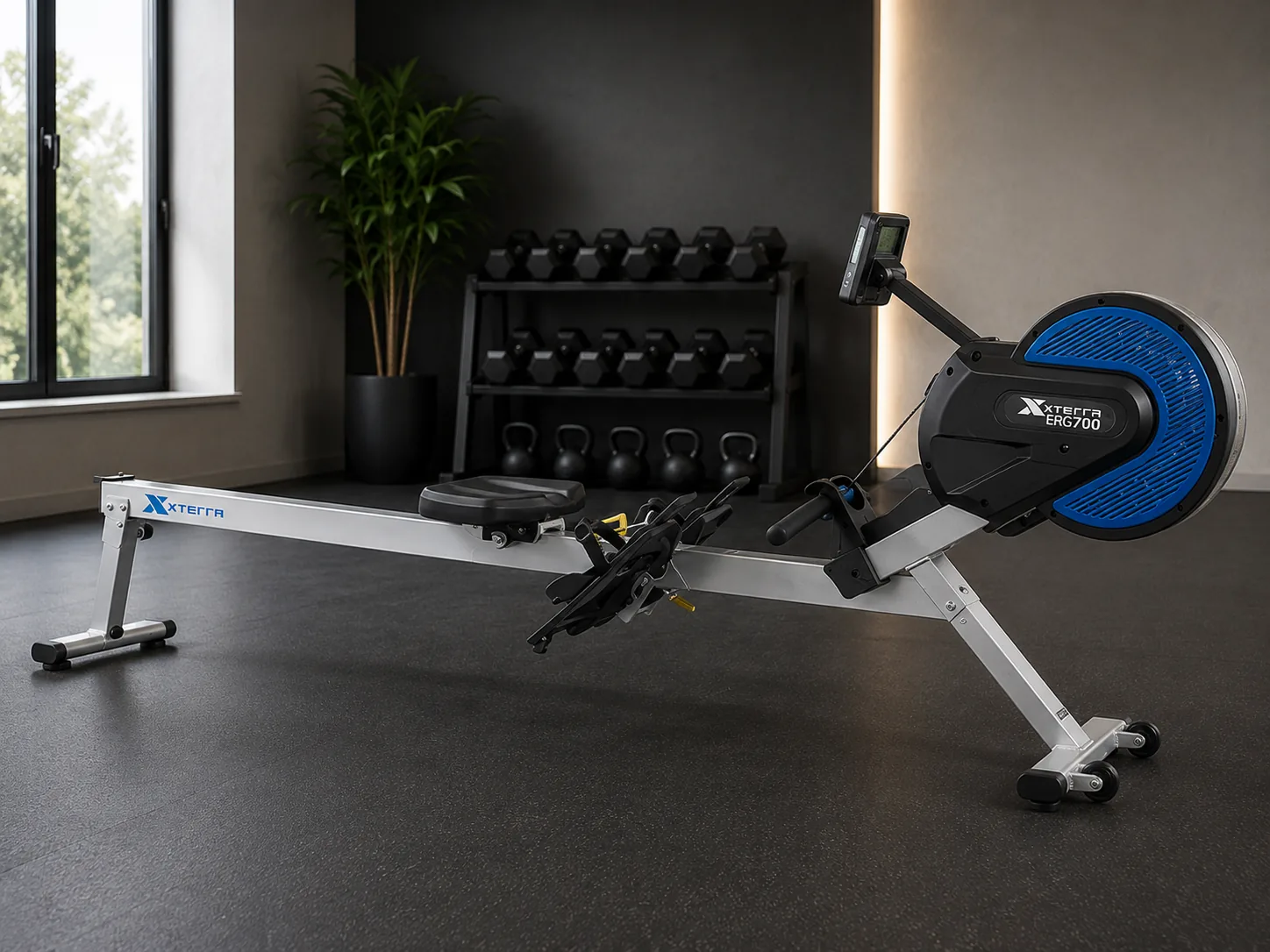
Air + magnetic rower · ~$600
XTERRA Fitness ERG700
A feature-rich air-plus-magnetic home rower with a high weight capacity, held back by a price that drifts into Concept2 territory.

How we review
Every rower is scored on the same six weighted criteria - resistance & feel, build, monitor, comfort, footprint, and value - from verified specifications, expert consensus, and aggregated long-term owner feedback. Our reviews are independent: we never accept payment for placement or a higher score. Reviewed by Jordan Lockwood (BSc, CPT). See our full methodology.
The XTERRA Fitness ERG700 sits at the upper end of XTERRA's rowing line and tries to bridge the gap between entry-level home machines and serious performance ergs. It pairs a flywheel that combines air resistance with eddy-current magnetic braking, giving 16 selectable levels rather than the single, speed-dependent feel of a pure air rower. On paper that flexibility, plus a 350 lb weight capacity and a backlit console, positions it as a well-rounded option for a household gym.
It is aimed at general fitness users who want a comfortable, quiet rower for cardio and steady-state training, and who value adjustable resistance and a clear metrics display over connected-app integration. Buyers cross-shopping the Concept2 Model D should weigh the ERG700's broader feature set against the Concept2's proven durability, resale value and software ecosystem, because at full list price the two land uncomfortably close.
Specifications at a glance
| Resistance type | Air + eddy-current magnetic, 16 levels |
|---|---|
| Console | 5.5-inch backlit LCD, adjustable height/angle |
| Programs | 10 preset workouts (interval, fat burn, cardio, strength) |
| Metrics shown | Time, distance, strokes/min, count, calories, heart rate, watts, level |
| App / Bluetooth | Built-in heart-rate receiver; no documented training-app ecosystem |
| Assembled dimensions | 97" L x 18" W x 38" H |
| Folded footprint | ~52.5" L, vertical fold with transport wheels |
| Machine weight | ~81 lb |
| Max user weight | 350 lb |
| Seat height | 20" |
| Warranty | Lifetime frame, 5 years parts, 1 year labor |
Pros
- Hybrid air-plus-magnetic resistance with 16 selectable levels for consistent, quiet drag
- High 350 lb user-weight capacity and a lifetime frame warranty signal solid build
- Backlit 5.5-inch console with adjustable height shows a full set of metrics including watts
- Contoured raised seat and accommodation for users up to about 6'4" aid comfort
Cons
- List pricing pushes it close to the Concept2 Model D, which it cannot match on resale value or software
- Limited connected features; no robust training-app ecosystem despite a heart-rate receiver
- Long 97-inch frame still occupies a tall, sizeable footprint even when folded
- Console requires mains power, so there is no battery-only operation
Best for: Home users who want a comfortable, feature-equipped hybrid rower for steady-state cardio and aren't planning to plug into a connected fitness platform.
Resistance and feel: the hybrid is the whole pitch
The ERG700's headline trick is pairing an air fan with a magnetic brake, and on this point the design largely delivers. The fan gives you the dynamic, wind-up resistance that air rowers are loved for, where pulling harder is met with more drag, while the magnetic element lets you dial in one of 16 fixed levels from the console for predictable, quieter sessions. The practical upshot is that you can chase a hard, breathless interval and then switch to a low, library-quiet steady-state row without changing your stroke mechanics. Most owners describe the catch and recovery as genuinely smooth, and the noise floor sits well below a pure air rower like a Concept2 at the same effort.
Be clear-eyed about what the hybrid does and does not buy you, though. It does not give you the infinitely variable, self-scaling drag that serious rowers prize about a flywheel-only erg, and the 16 magnetic steps are a convenience feature rather than a training tool you will live by. For general fitness rowers who value quiet operation in an apartment or shared space, it is a real advantage. For anyone training to a watts or split target, the air side is doing the meaningful work and the magnetic levels mostly change how heavy the machine feels, not how precisely you can program it.
Monitor and connectivity: capable readout, walled garden underneath
The 5.5-inch backlit console is one of the ERG700's stronger everyday features. It is height- and angle-adjustable, easy to read, and shows a full metric set including time, distance, strokes per minute, calories, watts and heart rate, which is more than many rowers near this price bother to surface. For someone who just wants to see honest numbers and a workout track while they row, it does the job without fuss.
The trouble starts the moment you want those numbers to leave the machine. The ERG700 leans on a proprietary 5kHz chest strap for heart rate rather than open Bluetooth, the strap is sold separately, and there is no meaningful pathway into the training-app ecosystem that buyers increasingly expect at this price. There is no robust Zwift, Kinomap or ErgData-style experience to lock into here. Owners have also flagged that the console can time out mid-session if you step away to do other exercises, which is a small but real annoyance for circuit-style training. Add the fact that the console runs off mains power with no battery-only mode, and the connectivity story reads as dated for a machine that wants Concept2 money.
Build, comfort and the reality of repairs
Physically, the ERG700 is built to reassure. The 350 lb user capacity, the contoured raised seat sitting around 20 inches off the floor, and a rail that comfortably handles users up to roughly 6'4 all point to a machine meant for a wide range of bodies and for long-term household use. The high seat in particular is an underrated comfort win for older or larger users, who can sit down and stand up without folding themselves to the floor. Assembly is widely reported as straightforward, in the region of half an hour, and the lifetime frame warranty plus five years on parts signals that XTERRA stands behind the structure.
The caveat that recurs in owner reports is serviceability. A minority describe resistance dropping out mid-stroke, handles failing early, and replacement parts that are slow to arrive, and at least one account relays a service technician calling these units difficult to work on. That does not make the ERG700 unreliable for most buyers, but it does mean the downside scenario is genuinely frustrating rather than a quick fix. The warranty paperwork is generous on paper; the lived experience when something goes wrong is the part to weigh.
Footprint and storage: folds, but stays big
XTERRA markets the ERG700 as foldable and space-saving, and that is half true. The frame folds and can be wheeled aside, with a folded footprint in the region of 52 inches long, so it will tuck into a corner rather than dominate a room. That is a meaningful improvement over a fixed monorail that you simply have to live around.
The honest qualifier is that this is a long machine to begin with, near 97 inches in use, so even folded it is tall and not trivially light to maneuver. If your plan is to stash it vertically in a closet between sessions, set expectations accordingly. It is apartment-friendly in the sense that it can be moved out of the way, not in the sense that it disappears.
Versus the Concept2 RowErg: the comparison that defines it
The ERG700's biggest problem is the machine it sits next to on the shopping list. At sale prices the XTERRA can be a genuine bargain, but at list it drifts up toward the Concept2 RowErg (the machine formerly sold as the Model D), and that is a fight it cannot win on the metrics that matter most to committed rowers. The Concept2 has the deeper data ecosystem via its PM5 monitor and ErgData, it is the de facto standard in gyms and CrossFit boxes so your splits are comparable to everyone else's, and it holds resale value almost uniquely well in home fitness. A used Concept2 is close to a liquid asset; a used ERG700 is just a used rower.
Where the XTERRA answers back is comfort and quiet. The raised seat is far kinder to get on and off than the Concept2's low slide, and the air-plus-magnetic system is noticeably quieter at matched effort, which can be the deciding factor in a shared home. So the decision is cleaner than the price overlap suggests: buy the ERG700 over the Concept2 only if quiet operation and an easy-entry seat outrank data depth, durability of resale, and software, and only if you can get it on sale rather than at list.
Our take: who should buy and who should skip
Buy the ERG700 if you are a general home-fitness rower who wants a smooth, quiet, comfortable machine, who values a high seat and a generous weight capacity, and who is buying it on a discount that opens up clear daylight against the Concept2. For casual-to-moderate users who will never touch a training app and just want honest on-screen metrics, it is a likeable, well-built rower that should serve for years if it arrives healthy.
Skip it if connectivity matters to you, if you want to follow structured app-based workouts or race online, or if you are looking at it near full price. At list it asks you to pay close to Concept2 money for a machine with weaker software, no real app ecosystem, a proprietary heart-rate strap, mains-only power, and a thinner repair and resale safety net. Serious rowers chasing data and longevity should put the money toward the Concept2 instead. The ERG700 earns its 3 out of 5 as a solid comfort-first rower that is undermined mainly by its own price positioning.
Our verdict
The XTERRA ERG700 is a comfortable, quiet, solidly built home rower that is mostly let down by where it lands on the price ladder. The hybrid air-plus-magnetic resistance is smooth and apartment-friendly, the raised seat and 350 lb capacity make it welcoming for a wide range of users, and the backlit console shows everything a casual rower needs. Buy it when it is discounted, treat it as a comfort-first machine for general fitness, and it will reward you.
What it cannot do is justify itself at full price against the Concept2 RowErg. Pay near Concept2 money and you give up the deeper data ecosystem, app-based training, gym-standard splits, and the resale value that makes a Concept2 almost risk-free to own, while accepting mains-only power, a proprietary heart-rate strap, and a thinner repair safety net. It earns a fair 3 out of 5: a likeable rower for the right buyer at the right price, and an easy skip for anyone chasing data, software, or long-term value.
Frequently asked questions
- Does the XTERRA ERG700 work with apps like Zwift, Kinomap or ErgData?
- Not in any meaningful way. The ERG700 does not offer the open connectivity needed for a robust third-party training-app experience, and it relies on a proprietary 5kHz chest strap for heart rate rather than standard Bluetooth. If app-based workouts or online racing are important to you, this is the wrong rower and a Concept2 is the better fit.
- Is the ERG700 quieter than a Concept2?
- Yes, generally. The air-plus-magnetic system runs noticeably quieter than a flywheel-only air rower at matched effort, and you can dial in one of 16 magnetic levels for low, library-quiet steady-state rows. Quiet operation is one of its strongest arguments over the Concept2, especially in apartments or shared spaces.
- Does the ERG700 need to be plugged in?
- Yes. The console runs on mains power with no battery-only mode, so you need an outlet near where you row. That is a small limitation compared with rowers whose monitors run on batteries, and worth checking against your room layout before buying.
- How reliable is the ERG700, and is it easy to repair?
- Most owners report smooth, trouble-free operation, and the frame carries a lifetime warranty with five years on parts. However, a minority report resistance dropping out, early handle failures, and slow replacement-part shipping, and these units have a reputation for being awkward to service. The downside scenario is real, so factor it in even though it is not the typical experience.
- Is the ERG700 worth it over a Concept2 RowErg?
- Only on sale, and only if you prioritize a quiet rowing action and an easy-to-enter raised seat over data, software and resale value. At list price it sits too close to the Concept2, which wins on its app ecosystem, gym-standard data, and class-leading resale. At a genuine discount it becomes a reasonable comfort-first alternative.
References
- XTERRA ERG700 Rower Specifications - XTERRA Fitness Global
- Xterra ERG700 Rowing Machine Review - RowingMachine-Guide.com
- XTERRA Fitness ERG700 Air Foldable Rowing Machine - Lowe's
Jordan Lockwood (BSc, CPT)
Certified personal trainer (CPT), sports-science graduate, and lifelong rower. Jordan writes and reviews every guide on Rowing Machine Nerd.